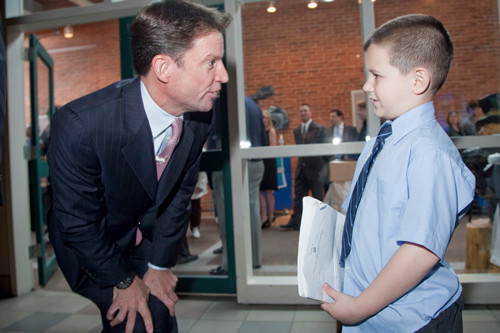
Roseann Gammal might be just a pharmacy intern at CVS Caremark Corp., but when she had a question about the company, she went right to the top, to the drugstore chain’s CEO.
That’s because she could.
The 23-year-old Westborough, Mass., resident has been a shareholder for years, along with her father, Charles.
On May 11, she stood at CVS Caremark’s annual meeting at its Woonsocket headquarters and quizzed CEO Larry Merlo about the company’s Pharmacy Advisor program and how it differs from Medication Therapy Management initiative offered by CVS’s biggest rival, Walgreens. Gammal’s attendance and question at CVS’ annual meeting make her somewhat of a rarity among corporate shareholders these days.
In the age of instantaneous online information on countless publicly traded companies and the proliferation of institutional investors, few shareholders actually make it to the annual meetings, mostly a procedural, scripted event where few, if any, shareholders actually cast votes and chief executives outline often stale financial data.
At the CVS annual meeting, a company with a market capitalization of $52 billion, fewer than 60 people attended, mostly board members, senior managers and employees.
Gammal’s was the only question asked, despite news circulating that the company has been under pressure to undo its four-year-old merger with Caremark because of the unit’s disappointing performance so far.
“If you care about the business in which you’ve invested, then the annual meeting could be important for people to be able to influence even a little bit how the corporation is run,” said Andrea Boggio, assistant professor of legal studies at Bryant University. “But the majority of investors don’t care, as long as the corporation is somehow profitable.”
Still, such annual gatherings are a legal requirement of publicly traded companies intended to give shareholders – the ultimate owners – a briefing on the financial performance, a chance to vote in person on such matters as electing board members, introduce resolutions and to ask questions. Such meetings are part of the legal requirements for a company to maintain limited liability for its shareholders, Boggio said.
They’re held in hotel conference rooms, or at the company itself, complete with catered food and glossy annual reports.
Some meetings can be entertaining. Berkshire Hathaway Inc., run by billionaire Warren Buffett, has transformed its annual shareholders meeting in Omaha, Neb., into a weekend-long event known as the “Woodstock of Capitalism” that includes a six-hour Q&A session with Buffett.
But most are low-key affairs, at least among publicly traded companies in Rhode Island this annual-meeting season.
Last week, only one shareholder other than board members and employees showed up at Bancorp Rhode Island Inc.’s annual shareholders meeting at Hotel Providence, even though – or maybe because – it would likely be the company’s last.
Only a month earlier, Bancorp Rhode Island, parent of Providence-based Bank Rhode Island, agreed to be purchased in a $234 million deal with Brookline Bancorp Inc.
The BancorpRI meeting was over in 30 minutes. There was a lot of leftover food.
At the recent Hasbro Inc. annual meeting in Pawtucket, about 30 to 40 shareholders received Transformer figures, My Little Pony toys and a Scrabble card game for attending. They also were shown a trailer of a new Transformers movie due out on July 1.
But when it came to the Q&A session with CEO Brian Goldner, there were no questions. That didn’t surprise Wayne Charness, vice president of corporate communications.
“When you look at our performance, it bodes well,” he told Providence Business News last week, referring to the corporation’s stock price doubling to about $47 a share in two years.
Elizabeth Eckel remembers Westerly-based Washington Trust Bancorp Inc.’s meeting being more of a social outing for many of the bank’s longtime individual shareholders, many of whom were Westerly residents. But the numbers have dwindled as shareholders have gotten older, said Eckel, Washington Trust’s senior vice president of marketing and investor relations. About 30 shareholders came to the April meeting.
Eckel suspects technology has a lot to do with the drop in attendance, too. Investors can listen to conference calls online following the quarterly earnings releases and they can pour over financial statements the moment they’re posted on the Web.
But information at the annual meeting, largely focusing on the 2010 performance, is dated.
And because KVH’s annual meetings have been sparsely attended, the company doesn’t splurge on catering. It will be doughnuts and coffee when a small number of shareholders gather at the Middletown headquarters in June.
Annual-meeting attendance has traditionally been low as a result of corporate governance, where “the people at the bottom – the shareholders – really don’t do that much,” Boggio said. “It’s not really the place where business decisions are made.”
Even the vast majority of votes on resolutions that are addressed at the meeting are cast weeks ahead of time by proxy. “And the presence of these institutional investors has really changed a lot in the last 20 to 30 years,” Boggio said.
Still, the annual meetings can serve a purpose, he added, allowing for any shareholders “to voice concerns,” even if management would rather they remain quiet.
Case in point: BancorpRI’s annual meeting in 2008, when an out-of-state dissident shareholder attempted to gain three seats on the board of directors. The shareholder, the investment firm PL Capital, openly criticized the bank’s performance during the meeting. Then, during a discussion about the bank’s charitable giving, another shareholder questioned whether the bank directors donate any of their own money to charity, or just the company’s.
That touched off an angry response from CEO Merrill Sherman and from one director who shouted at the shareholder that he donated his director’s fee to charity.
In the end, the takeover bid failed.
Boston-based Green Century Capital Management spoke up more sedately at the CVS shareholders meeting.
A representative of the environmentally responsible mutual fund firm made a last-ditch push for the approval of a resolution calling for CVS to disclose and account for all of its political spending.
The resolution, which has been introduced every year since 2007, was opposed by the CVS board. About 60 percent of the shareholders rejected it, but Green Century’s Larisa Ruoff wasn’t discouraged.
“It’s a strong vote [in favor] and it demonstrates that a significant portion of the company’s shareholders are very concerned,” she said. •