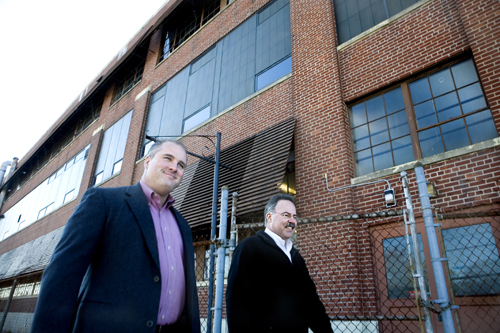
A seven-year remediation and redevelopment of the former Swank building in Attleboro is expected to be completed early next year, one of three major projects the Attleboro Redevelopment Authority is now tackling.
The project, at the corner of Hazel and Pearl streets, couldn’t have been completed without cooperation and some funding from a private company. The redevelopment is a partnership with Cookson Precious Metals and is the cleanup of a 200,000-square-foot building on six acres of a former brownfield site.
“We purchased the building and have taken the responsibility of remediating that site,” ARA Executive Director Michael Milanoski said recently. “And it will be sold off to the abutter, Cookson Precious Metals, which will utilize the building for an expansion of its jewelry manufacturing.”
That remediation has cost about $500,000, but other ARA improvements have cost about $8 million, Milanoski said. Cookson has invested about $5 million, too, bringing the total investment to at least $13.5 million.
Cookson CEO Richard Powers said collaboration is for the “betterment of the community” and that “we need to protect the significant number of manufacturing jobs in the city,” including at Cookson. The project will add 125 new jobs, increasing to 900 the number Cookson employs in the city.
“Attleboro is growing because it’s become a bedroom community to Boston through the transit system,” Powers said.
The ARA-Cookson project is just one of three major developments the ARA is working on to try to change the face of the city’s downtown. The most expansive and expensive is the proposed revitalization of 26 acres. That $60 million project includes the stitching together of parcels near the commuter rail station, Milanoski said.
“And we’re creating an intermodal center, where we’re bringing all the buses into a garage,” he said. “We are assembling the land. We are doing the environmental cleanup. We are building a new parking garage that will increase capacity” to more than 1,000 parking spaces. The project also will include the cooperation of a private developer, who will build a 300-unit, mixed-income housing development. That’s also going to include 35,000 square feet of commercial space – for an undetermined cost not included in the $60 million in public money budgeted for the project, Milanoski said.
Bids for the private development rights have not been put out yet. “But it would certainly far exceed the $60 million in public commitment,” he said.
“Planners approved the project on March 29, 2007, and since then we have been working through the land assembly process,” along with the final permitting and environmental testing at the sites. Preliminary demolition and construction has started, Milanoski added.
In the end, it is ARA’s goal to revitalize downtown, but in doing so it must first make agreements with property owners and buy the property that will allow it to create an area for the project. “Right now, with these large-scale projects, we have to first look at relocation” for businesses currently in the area, Milanoski said.
By 2011, he said, ARA hopes to start major construction on the sites, for what will be ARA’s most costly current project.
With only four staff members and a full plate of development projects, it might appear ARA is spreading itself thin. But Milanoski said the agency is doing what it was created to do. Because the ARA is the economic-development arm of the city, it is a bridge between the municipal “bureaucratic” system and the private sector, he said.
“We are charged with implementing projects – complex projects – sort of like a government would, but we have private-sector abilities to move them forward quicker and cheaper than the normal bureaucratic system,” Milanoski said.
The third major project ARA is working on is a 90-acre industrial business park, pre-permitted for up to 800,000 square feet of commercial development. And an $8.5 million road is being built by the Massachusetts Highway Department, Milanoski said.
So far, ARA has spent about $600,000 in federal funds on that project. But this summer, that project was the center of a legal dispute over whether ARA misused grants from the U.S. Department of Housing and Urban Development.
“There was a question on whether or not the agency could utilize block grant funds, HUD funds, to develop an industrial park,” he said. “The concern was that these projects take a couple years to be up and running. They wanted to make sure these projects are still going forward.”
In response to a city-sponsored report that last week said the ARA had overextended itself and would not be able to afford that project, Milanoski said the project needs investment from the city. The project was expected to cost $12 million and ARA secured more than $15 million in grants, but because of inflating building and energy costs it now needs a $400,000 investment from the city for roadwork for the first phase of the project, he said.
“Our job is to implement these for the city,” he added. “These are city projects that the city has handed to our agency and said, ‘Please implement these for us.’ ”
But he said that the task force’s conclusion that the ARA is insolvent, with more than $4 million in loans it will be unable to pay back is “not correct.” The project only needs an investment from the city, he said.
Mayor Kevin J. Dumas last week declined comment on his office’s involvement with ARA. He appointed the group that completed the report.
About three weeks ago, HUD “dropped all their findings on that,” he added. A call to HUD’s regional office was not immediately returned before press time.
The goal for all three of the current projects, in the end, is growing the job base by creating a business-friendly downtown, Milanoski said.
Powers said the environmental cleanup at Cookson’s new facility wouldn’t have been done without ARA and city help.
It is “all in an effort for the Cookson Precious Metals company to expand its manufacturing, contiguous to its current facilities in Attleboro,” Powers said. “In order to do that … we needed to work with the Attleboro Redevelopment Authority” to acquire and remediate the property. •