People skills may hold key to advancement, opportunity
Pity the technical support geek, that poor creature. Is he doomed to roam the outer reaches of the high-tech industry forever, never fully scaling the corporate ladder?
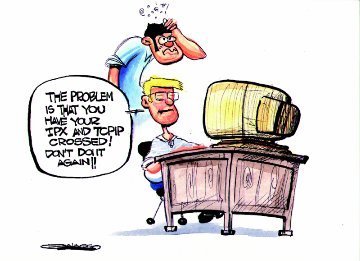
The most iconic figure of the Internet age, the tech geek was hailed at the dawn of the high-tech revolution as its standard bearer, capable of revolutionizing the world without once shaving his downy chin. His considerable powers include facile knowledge of HTML, ability to uncross an IPX from a TCPIP, one-sided conversations and making coworkers uncomfortable by snickering while remedying their computer meltdowns.
Selling Luxury Real Estate Requires More Than Exposure
By Emilio DiSpirito IV License Partner | Private Office Advisor Engel & Völkers Oceanside www.DiSpiritoteam.com…
Learn More
His interests include comic books, video games, action figures, and Star Wars. His powers do not include eye contact, donning a tie or playing well with others.
Exaggerated, even celebrated, the stereotype of the tech expert with no social skills is nevertheless grounded in truth. Geeks made people grumble, but their ability to navigate in a brave new world gave made them indispensable to high-tech companies in the giddy 1990s, before the crash of the NASDAQ.
But in a contracting industry marked by a sober return to blue-chip values and strategies, the world has changed for the techie. Today, technical skill is an entry-level requirement, not what sets star performers apart, say people who run high-tech companies. In the high-tech universe, post bubble, geeks are learning that what they really need is people skills.
"This industry really is a relationship business. You certainly have to have the technical wherewithal, but you also have to have the interpersonal skills to develop a relationship with the customer, and the sensitivity to anticipate another person’s needs," said Glenn S. MacNaught, president and CEO of Aquidneck Management Associates, the second-largest software company in Rhode Island. "I think a lot of these people have the skills, but they’ve been so keen on the technology that they’ve lost sight of basically who they are."
High-tech corporate heads complain that many of their employees who came of working age during the mid- to late-90s are myopic in their work, have little understanding of business, and don’t know how to deal with people. As these workers advance in their careers, many times their technical skills do not offset the liability they often pose when dealing with important clients.
To illustrate the point, MacNaught told a story about a recent project of Aquidneck, which engineers computer systems mostly for government clients. The company had a West Coast client using Aquidneck software to manage court case data. When media requests were made for public information the queries were referred to Aquidneck techies, who often turned over incomplete files. Fortunately, Aquidneck discovered the problem before it turned into a disaster.
"Programmers here were making judgements on what the media were allowed to see – obviously not a decision we’re allowed to make," said MacNaught. "It was a tech person who read the technical specifications and interpreted them in his own way, and didn’t look to get customer input. You have some code guys – they think they absolutely understand the client’s needs."
Many CEOs tell similar stories of technical support staff who interpret their business and workplace worlds in technical terms, and fail to communicate well with clients and coworkers. Often, these employees have been with a high-tech company since it was founded, and are now running into problems as they move up in a growing company. Often a worker who did well in a purely technical-support position flounders when he is asked to manage projects, say many high-tech executives.
Jay McNally, president and CEO of Ibis Consulting, a data processing firm in Providence, said that as his company grew quickly in the 1990s, Ibis tended to promote the people who were first in the door and to fill in underneath. As a result, the company ended up with some bad fits in management-level positions, he said.
"We have had in the past fairly senior people who haven’t had the people skills, where there’s been a mismatch. Typically those people were demoted and terminated," said McNally. "Typically they saw business in black and white terms, as an engineering problem. They’re not thinking strategically. They may be able to function at a low level, or in a purely engineering function. But people like that can’t function at a high level in an organization that has any structure to it."
The phenomenon of the tech geek with low people skills was documented by Daniel Goleman, a business consultant and psychologist whose 1995 book "Emotional Intelligence," coined a phrase that is accepted in the world of business and psychology.
In the book, Goleman argues that the high-tech industry faces a crisis because it is populated by workers who grew up alone, absorbed at the computer. They became masters of computers, but they missed out on a parallel track of social learning. They become emotionally de-skilled, which pulls them back later in their careers.
The early returns show a negative impact, particularly as it affects kids – the average level of emotional intelligence has been declining among young people for the last 20 years.
Goleman’s argues that human competencies like self-awareness, self-discipline, persistence and empathy are of greater consequence than IQ in much of life, that we ignore the decline in these competencies at our peril, and that children can — and should — be taught these abilities. The increasing reliance on communication via the Web and e-mail weakens the fabric that makes a company or organization work.
A University of California Berkeley study, started in the 1950s, followed a group of Ph.D. students in science and the technical fields for 40 years. It turned out emotional intelligence abilities were four times more important than IQ in determining professional success and prestige by the end of their careers. And in a study of managers who failed, it was always because of a deficiency of EI, Goleman argued.
The book was on The New York Times bestseller list for a year-and-a-half and continues to be a best seller throughout Europe, Asia and Latin America. It has been translated into 30 languages, and is mantra in Japan.
Still, many companies in the U.S. don’t seem to be getting the message, according to Joseph Sheedy, president of Marketing Resources, a Chelmsford, Mass.-based professional recruiting firm for the biomedical industry. Despite the research that shows a well-rounded person is preferable to a person with only great tech skills, many companies want the tech guy.
"I don’t think that technical managers are always aware of this, if it’s a pure tech job," said Sheedy. "They’re looking for an X, Y and Z fit in terms of a need that they have. They’re doing replacements, and they’re looking for similar backgrounds."
Sheedy said a lot of the problem that tech people face in dealing with others is not a result of genetic predisposition, but of years of training to take a certain approach. And he speaks from experience. After studying chemistry in college and becoming a licensed engineer, he decided to get a business degree before launching a business.
"My training was in the sciences and metallurgical engineering, and I thought it would be a good idea to get some skills that involve human beings. You’re dealing with personalities and issues that are difficult," said Sheedy. "Some people are like a horse with blinders – they look at problems and miss the periphery. They don’t see the overall impact of the decision. A narrow viewpoint and a reactive personality – that’s a recipe for disaster."
Many companies that survived the burst of high tech learned the lesson and are profiting from it.
"I definitely look for the combination of skills. There’s no doubt," said Edward Weisberg, president of BX.com, Inc., the largest Web site developer in Rhode Island. "Clearly there are people we have who sit in the back and write code. They don’t have to communicate with clients, but even they need to be team members. But at a senior level, it’s important to have people skills and you certainly need to know your business."