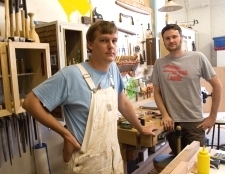
It’s inevitable. That’s the way Nick Hollibaugh feels when discussing the relocation of his and fellow artist Ben Watkins’ 7,000-square-foot woodworking studio and metal shop at 10 Eagle Street.
“It’s not like they’re trying to displace us,” he said, referring to the developers of the $333 million American Locomotive Works project in the Valley neighborhood. “This building is not making any money.”
Your Business Has Gone Global. Has Your Insurance?
A decade ago, “doing business internationally” was mostly a large-company concern. Today, a manufacturer in…
Learn More
But that doesn’t mean he’s happy about leaving the space in which he and Watkins, both Rhode Island School of Design graduates, invested about $60,000 to renovate when they moved in two and a half years ago.
“It had all this trash,” he said. “We tore down the walls. We thought we were going to be here a long time.”
Four artists besides Hollibaugh and Watkins rent space at Box Elder Studios, where they share the equipment. Hollibaugh said he works 60 hours a week on commissioned pieces, mostly furniture and sculpture.
“Every year gets a little better,” he said of his business. “My things have been moving well. I’ve been getting higher paying jobs.”
Hollibaugh won “best in show” at the Providence Fine Furniture Show last year. And he was awarded a $5,000 fellowship from the R.I. State Council on the Arts this year. It is one of 14 awards given annually to artists whose work stands out, said Cristina DiChiera, director of individual artists programs at the council.
“The fellowship is the state’s way of identifying artists [who are] good at what they do,” she said. “The idea [is] that people who are accomplished in their work are people you want to have in your community.”
Hollibaugh’s is one of about 40 small businesses being displaced by the mixed-used development, said Erik Bright, co-director for the nonprofit Partnership for Creative Industrial Space (PCIS), hired to organize relocation of the tenants by the developer, American Locomotive Company, a partnership between Struever Bros., Eccles & Rouse and Licht Properties.
Bright said the relocation of 23 businesses in phase one is complete. Now PCIS is working to help relocate the remaining 16. “Our primary goal is to help relocate these businesses within Providence by putting them in touch with other comparable properties for lease,” he said.
PCIS also disburses relocation funds provided by the developer. (Bright would not disclose the amount.)
PCIS put Hollibaugh in touch with a machine shop that has space for lease in Olneyville Square, but no deals are set, and Hollibaugh said he is not going to find space for $2 per square foot, which is what he’s paying now. And it will cost at least $30,000 to move.
He and Watkins have been looking for space on their own, and the cheapest goes for $5 per square foot. They say they will have to scale back in size if they stay in Providence.
American Leather Products Inc. and Desmark Industries Inc. will not be staying in Providence, said Jim Caito, president of both companies, which occupy about 11,000 square feet at 10 Eagle St. The two companies will move to a location in Cranston, he said, because he found a 14,000-square-foot space to rent for about $25,000 less per year than he would be paying in Providence. In fact, Bright said, about 50 percent of the companies from phase one moved outside the city.
American Leather Products has also changed its focus. Once a manufacturer of leather binders it now embroiders company logos onto clothes. Desmark Industries is a Christmas ornament manufacturing company. The two companies employ about 24 people.
Caito said he is worried most of the funds ALCO set aside for relocating the tenants were used in phase one, leaving insufficient funds to help phase two tenants. If he doesn’t receive what he thinks is a suitable amount to cover some of the moving expenses, Caito said, he won’t move. He will try to find loopholes in the lease that would allow him to legally stay until his lease runs out in September 2007.
Monica Shinn, whose business was part of phase one, said she doesn’t blame ALCO for redeveloping the site. “They did OK by us,” she said. “We worked out a deal with them that we thought was fair.”
She and partner Jeremy Woodward moved their set-building business, called Fabrication Services, to a temporary space at The Steel Yard while looking for a new work space.
“We really don’t have a place to work yet,” she said. “We took other jobs to keep money coming in.”
Another phase one company, called Equipex, might be in a better position now than before the move, said Val Ginzburg, vice president of the food service equipment manufacturer.
Equipex was able to move to a building across the street owned by Licht Properties, and only lost one and a half days of production. The new space is bigger, Ginzburg said, and the company had wanted a bigger space.
Bright said ALCO is the first mill developer in the past five years to allocate money to help displaced tenants with relocation costs.
PCIS is lobbying for a city ordinance that would make it mandatory for developers seeking a city subsidy, such as property tax abatements and tax incremental financing (not the state’s historic tax credits), to provide relocation assistance to its commercial tenants, he said.
Tony Lombardo said the relocation money covered about 30 percent of the expense of moving Lombardo & Brown Inc. to Cranston (the company was part of phase one).
“It’s better than nothing,” said Lombardo, co-owner of the Western-style belt buckle manufacturing company, which employs three people, and subcontracts about 70 percent of production jobs to temporary workers.
Lombardo said he and his partner decided to purchase a 2,500-square-foot industrial condo instead of renting because this is the second time the company has had to relocate because of development. The first was for a Home Depot.
“We didn’t want to set ourselves up again,” he said. “If I had my druthers, we would not have moved. Ultimately, in the long run, I think things will be better. Our expenses are a little higher. Hopefully we will be able to handle it.”
Hollibaugh said he doesn’t want to set himself up again either. That’s why he does not want to sign another one-year lease at a mill building.
“There have been artists getting displaced at an alarming rate” since the implementation of the historic tax credits, which made old mill buildings ripe for development, DiChiera said.
Many artists are moving to Fall River and New Haven, Conn., Hollibaugh said, because Pawtucket is getting as expensive as Providence. But Hollibaugh wants to stay in Providence because he likes it here.
Asked whether it would be possible for a group of artists to purchase a building for artist studios, Hollibaugh said it would be difficult to get financing. And most artists don’t have the down payment for such a venture.
“I don’t know what the answer is,” he said.