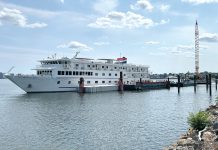
From Sept. 19-21, more than 80 mill artists and businesses at 10 locations in Pawtucket will open their doors for the annual Pawtucket Open Studios event. Visitors can shop at the studios of artists whose work includes fine art, photography, designs, demonstrations and performances, and they can also see the transformation of the mills from manufacturing to creative work.
Len Lavoie, a partner with Rhode Island Commercial Industrial Realty, has been involved with the mills’ redevelopment for over a decade and is the organizer of Pawtucket Open Studios.
PBN: How did Pawtucket Open Studios originate?
LAVOIE: Basically, Pawtucket Open Studios started out as a way for a group of Pawtucket artists who wanted to show their paintings and sculptures and the like as a group to funnel a little bit of money through a lot of people and get enough to do some advertising and put an open studios together. The original [event] form of it started eight years ago, but it floundered in the first years. … But three years ago, there was a core group of artists who really got this going again.
It’s a three-times-a-year event. There’s a spring event, usually in May, which we call a business-to-business open studios and where we invite other businesses in the state to meet with our artists and our small-business people in the mills of Pawtucket, and let people know that there are viable businesses there.
Right now, for this upcoming event, we have seven mills so far and about 50 artists [registered to participate].
Rhode Island's Market Has Changed. Developers, Builders, Investors and Sellers Must Change With It.
By Emilio DiSpirito IV License Partner | Engel & Völkers Oceanside Leader | The DiSpirito…
Learn More
PBN: What’s the idea behind the event?
LAVOIE: It’s exposure – but the beauty of it is, it’s exposure for the mill and it’s exposure for the artists. … We’ve got thousands and thousands of names of people who’ve come to Open Studios who are interested in being on our mailing list. Plus, we focus on businesses and galleries and designers and interior decorators, and we send invitations out to all of those people because it all works for them, whether it be a painting or a sculpture or textiles. We even have an architect this time.
PBN: Who is the event’s target audience?
LAVOIE: It can be anyone from someone who’s looking for a small gift for somebody to a corporate buyer of art for a new building. We have an awful lot of gallery people that come that are looking for new talent in their galleries – a lot of that – some of the major museums in the Boston area come.
PBN: What was the original thinking behind the conversion of mills from large spaces to small spaces?
LAVOIE: I’ve been in real estate for about 34 years, and I always sort of worked with mills. Twenty-five years ago, mills were filled with large users, with jewelry people – because remember, this was the jewelry capital of the world – and then, all of a sudden, the jewelry business started dying out and we had all these empty mills.
So we started working with these mill owners to convert these spaces from large spaces to small spaces. And, luckily, this occurred at just about the time that Providence was starting its economic redevelopment. So at that time, I had a full complement of artists looking for spaces who had basically been forced out of their mills due to redevelopment. … The first one I did was 250 Esten Ave. about 13 years ago. That owner, Robert Ball, basically allowed me to redevelop 18,000 square feet of open space into eight units, and we had those rented in 30 days. … An empty mill is a mill that’s going to burn, so the best thing to do is to fill it up as soon as possible.
PBN: Has the success of the mill redevelopments surprised you?
LAVOIE: No. I knew that the market was there and I just needed to get the spaces redone. … A big part of the appeal is the community. The upholsterer talks to the fabric-design person who needs something done for a customer in New York, and it all works. … It’s all there, and it’s really kind of nice to have all these tenants together.
PBN: How many mills are there today? Is the economic downturn hurting demand?
LAVOIE: There are five right now [in Pawtucket] that are actively being done for workspaces and for artist spaces. But no, I’m not seeing any drop-off in the demand.
As a matter of fact, we’re placing a whole group of new art instructors for RISD, and I’ve placed three or four so far in studios. Plus there are people who have taken the summer off, who graduated from RISD, and now they’re looking for studios. And there are lots of people who are working at home who want to have a more professional location to work.
The other wonderful thing is we have a lot of successful people who are expanding. Just to give you an example, Embolden – they’re a computer-site developer – they’ve expanded twice in the last year, taken two more units. So they’re twice the size that they were a year and a half ago. … I have people in several mills waiting for vacancies. •