PROVIDENCE – Local arts organizations “are continuing to suffer from the effects of a declining state and national economy,” and that in turn is “threatening Rhode Island’s own economic recovery, as [the reduction in local] arts events begin to affect our state’s restaurant and hospitality industry,” according to the R.I. State Council on the Arts (RISCA).
The council’s new report is an update of a study whose initial results were released Oct. 30. (READ MORE) Since then, contributions to local arts groups have continued to fall and their ticket revenue has fallen “significantly … even though ticket sales are generally seen to be stable,” RISCA said.
That decline “continues to be a significant problem for all Rhode Islanders, not just the many who enjoy and participate in the arts,” stressed Randall Rosenbaum, RISCA’s executive director.
“Any cultural program slowdown in Rhode Island affects so many financial bottom-lines,” agreed Robert D. Billington, president of the Blackstone Valley Tourism Council, in a statement last night accompanying the RISCA report.
“Our cultural organizations provide one of the chief reasons people travel to our state,” he said. “Many businesses rely on arts and cultural program successes to support their own businesses – so if programs falter, business slowdowns will follow. We should do all we can to ensure success the ‘geotourist’ activities of our state provide.”
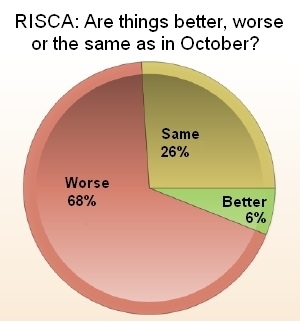
Sixty-eight percent of local arts organizations told RISCA they feel their economic status has worsened since October, the new survey found.
The problem of falling contributions also has worsened: Total contributions are “significantly” or “a little” short of where they were a year ago at 74 percent of respondents, up from 63 percent in October. And those affected now include more of the area’s larger organizations, as well as the small and mid-sized groups that led the decline last fall, RISCA found.
Moreover, although only half the respondents reported a decline in the number of tickets sold, “practically all” said ticket revenue had fallen significantly, the survey found. “As we saw in our earlier survey, more people are purchasing single tickets, discounted tickets or lower priced seats, and the uncertainty for arts organizations is compounded by patrons waiting until the last minute to purchase tickets,” the council said.
The declines in revenue are spurring program cuts at 45 percent of local arts groups, down from 57 percent in October, although most groups were looking to reduce programs’ scope rather than eliminate them entirely, RISCA found.
Other tactics the organizations planned to employ included hiring freezes at 31 percent of arts groups, up from 21 percent in October. Fewer are planning layoffs at 16 percent, down from 21 percent in the last survey, or using endowments to meet current budget needs – 14 percent, down from 18 percent in the earlier survey – as they settle in for the long haul.
The full survey report is available online at www.arts.ri.gov/economy.
“The arts contribute significantly to our state’s economy,” Rosenbaum said. “Yet the arts organizations that help fill our restaurants and parking garages are fragile, and can be seriously affected by a poor economy. If conditions require organizations to cut programs or fire staff, the impact will be profound – not just for those organizations and artists, but also for all the sectors of our economy that depend on an active arts scene.”
The council has established a special Web page, entitled Economic Recovery and the Arts, “to document what is happening here in the Ocean State and throughout the country” and to seek ideas for addressing the crisis. To take part in the ongoing discussion, or to submit your strategies and suggestions, visit www.arts.ri.gov/special/econ-crisis.
The R.I. State Council on the Arts, established by the R.I. General Assembly in 1967, is charged with encouraging public interest and participation in the arts. RISCA is supported by a combination of federal grants, from the National Endowment for the Arts, and state appropriations. For more information, visit www.arts.ri.gov.
Building a Strong Data Foundation in the Age of AI
Artificial intelligence (AI) has become a key priority in the boardroom and across management —…
Learn More