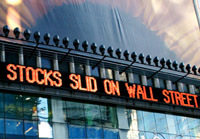
Number of U.S. companies going public plummeted since the tech bubble burst
The Vermont Teddy Bear Company is growing: Its first-quarter sales were up 27.4 percent over last year, and it’s planning to expand further by creating new products and acquiring other gift companies. But first, the NASDAQ-traded company is going private.
Building a Strong Data Foundation in the Age of AI
Artificial intelligence (AI) has become a key priority in the boardroom and across management —…
Learn More
The reason was simple, President and CEO Elisabeth B. Robert said last week: “As a private company, Vermont Teddy Bear will no longer face the challenges of a small company trying to comply with increasingly complex and costly public company requirements. We will have more time and resources to devote to growing our business.”
Five years ago, such a thought would’ve been anathema: Growing companies aspired to go public; an initial public offering was a sign that you were primed to make it big, and many young entrepreneurs got rich from well-publicized IPOs.
Then the tech bubble burst, the investment world grew skeptical of unproven companies, and the Sarbanes-Oxley Act of 2002 imposed all sorts of expensive, cumbersome new requirements.
Nationwide, the number of IPOs plummeted from 406 in 2000, to 83 in 2001, to 68 in 2003.
In Rhode Island, never a big IPO breeding ground in the first place, there’s been only one in the last five years: LIN TV, in 2002. Massachusetts, which in 2000 had seen 34 IPOs, had a total of six in the next three years.
Last year, a Renaissance Capital analysis on IPOHome.com shows, IPOs bounced back, with 216 deals, including the high-profile Google IPO, and the best returns in years. But does this mean we’ll be seeing a new wave of companies going public?
Don’t bet on it, local experts say. In fact, in Rhode Island, don’t be surprised if we don’t have a single IPO for several years still. The reason, said state Economic Development Director Michael McMahon, is that the financial standards for a viable IPO have gone way up.
“I spent most of my life as an investment banker, taking companies public,” McMahon said. In the 1980s, he added, if a company’s market capital after an IPO would be less than $100 million, “we tended to tell them, ‘Don’t do it.’ In today’s market, that number is closer to $250 million, if not $500 million.”
That’s because large firms such as Fidelity need to be able to buy sizable amounts of stock if they’re going to invest in a company, McMahon said, and $7 million worth, for example, won’t do. But size is also viewed as evidence that a company is solid, he said.
“In the post dot-com crash, the market is much more disciplined, and it’s going to require top line and bottom line results,” he said. Much smaller firms still flirt with going public, McMahon added, but without a Fidelity type onboard, “the stock doesn’t trade well.”
Some perspective: Of Rhode Island’s top private companies in the 2005 “Book of Lists,” only 12 had more than $100 million in 2003 revenue, and only six exceeded $200 million. Of those, three are in construction and real estate – not IPO-friendly fields, McMahon said – and one is a nonprofit.
There is a strong second tier, however: 34 private Rhode Island firms had more than $25 million in revenue in 2003, and several are growing rapidly. But prime candidates such as Heartlab Inc. and Abaqus, McMahon noted, have taken a different route – selling to a larger firm.
“What you’re seeing today, and those are two very good examples, are companies being sold to big, foreign owners,” he said. “You’re going to see more (of those) strategic transactions.”
Ben McCleary, of Seaview Capital in Providence, has spent his career advising companies on how to get to the next step, and he said he’s far less likely to recommend an IPO these days.
There are still benefits to going public, McCleary said: If you’re planning to expand by acquiring other companies, it’s useful to be able to use your stock as currency, and if you need more capital, you can raise it by offering additional stock.
Bank Rhode Island just did this, selling 628,418 shares to produce about $21.5 million. And John C. Warren, chairman and CEO of the Washington Trust Company, said being public has given his bank “a lot more flexibility” in financing acquisitions and new endeavors.
“It gives you the ability to raise capital much more easily,” Warren said. But being public also means he’s devoting a great deal of energy to “getting the message out” to shareholders, he said, and the complexity and “regulatory burdens” of being public may not be worth it for many companies. In fact, some smaller banks are going private again, he noted.
BankNewport, Rhode Island’s third-largest locally owned bank, has never gone public, even though it is also growing steadily. Originally a mutual bank, it reorganized itself last year as a mutual holding company, with a provision allowing it to sell a minority share of the bank in the open market, but “no plans at all” to do so, President and CEO Thomas W. Kelly said.
As a mutual company, BankNewport has the advantage that it doesn’t have to pay quarterly dividends to stockholders, Kelly said, so even though it does issue payouts to its depositors, it can hold on to its earnings as needed to finance new acquisitions and investments.
And rather than acquire other banks or merge with them, as a public company would do, Kelly said, BankNewport has a less cumbersome option: to affiliate with another mutual bank – no stock issuance, no huge transactions involved. Asked whether the bank had considered going public, Kelly replied: “Not in the least.”
BankNewport is not alone in having good alternatives to going public to raise capital. Warren, McMahon and McCleary all said there are many more sources out there, from startup-oriented funds such as Slater, to numerous venture capital firms, to private equity firms such as The Mustang Group, the company that’s taking Vermont Teddy Bear private.
“There are a lot of private equity firms out,” McCleary said. “There’s been an explosion in that arena, so there’s plenty of capital.”
In the past, IPOs were seen as more desirable than a private equity firm because they generally yielded substantially larger amounts of money, McCleary said. But IPO valuations are down, he said, so “people don’t get the prices they used to get.” And the costs associated with Sarbanes-Oxley – estimated at as much as $1 million per year for smaller public companies – offset a lot of any potential revenue.
From a broader perspective, though, does it matter for Rhode Island if it doesn’t have any new public companies sprouting up to replace some of the ones it has lost?
Big, strong public companies are, indeed, “hugely important” to the state, McMahon said: locally headquartered ones like CVS, GTECH, Hasbro, Textron, but also out-of-state firms with a major local presence, such as Amgen and American Power Conversion.
Successful, growing public companies are likely to be more stable and anchored in the community, McMahon added. And they can contribute to philanthropy and civic life – though so can strong private companies. Ultimately, though, what matters most is the leadership, he said.
“We need CEOs like Royal Little, like Terry Murray, like Tom Ryan. … I don’t get so hung up on public vs. private as long as we have outstanding managers.”
It’s not even a bad thing when large local companies choose to sell instead of going public or seeking new financing, McMahon said, because their CEOs can go on to build new firms.
“Companies are built to be bought, so we shouldn’t fear that,” he said. And “we need more serial entrepreneurs in Rhode Island. The more companies they can create and sell out, the better off we are.”