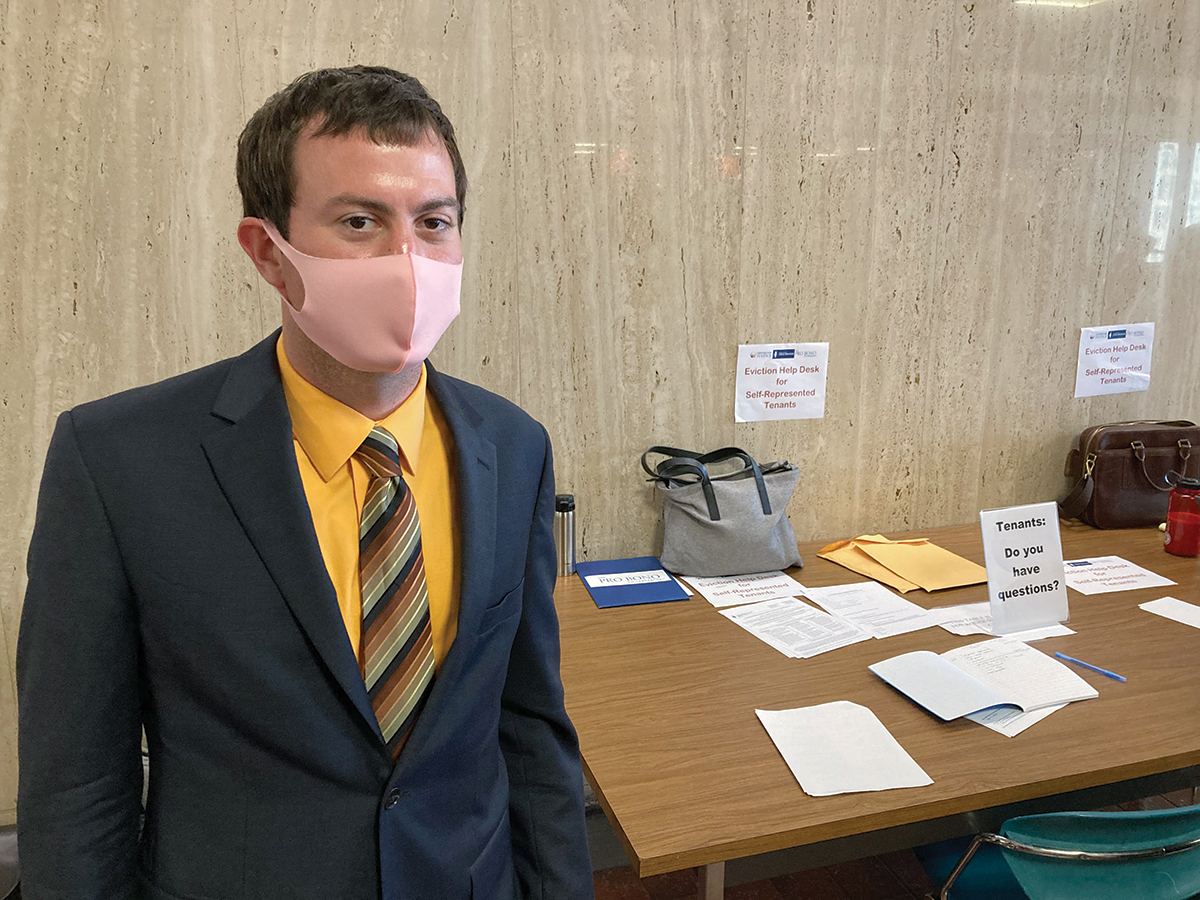
The third-floor hallway of the Garrahy Judicial Complex in Providence was choked on a recent Thursday morning with tired-looking families, upset mothers with baby strollers and frustrated older couples.
Three tables were set up, one with pro bono attorneys assisting tenants who were dealt eviction notices, another with a lawyer offering his services to property owners looking to collect rent or kick tenants out, and a third staffed by state workers helping to streamline applications for a rent relief program established with federal COVID-19 aid.
ISO 9001:2026: A Practical Opportunity to Build for What’s Next
For Rhode Island manufacturers, ISO 9001 has been much more than a certificate on the…
Learn More
Eliza Vorenberg, the director of the Pro Bono Collaborative at Roger Williams University, refers to this place as “heartbreak hallway” because of the stories she hears from tenants facing eviction.
The Pro Bono Collaborative and lawyers from the nonprofit Rhode Island Center for Justice and Rhode Island Legal Services established the Eviction Help Desk with court approval about five weeks ago to aid self-represented tenants when a national moratorium on evictions was struck down by the U.S. Supreme Court on Aug. 26.
Affordable housing advocates feared the decision would put hundreds of thousands of Americans at risk of losing their homes as the administration attempted to distribute rental assistance funds. In Rhode Island, the state struggled with the launch of its $200 million RentReliefRI program earlier this year.
“We were seeing a lot of noise about the evictions skyrocketing,” said Vorenberg, who helped present the idea of the help desk to two District Court judges.
The judges approved it, seeing it as a way to ease the strain on the court and on the people unfamiliar with legal procedures. “You can see coming in here, it’s a scary place to walk into,” Vorenberg said.
The impact in Rhode Island from the national moratorium on evictions being struck down isn’t so straightforward.
‘You can see coming in here, it’s a scary place to walk into.’
ELIZA VORENBERG, Pro Bono Collaborative director
The moratorium had only applied to cases of nonpayment, meaning court orders involving other types of evictions had continued through the pandemic.
And there’s the aid now being pumped out from the RentReliefRI program at an efficient pace, according to several lawyers who work with tenants and landlords in these cases. RentReliefRI launched on March 31, but the online portal was mired with technical problems, leading to a backlog of thousands of applications. A replacement system was launched in mid-May.
When the ban on evictions was struck down, 2,000 families were already facing eviction – cases that were processed by the courts during the pandemic but not acted upon, said Jennifer Wood, executive director of the Rhode Island Center for Justice. There was a “scramble” to get the most vulnerable money from RentReliefRI. Other cases that were never heard by a judge also have been resolved with the rent relief funds, she said.
As of Oct. 20, the state has distributed $43.6 million of the rent relief funds, approving 5,756 of 7,613 applications, with $39.78 million of that provided directly to 4,855 landlords.
“It’s a very powerful intervention,” Wood said, referring to the emergency rental assistance. “Landlords who are economically distressed, and there are many, have a clear solution to be made whole.”
A lawyer representing property owners said that some tenants didn’t bother applying for RentReliefRI funding while the moratorium was in effect.
“In all honesty, the difference now with the moratorium over is we can get rid of people, the bad tenants, who never even applied for rent relief,” North Providence-based eviction lawyer Steve Conti said.
Some landlords were left high and dry during the moratorium, Conti said.
“I have people out $20,000 worth of rent,” Conti said. “And they can’t get it because the tenant moved out and never applied for rent relief.”
In the end, there are “very few tenants who are being forced out,” Conti said. “Most landlords, whether there is a moratorium or not, if there is an ability to get money, they take the money. They are not looking to throw people out.”
That’s not always the case, according to an attorney representing low-income tenants.
Troy Lange, a staff attorney in the Housing Law Center at Rhode Island Legal Services, said some landlords looking to get around the moratorium started eviction proceedings on grounds other than nonpayment.
State law allows for monthly tenants to be evicted for any reason, with a 30-day notice, Lange said. And these cases were not covered by the national moratorium, he said.
“When they weren’t getting the money, some of them were going that latter route,” Lange said. “According to state law, as long as it’s not discriminatory, any reason is good enough.”
It’s difficult to tell how many tenants who fell behind on the rent were evicted during the moratorium, he said.
A database of eviction filings, hearings and rulings maintained by the R.I. Housing and Mortgage Finance Corp., the state’s housing finance agency, shows that court hearings in eviction cases for reasons other than nonpayment grew steadily during the pandemic, from 11 in June 2020 to 136 in June 2021. Records also show that eviction filings for reasons other than nonpayment were up 86% from pre-pandemic levels in June this year while nonpayment eviction filings were down 53%.
The Eviction Help Desk at the courthouse provided legal services for more than 30 people in its first three weeks – either through pro bono legal representation during a hearing or resolving matters ahead of a court appearance. Some of those tenants were not aware of the RentReliefRI program and were shepherded through the application process.
Rhode Island’s $200 million rent relief fund, nearly 25% spent, represents a “medium-term solution,” Wood said. She argues more needs to be done to address the lack of affordable housing and well-paying jobs.
Those rent relief funds can’t help those that are being thrown out of homes for reasons other than nonpayment of rent, Vorenberg said.
“We had a single mom who can’t work because it’s really hard to find child care during COVID-19,” Vorenberg said. “Her landlord wanted her out. The landlord wanted to renovate, or there was a new landlord. The judge just gave her five more days. It’s an impossible deadline. She is understandably devastated and panicked. We’re trying to offer her resources, but there’s not much else we can do once a judge says you’re out.”
Marc Larocque is a PBN staff writer. Contact him at Larocque@PBN.com.