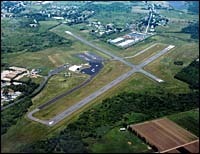
planned for hangar in center,
along with other work.
After decades of neglect and decay, Rhode Island’s five general-aviation airports are beginning to show a faint sparkle.
The Rhode Island Airport Corporation this year is funneling $7.6 million into rebuilding runways and upgrading terminal buildings and aircraft hangars in an ongoing effort to make the airports easier for pilots to use.
For Leaders Who Don't Have Time to Get Sick
Top performers guard their calendars, delegate relentlessly and optimize every hour of the day. Health,…
Learn More
“We’re finally getting to the point where we can start doing revenue-enhancing projects instead of Band-Aiding these facilities,” said RIAC Manager of Properties and Real Estate David Cloutier, who oversees the state’s GA airports. “The life/safety and environmental problems we inherited from the state (in the early 1990s) have been taken care of for the most part.”
A new, nearly $3 million terminal at Westerly Airport is slated to open next month. At Block Island Airport, a new $4 million terminal is being designed and could open by late 2003 or early 2004.
Millions of dollars in renovations also are planned at Newport Airport, Quonset State Airport in North Kingstown and North Central Airport on the Smithfield/Lincoln line.
RIAC began an effort in 1996 to improve the infrastructure at the five airports when it entered a five-year contract with Hawthorne Aviation to manage daily operations. On July 1, RIAC renewed the contract, which will pay the private company $325,000 over the next five years.
But funding for the capital-improvement projects comes from RIAC’s budget, which has swelled in recent years with the success of T.F. Green Airport. The growth has meant a cash infusion for the state’s GA airports.
“We’ve been spending a ton of money on improving these airfields,” said Cloutier, who says the budget for the GA airports has been growing every year since 1996. The $7.6 million slated for fiscal 2002, which began July 1, is about 40 percent more than was spent two years ago.
Overall, beefed up service at the five airports has improved the experience for pilots, Cloutier said.
Often left unattended in prior years, the airports now are staffed daily. The installation of computerized, above-ground fuel tanks has also been a major improvement, he said. Pilots at some airports are able to fuel their planes at any hour by using a credit card.
The fueling stations have become “a significant revenue source” for the airports, Cloutier said.
But the airfields still are operating in the red – something RIAC had hoped to rectify when it first entered the contract with Hawthorne. The five airports combined will lose about $300,000 in fiscal 2001.
“GA airports seldom make any money. They typically need to be subsidized,” Cloutier said. He added that the airports have become more efficient since Hawthorne took over in 1996, cutting combined losses from more than $400,000 that year to $180,000 last year.
The deficit will grow this year because of the jump in capital expenditures. The new contract with Hawthorne includes financial incentives if the company is able to trim losses, Cloutier said.
Work slated for the five GA airports:
At Newport Airport, more than $450,000 will be spent this year on repairs to the terminal building and hangars. Another $400,000 will go toward a new storage facility for snow-removal equipment and $222,000 will be spent on clearing trees that now obstruct the runways.
Reconstruction of a secondary runway at North Central Airport is set to begin next month at a cost of $1.3 million. Completion of the runway work is predicted for November. The airport also will get hangar improvements and a new septic system.
At Quonset, about $1 million will be spent on parking-lot improvements and terminal repairs, including a new coffee shop. RIAC will spend another $400,000 to remove World War II-era training towers.
The grand opening next month of the new, 6,000 square-foot terminal at Westerly Airport, which was destroyed in an August 1998 fire, will replace the double-wide trailer now serving as the terminal. The new building will house New England Airlines, which runs scheduled service between Westerly and Block Island.
The planned terminal for Block Island airport will replace the existing terminal, which is too small to handle the facility’s heavy seasonal use.
(Photo, Pilsbury Associates Aerial Photographers)