First they stopped requiring deposit slips. Then, more recently, Bank of America put out new ATM deposit envelopes that specifically direct you not to write your account information on them – the machines will take care of it.
Now, in a test of the latest ATM technology, Bank of America has disposed of envelopes altogether for a handful of machines. It started at three ATMs in Charlotte, N.C., earlier this summer; now the pilot has been expanded to 15 machines in that region.
For Leaders Who Don't Have Time to Get Sick
Top performers guard their calendars, delegate relentlessly and optimize every hour of the day. Health,…
Learn More
The goal, said spokeswoman Betty Riess, is to make customers “more comfortable” with making deposits at the ATM, and to make it easier to make deposits.
Bank of America doesn’t break out its ATM figures by transaction type, according to Riess, but a study by Boston-based Dove Consulting found that as of 2003, withdrawals made up 78 percent of ATM transactions, while deposits were only 8 percent. (Transfers were 11 percent, and balance inquiries and other transactions made up the rest.)
Riess said Bank of America’s ATM deposit volume is “well above the industry,” but she acknowledged that “among some people, there may still be they have less comfort putting money in rather than taking money out.”
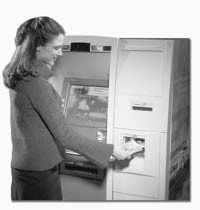
Enter the new ATMs. Instead of putting checks and/or cash into an envelope and inserting it into the machine, customers feed them directly into the ATM, which makes an image of each item and displays it on the screen. No need to worry about that paycheck getting lost in a pile somewhere; right away, there’s a record of it, front and back, in the bank’s database.
“What we’ve seen in the pilot satisfaction with making deposits has increased,” Riess said. “Among people who might have been more reluctant to make deposits, there’s a greater comfort level, because they actually see it up there on the screen, and then get a copy of it.”
Bank of America is not the first to try envelope-free ATMs. Both Diebold and the NCR Corp. – the major ATM makers – have offered machines with built-in imaging modules and bulk note accepters for several years, and institutions from Wells Fargo, to Chicago-based Bank One, to small local credit unions have installed them.
A big part of the new machines’ appeal, trade publications report, is the ability to reduce costs by automating deposits and “truncating” checks – converting them from paper to electronic documents, as required by the Check 21 law – as early as possible in the process.
Imaging-equipped ATMs are also viewed as a major tool against check fraud. An article in London-based The Banker last year cited industry predictions that the technology could save U.S. banks $750 million a year, and that 7 percent of ATMs would have it within two years.
Given the lower costs associated with ATMs (a 2001 TowerGroup estimate pegged it at 40 cents per transaction versus $1.40 with a branch teller), banks also have a financial incentive to install the new machines, though the cost is only worthwhile, experts admit, if the deposit volume is high enough.
For banks, which have seen ATM use level off and even decline in recent years, it’s not an easy decision: Do they invest in a technology that’s been stagnant, and hope this produces a turnabout, or do they put their resources elsewhere?
At Bank of America, which boasts of a 16,600-unit ATM network, the no-envelope experiment is starting on a very small scale. Riess said the company plans to expand the pilot beyond its hometown “later this year,” but she added that “we’d still be talking about, I’d say, 100 ATMs. And then we’ll continue to look at expanding it in 2006 and beyond.”
Asked when the technology might reach New England, Riess said it’s too soon to tell.
Bank of America won’t say which vendor is supplying its new technology.