When a Rhode Island soldier’s home burned to the ground shortly before Christmas, on top of the personal loss he was left with several sticky legal problems involving his insurance company and a building contractor.
The insurance company balked at payment and the contractor dealt with him “in a manner that was less than honorable,” said Capt. Michael P. Jolin, an Army lawyer and a member of the 43rd Military Police Brigade based in Warwick, to whom the soldier went for advice.
“I want to make sure the soldier gets what is due to him,” Jolin said, so he referred the National Guardsman to the Rhode Island Bar Association for legal assistance under its U.S. Armed Forces Legal Services Project. The project, established in late 2009, provides full legal representation at no cost to members of the military and veterans in the state, as well as their families.
Victoria M. Almeida, immediate past president of the state bar association and a partner with the Providence law firm of Adler Pollock & Sheehan, said she started the program because she remembers how badly Vietnam veterans were treated when they returned home in the late 1960s and 1970s.
“Did we listen? Did we learn anything from Vietnam?” asked Almeida, who is in her 50s. “My generation does not understand, as our parents in World War II did, what comes with war and with separation from home. I want to make certain that these men and women do not feel abandoned, that they don’t feel left behind. I want them to feel like heroes, which they are.”
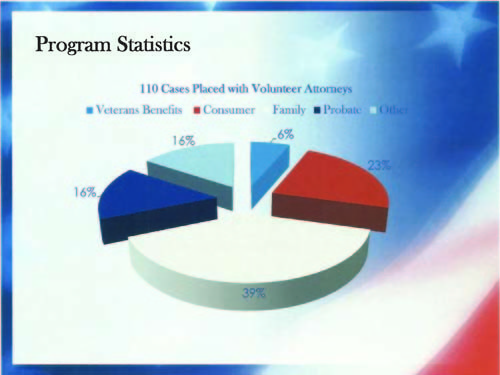
As of 2009, 59 lawyers in Rhode Island were recruited to offer their services to local military members, but Almeida said more than that are involved today, perhaps as many as 100. She dismissed out of hand the notion that working for free to help soldiers could take too much of an attorney’s time or impede efforts to build a clientele.
“It’s not a question of a lawyer losing business. It’s a question of serving others in need,” Almeida said. “Where the need is greatest and the times most difficult, lawyers respond more than any other profession in pro bono hours, and that’s according to the American Bar Association.”
Assistance often can go beyond legal advice.
Almeida said the program encompasses full legal representation, so volunteer lawyers routinely file documents and make appearances in any court necessary. As an adjunct, the local bar association provides continuing education programs on veterans matters so members will be up to date on the latest issues, she noted.
Although the armed forces do maintain legal assistance offices on each of their military bases, where routine matters such as the writing of wills are handled, Jolin said the bar association program is a valuable and “effective” supplement for several reasons.
Military lawyers seldom make court appearances because of staff shortages and the considerable preparation time involved, he explained. But court appearances can be necessary. “You have to go to court to get anything accomplished [in family law],” said Jolin. “We would use the Rhode Island Bar Association volunteers to do that.”
Another reason is the volume of cases that the pro bono lawyers must handle. “For a small state, we have a large veterans’ population,” he said and, even with 100 lawyers taking part in the military-assistance program, “we don’t have enough lawyers to handle the need.” Jolin was slated to leave this month for a yearlong deployment to Afghanistan.
The state has a total of 71,200 war-service veterans, according to the 2010 report to the General Assembly by the division of veterans affairs, part of the R.I. Department of Human Services. The largest number, 24,100, are Vietnam veterans. Second in number are peacetime service members at 18,500, but for the first time last year, soldiers of the Persian Gulf wars at 14,300 edged out Korean War veterans at 8,800 for third place. •