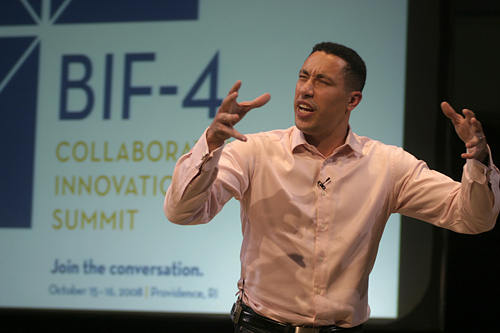
Tony Hsieh was only 24 back in 1998 when he sold Link Exchange, his online advertising company, for an eye-popping $265 million. After a success like that, lots of people might be content to sit back and rest on their laurels.
Not Hsieh. Within a year, he was hard at work developing a new e-commerce Web site built on the novel concept of selling shoes online. Investors were skeptical – and wrong. The site, now known as Zappos.com, has watched its sales soar from $1.6 million in 1999 to $840 million in 2007, and it now boasts 9 million customers.
Hsieh told attendees at the fourth annual Collaborative Innovation Summit, a two-day conference hosted on Oct. 15-16 by the Business Innovation Factory, that the key to both Zappos’ success and his own has been thinking independently and critically.
For example, he pointed out that most e-commerce companies hide their telephone customer service number, seeing customer reps as a revenue drain. But Zappos lists its 24-hour service line at the top of its home page, and Hsieh credited the company’s emphasis on customer service with much of its success. “We’re trying to build a lifelong relationship with the customer,” he said.
Hsieh’s message – think different – was a common theme at the event, which was once again held at Trinity Repertory Company’s Lederer Theatre in downtown Providence and brought together three-dozen innovators from the business, academic and nonprofit worlds to tell their stories to about 350 local business people, entrepreneurs, developers, teachers, artists, and government officials.
As was true of past summits, the speakers came from diverse backgrounds. David Yaun, an executive at century-old IBM, spoke about his efforts to bring together the best thinkers from different departments to work on corporate strategy.
“What I kept hearing was, ‘We already do this,’ ” Yaun recalled. “This is the death knell for innovation.” But with his CEO’s support, Yaun was able to build a new program that has become a core part of the company’s development efforts.
Deborah Brooks, a former Goldman Sachs analyst who co-founded The Michael J. Fox Foundation for Parkinson’s Research, talked about her organization’s efforts to shake up the early stages of treatment research – by pushing, in her words, “a disruptive point of view.”
The Fox Foundation, which Brooks said is now the largest provider of Parkinson’s research funding other than the federal government, has also partnered with companies, from small biotech firms to the major drug manufacturer Wyeth.
Saul Kaplan – executive director of the R.I. Economic Development Corporation – also heads the Business Innovation Factory, an independent nonprofit that uses public and private money. Kaplan said the annual summit is a key part of the broader push to transform Rhode Island from a manufacturing-based economy to one focused on innovation and advanced technology.
“It’s fantastic. We’re turning Rhode Island into an innovation hotspot,” Kaplan said. “People are thinking about Rhode Island in a completely different way.”
Among the attendees were Devron Dugan, 15, and Melvin Turcios, 17, two students in the entrepreneurial program at Providence’s Met School. Both young men said they were inspired by the stories they heard at “BIF-4,” as the summit was nicknamed. The pair attended along with Dennis Littky, the school’s co-founder and co-director, who said he was struck by the importance of focus in the stories told by all the speakers.
“It definitely gets me more excited to find out there are people who want to sit down and innovate,” said Dugan, who added that a number of the speakers and other attendees offered to meet with him one-on-one to offer advice and guidance. •