With land limited elsewhere, developers eye larger parcels – and bigger payouts
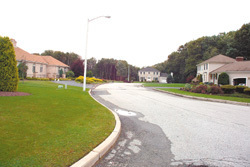
In Cranston’s Auburn neighborhood, the little Capes and bungalows are so tightly
clustered that a two-acre span can hold 20 houses, each with a tiny patch of
grass. People know not just the family next door, but around the bend too.
But nobody builds in Auburn these days – the land ran out long ago, and even if there were plots, they’d be too small for the spacious, three- or four-bedroom houses that developers know are most marketable.
For Leaders Who Don't Have Time to Get Sick
Top performers guard their calendars, delegate relentlessly and optimize every hour of the day. Health,…
Learn More
Houses that size are built on half-acre lots, if builders can find the land. Most of what’s left in Cranston, however, is on the west end of the city, a sprawl of old farmland and rolling hills where zoning rules require two acres for a single house.
The lots alone can cost more than a house in Auburn. And the houses in western Cranston developments – the Alpine Estates, Ridgewood – go for $500,000, $800,000, even $1.5 million. Cranston isn’t unique, either: More and more, new houses across the state are big and luxurious, on very large parcels.
Standard city lots – in Cranston, the minimum for a single-family house is 6,000 square feet – are now a rarity. Standard suburban lots – Cranston’s are mostly half-acre lots, or 20,000 square feet – are scarcer every day. What’s left, for the most part, is rural land zoned for two-acre and even five-acre lots; 89 percent of Rhode Island’s open land is in outlying areas, according to William R. Landry, a lawyer for developers.
Add to this the fact that Rhode Island’s landscape is hilly, sometimes rocky, and full of wetlands, and the challenge is even greater. A recent study by the Rhode Island Public Expenditure Council said those constraints, coupled with tough zoning rules, now typically allow development of only 35 percent to 40 percent of a parcel, according to builders, down from about 50 percent a decade ago.
That means that to build 20 houses in western Coventry, or the more rural parts of Burrillville, Cumberland or South Kingstown, for example, you might need to buy 250 acres, 125 times what it took in Cranston’s old neighborhoods.
“A lot of the good land, the easy land to build on, has already been built on,” said Sheila Brush, director of programs at GrowSmart Rhode Island. “So now you have developers going after land that’s got more problems, and it’s taking more land to carve out buildable lots.”
Even in a two-acre zone, a recent RIPEC study estimated, a drop in the land yield from 50 percent to 40 percent will require a 25 percent hike in the house prices to give the developer the same return, meaning a $230,000 house would go up to $287,500. In reality, experts say, the prices go much higher.
But in reality, experts say, developers go farther, building bigger, luxurious homes to sell for three times as much.
“Right now, an acre of land is hard to find for less than $150,000,” said Landry, who works with nonprofit and for-profit developers. “If a developer is going to pay $150,000 for the land, there’s going to be a trophy house on that land.”
Most communities have zoning ordinances encouraging “cluster” developments – where, say, 10 of those 250 acres would be developed into half-acre house lots, and the rest of the land would be left untouched. Such projects cut road and infrastructure costs dramatically, maintain the “country living” feel of the area, and protect habitats. But clustering doesn’t increase land yield, Landry said; if a 250-acre parcel would yield 20 conventional lots, only 20 clustered lots will be allowed.
Environmentally, the impact of such heavy land consumption is major: Those 250 acres used to build 20 houses will no longer be open farmland, or woods and wildlife habitats. According to the state chapter of the Sierra Club, Rhode Island lost 11 percent of its farmland, more than 8,000 acres, between 1989 and 1999. And since 1985, Rhode Island has lost more than 1,000 acres of forest each year to development.
Yet large-lot zoning and terrain restrictions have their reasons, as even critics will acknowledge. Areas without water or sewer need enough land to keep leech fields separate from water wells – Brush said the standard has been two acres, though better science can now cut that substantially. Road capacity is a factor. Many towns use zoning to protect natural resources. And almost all are concerned about school costs.
Still, developers, smart-growth advocates, environmentalists and even local officials agree that the system is flawed. If all of western Cranston were developed as zoned, City Planner Kevin Flynn acknowledged, the result would be “low-density sprawl,” broken up only by city-owned land.
Because of this, many local officials seem to be welcoming the demands of the state’s new affordable housing law, which requires towns to find a way, at least in some neighborhoods, to make affordable housing development possible.
In Lincoln, Town Administrator Sue Sheppard said officials are looking at how the village of Manville, for example, could be revitalized through mixed-use zoning. And Burrillville, where about 60 percent of the open land is zoned for five-acre lots, has received accolades for its affordable housing plan, which includes a major mill redevelopment and overlay zones allowing up to 12,000-square-foot lots in one-acre zones as long as builders stay near the villages, create visual connections to existing neighborhoods, and include units affordable to Burrillville’s middle-class residents.
“Their plan incorporated a lot of the strategies we think more towns should be looking at,” said Brush. “Our belief, from a smart growth point of view, is that growth is going to happen, and the question is how it happens. If communities can encourage growth on smaller lots, you can accommodate the housing that’s needed without necessarily gobbling up the open space that we’ve been gobbling up in recent years.”