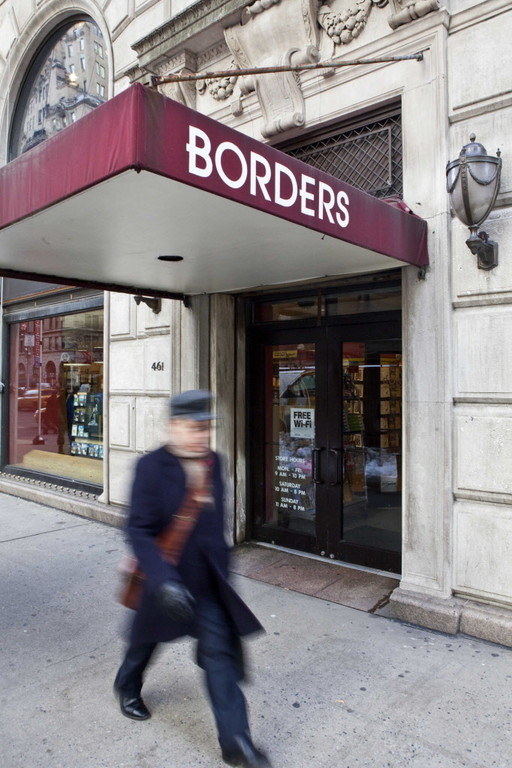
NEW YORK – Borders Group Inc., the No. 2 U.S. bookstore chain, filed for bankruptcy in New York on Wednesday after management changes, job cuts and debt restructuring failed to make up for sagging book sales in the face of competition from Amazon.com Inc. and Wal-Mart Stores Inc.
Borders will shut about 30 percent of “underperforming” stores “in the next several weeks” and restructure with $505 million in so-called debtor-in-possession financing from lenders led by GE Capital, according to a statement. The 40-year-old chain listed debt of $1.29 billion and assets of $1.28 billion as of Christmas 2010 in its Chapter 11 petition filed on Wednesday in U.S. Bankruptcy Court in Manhattan. The company plans to restructure and continue to operate.
Building a Strong Data Foundation in the Age of AI
Artificial intelligence (AI) has become a key priority in the boardroom and across management —…
Learn More
“Borders Group does not have the capital resources it needs to be a viable competitor,” the company’s president, Mike Edwards, said on Wednesday in a statement. The filing will give it “time to reorganize in order to reposition itself to be a successful business for the long term.”
Borders, whose market value shrunk by more than $3 billion since 1998, racked up losses by failing to adapt to shifts in how consumers shop. Its first e-commerce site debuted in 2008, more than a decade after Amazon.com revolutionized publishing with online sales. The world’s largest online retailer beat it again by moving into digital books with the Kindle e-reader in 2007, a market Borders entered in July.
‘A Follower’
“Instead of leading and being innovative, they were certainly a follower,” said Michael Souers, an analyst for Standard & Poor’s in New York.
Borders, based in Ann Arbor, Mich., began looking for a cash infusion in December after disclosing lenders cut its borrowing capacity and failure to find replacement credit could lead to a violation of its loan agreements and a “liquidity shortfall” in the first quarter of 2011.
The company has 639 stores under the Borders, Waldenbooks, Borders Express and Borders Outlet names in the U.S. and three in Puerto Rico, according to the court filing. The company has 6,100 full-time workers and 11,400 part-time employees, it said.
The latest planned store closures are subject to bankruptcy court approval. The company seeks permission to close as many as 275 of its stores, and filed an emergency motion with the court to sell furniture and merchandise. It will publish a schedule of stores that will close this afternoon, according to its website.
Cash Drain
“It buys them a little bit of time, because they are closing stores that are a drain on cash flow,” said Peter Wahlstrom, a retail analyst for Morningstar Investment Services in Chicago. The bankruptcy filing “allows them to retrain their focus on the stores that are profitable.”
Borders asked a judge for quick approval of store closings, saying it costs $2 million a week to keep open the stores targeted for closure. The company will use a group of liquidators to handle the closings. Borders wants to start selling inventory during Presidents’ Day weekend. Merchandise sales will bring in as much as $148 million, the company estimated in a court filing. About 265 stores were closed in 2009 and 2010, it said. Liquidators’ cut of merchandise sales is about 27 percent.
Penguin Putnam was listed as the largest unsecured creditor with a $41 million claim. Hachette Book Group has a claim of $36.9 million and Simon & Schuster Inc. has a claim of $33.8 million. Random House, the publisher owned by Bertelsmann AG, Europe’s biggest media company, has a claim of $33.5 million.
Unsecured Creditors
In court papers, Borders said it expects to be able to pay some claims of unsecured creditors.
The company in May raised $25 million in a private sale to an entity controlled by Bennet S. LeBow, who was then named CEO and chairman. Pershing Square Capital Management LP, the hedge fund run by William Ackman, is Borders’s largest shareholder, according to the filing. Borders’ biggest shareholders also include Zurich-based UBS AG, according to the court filing.
In its petition, Borders says Pershing Square holds 31.3 percent of the stock and LeBow is a 15.4 percent stakeholder.
The New York Stock Exchange suspended trading in Borders shares on Wednesday and is moving to delist the company. The shares traded at a 52-week high of $3.29 last April 12.
Borders estimated that funds would be available for distribution to unsecured creditors, according to the filing signed by the company’s chief financial officer, Scott Henry.
Restructuring
Kasowitz, Benson, Torres & Friedman LLP is the law firm that filed the petition and Jefferies & Co. is handling restructuring.
Borders has struggled with cash levels since at least 2008, when it ran short of money and was forced to borrow from Pershing Square, its largest shareholder at the time. After missing a deadline to find a buyer, the company issued 5.15 million warrants to Pershing, making the fund the bookseller’s largest investor.
Borders borrowed $42.5 million from Pershing to remodel stores and upgrade technology to compete with Barnes & Noble Inc., the largest bookseller in the U.S., and Amazon.com. Cost-savings measures have been implemented over the past year.
In January 2010, Borders announced it would close some of its bookstores in the U.S. and cut 11 percent of staff at its headquarters and eliminate 76 other jobs. CEO Ron Marshall resigned after a year on the job. Michael Edwards was put in a role as interim CEO.
Delayed Payments
Borders delayed payments to publishers in December as part of a plan to restructure financing arrangements with vendors. The stock lost more than a fifth of its market value, its biggest drop in two years, after the announcement.
Kmart Corp. acquired Borders in 1992, then a chain of about 20 stores founded by Tom and Louis Borders, for about $190 million and combined the retailer with its Waldenbooks unit.
In 1995, Kmart renamed the unit Borders Group Inc. and spun it off in an initial public offering. The new public company, with a market value of about $500 million, had more than 1,000 locations under the Borders, Waldenbooks and Planet Music brands and generated $1.5 billion in revenue.
Borders then joined Barnes & Noble in dotting the U.S. with book superstores that proved to be more profitable than its mall-based Waldenbooks locations. The superstore unit grew to 200 by 1996 and doubled by 2002.
“They over-expanded and built up some debt on their balance sheet,” said Souers, who has covered Borders for six years. “There was also less control to those businesses.”
The case is In re Borders Group Inc., 11-10614, U.S. Bankruptcy Court, Southern District of New York.