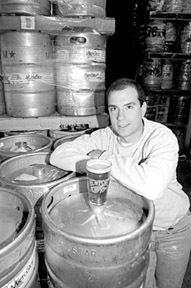
based Coastal Extreme Brewing Co.,
poses in the keg room.
Company: Coastal Extreme Brewing Co.
Type of Business: Microbrewery
Your Business Has Gone Global. Has Your Insurance?
A decade ago, “doing business internationally” was mostly a large-company concern. Today, a manufacturer in…
Learn More
Owners: Brent Ryan, Derek Luke, Mark Sinclair, Will Rafferty
Employees: 7
Location: Middletown
Web site: www.newportstorm.com
Annual Revenue: $900,000 in 2003 (estimate)
Mike Colias
In early 1999, college seniors were being offered six-digit salaries
to join dot-com and technology companies. At the same time, the custom-beer
industry was going flat and stale, with microbreweries across the country calling
it quits.
So the decision of four graduates from Colby College in Waterville, Maine,
to start a microbrewery in Middletown might have, at the time, seemed a bit
of a head-scratcher.
“People were telling us, ‘Microbreweries are all going out of business, so
why are you guys starting one?’” explained Brent Ryan, co-founder and president
of Coastal Extreme Brewing Co.
Coastal Extreme, however, was founded on more than post-college gush over
how cool it would be to make beer for a living. Well, it was a bit of that,
too, Ryan conceded.
But Derek Luke, Mark Sinclair, Will Rafferty and Ryan, now each 28 years old,
were more entrepreneurs than beer aficionados.
The four college buddies scratched together more than $100,000 of seed money
from friends, family and their own pockets, and secured a $150,000 loan backed
by the U.S. Small Business Administration. They bought used equipment from a
belly-up brewery in Alabama.
“By 1999 there were a lot of people making crappy beer and not marketing it
well,” Ryan said. “And there were a lot of breweries with great brands that
had overextended themselves.”
The industry shakeout provided elbowroom to grow its fledgling Newport Storm
brand – sort of like clearing out the dead brush from the forest floor to make
way for the saplings.
“There was less clutter on the shelves and on tap,” Ryan said. “At the same
time, a lot of retailers and consumers were fed up with inconsistency. It was
an opportunity for us to come in and see where a lot of other brewers made mistakes.”
He paused.
“Or maybe we just really wanted to start a brewery.”
After more than four years, it appears their counterintuitive gamble is paying
off. Newport Storm is on tap at hundreds of bars and restaurants throughout
Rhode Island. The company has extended its distribution into Boston, southeastern
Massachusetts and parts of Connecticut. It expects to pull in roughly $900,000
in revenues this year.
Newport Storm Hurricane Amber Ale is the company’s flagship beer, a mild,
sweet brew that accounts for roughly 80 percent of sales. The company now makes
an Irish red for springtime; an Indian pale ale for summer; a malty Octoberfest
in the fall (on shelves now); and a dark, “Blizzard Porter” for winter, named
after the ’78 storm.
Perhaps it’s fitting, though, that the smallest state’s only microbrewery
is, well, really micro.
Coastal Extreme distributes about 4,500 barrels (9,000 half barrels, or kegs)
annually, Ryan said. In comparison, Ryan estimates Harpoon Brewery in Boston
probably does around 80,000 barrels.
Coastal Extreme is housed at the Middletown Tradesman Center, a drab collection
of squat warehouse spaces, constructed of cinder blocks and light blue corrugated
metal. Inside, a forest of shiny, stainless steel vats are jammed into the brewery’s
one-story, 2,500-square-foot space, permeated by the pungent smell of yeast.
Sacks of imported malt and hops are stored in a room the size of walk-in closet.
The seed-like malt is shot through an auger and into a stainless steel mash
tun, where it soaks in 150-degree water to extract sugars from the grain. From
there it’s pumped to a 10-barrel brew kettle, where it boils for an hour and
hops are added for bitterness and aroma.
From the kettle, the batch goes to one of six 20-barrel fermenters, where
the brew will sit for two weeks. After filtering its sent to yet more big steel
tanks for carbonation, before being bottled or pumped into kegs.
All that, Ryan said, is the easy part. As a relatively new entrant into the
beer market, and with a shoestring marketing budget, the difficulty is in convincing
bars and restaurants to put their craft brews on tap.
“You can control the brewing process; you can’t control your sales,” he said.
Ryan concedes that the company’s entry into Boston has been met with only
limited success, and it has “a long way to go” to penetrate the Providence market.
So what’s next?
Ryan says the brewery has pretty much hit its brewing capacity, and by next
summer it must either expand or relocate.
There’s also been informal discussion of extending its distribution down to
Newport News, Va. The name recognition is obvious, but he says there are other
synergies – it’s a coastal tourist town with a large Navy presence.
Mostly, though, the young owners are having as much fun as they can during
their 70-plus hour workweeks, putting on promotional pub crawls, luaus and Halloween
parties, mostly around Newport.