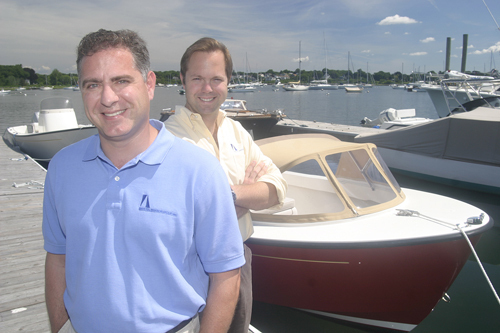
While some boat builders are struggling to move all but the most expensive watercraft, diversification has helped Bristol Harbor Boats navigate through choppy economic waters.
With Bristol Harbor’s line of smaller recreational boats – a mid-sized series of 24-to-27-foot, center-console boats – the relative newness of the product has pushed sales. But it’s not that way for all manufacturers, said Cory Wood, vice president and co-founder of Bristol Harbor Group, which two and a half years ago started a new boat-builder branch, Bristol Harbor Boats.
“Industry wide, I think the general consensus is that sales are off 30 to 50 percent in some markets,” Wood said. “When everyone was making money in their home equity, it wasn’t as big a deal to buy a $150,000 boat, but that’s certainly not the case anymore.”
While much of the market for high-end boats and megayachts comes from the super wealthy, who usually aren’t hit as hard by the economy, sales of mid-range boats and orders are down across the industry, he said.
Wood said the Bristol company has been working to diversify the spectrum of its designs, which has helped insulate it from the down market. There are five current projects – locally and as far away as Louisiana – being built from Bristol Harbor designs.
“We would likely be affected [by the economy], except for the fact that we’ve purposely gone after projects to help even out our workload,” Wood said. “So we do yachts, but we also do commercial vessels. Typically, when the yacht guys aren’t building, when they’re holding onto their money, the commercial guys are building. And it’s vice versa.”
Others, including those who’ve been around longer – like luminary Ted Hood, the America’s Cup winner in 1974 and owner of Ted Hood Yachts LLC in Portsmouth – said this current down-cycle isn’t as bad as others, but is still cutting into their business.
About 50 years ago, Hood started Hood Sailmakers in Marblehead, Mass., and during 1985 started Ted Hood Yachts in Portsmouth. During the years, he’s seen economic down cycles that have affected the boat-building industry worse than the current one, he said. He’s designed about 150 boats in his career, and at the moment two boats are being constructed from his designs. “We do three or four designs a year,” he said. “Right now building is slow.”
Megayachts – the oversized ships that can cost far more than $10 million – are still doing well, but buyers of boats under $1 million, like Hood’s, aren’t as readily available now as they were a few years ago, he said.
At Portsmouth-based Friendship Yacht Company, where the high-end sailboats are designed in Rhode Island and constructed in New Zealand, only five to six yachts are built each year. They’re “exclusive” and carry price tags higher than $1 million – and demand hasn’t slowed, said Sales Manager Jennie Caiazza.
That company – which designed its first boat during 2001 and the first yacht hit the water during 2004 – is on-track with previous years, she said. “It’s pretty interesting – we’re actually doing well,” she said. “I think our yachts are at the very tiny pinnacle at the top of the pyramid of boats that are continuing to do well.”
The Friendship yachts – the company offers 40- and 53-foot models designed by Ted Fontaine, who learned the trade from Hood – take about 12 months to build. There’s a backlog for buyers now – the next available for purchase would start construction late this fall, Caiazza said, making delivery in late 2010.
Along with many buyers cutting costs because their home equity has lessened, Caiazza said she’s also heard that gas prices are cutting into powerboat sales. “I’ve heard that a lot of people are asking about sailboats instead,” she said.
Hood added that “secondhand boats are selling for 15 percent less than they were a year ago.”
At Bristol Harbor, Wood said management for current construction projects and design work for the group’s double-hull oil tanker designs take up about 70 percent of the firm’s time, with the rest being portioned between design work on a range of boats that include a 31-foot water taxi and 28-foot fire-rescue boat.
The double-hull design – it ads stability for oil transportation – is something that few other U.S. firms take on, Wood said. “Our firm, along with maybe one or two others, is known for those double-hull designs,” he said. “It’s a niche in the market that we recognized five years ago and went after.”
The company is now overseeing construction of a 350-foot, 60,000-barrel double-hull boat. Wood hopes to soon have designs ready for an 80,000-barrel model, for which there is a demand, he said. “But on the small-boat side, it’s absolutely something that’s affected by the economy,” Wood said. It’s a bad market right now to be selling small boats.”
Even in a troubled market, Rhode Island is still one of best places to grow a business like Bristol Harbor, he added.
“That is the reason we located our firm here,” said Wood, who moved to the state with his business partner in 1995. “Rhode Island is the center of boat building.” •