A team of chemists at Brown University recently announced a breakthrough in the development of cheaper, more efficient hydrogen-powered fuel cells.
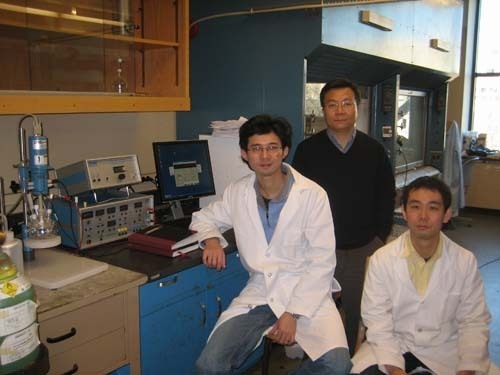
Shouheng Sun, a chemistry professor at Brown, led a team that overcame a technical barrier that scientists have struggled with in the decades-old quest to build widely-affordable engines powered by hydrogen instead of gasoline, producing water instead of emissions linked to global warming.
Hydrogen fuel-cell engines have existed for years – General Motors is already manufacturing a line of hydrogen-powered cars – but the technology’s high cost and low efficiency prevents mass commercialization of hydrogen-powered vehicles.
Research supported by both automakers and the federal government has tested a wide range of metals and materials to drive down the cost and lengthen the life of fuel cells, which like batteries produce electrical power through chemical reactions.
Sun and his team proved a new way to boost the chemical reactions in fuel cells using platinum. While the precious metal has long been used to spark the chemistry of fuel cells, Sun discovered that molding platinum into microscopic cube shapes enhances its catalysis – that is, it boosts the rate of a chemical reaction while using less of the expensive platinum.
“We’re a step closer now to the reality of developing a very efficient platinum catalyst for hydrogen cars that produces only water as exhaust,” Sun said last week.
Platinum cubes are more efficient catalysts than platinum formed in other shapes because the surface structure of the cube creates a more robust reaction with oxygen, and because the cubes are more resistant to being absorbed by the chemical solution in the fuel cell, the research team found.
Until now, scientists have had very limited control over the shape of the miniscule platinum pieces used as catalysts in fuel cells. The platinum cubes that Sun’s team was uniformly and consistently able to create are about four nanometers across. In comparison, a human hair is about 40,000 nonometers in width, he said.
During his experiments, Sun, along with Brown graduate engineering student Chao Wang and engineers from the Japanese firm Hitachi Maxwell Ltd., created cube shapes by mixing platinum acetylacetonate and a trace amount of iron pentacarbonyl at a controlled temperature.
“It’s what we call a bottom-up approach,” he said. “You build an atom, atom, atom and add them up together to form a small particle, using chemical conditions that control the reaction at a certain point, making sure the particle will stop growing.”
Sun’s results have been published online in the German-based journal Angewandte Chemie, one of the top chemistry-related academic journals in the world. The paper was selected as a “very important paper,” a distinction reserved for less than 5 percent of articles submitted to the peer-reviewed journal.
The research project, which Sun launched two years ago and is ongoing, has been funded by the National Science Foundation and by Brown University’s Office of the Vice President for Research, through its Research Seed Fund.
The next step in the research, Sun said, is to build a polymer electrolyte membrane fuel cell and test the platinum nanocubes as catalysts in it. The team expects the experiments will yield fuel cells with a higher electrical output than previous versions.
Sun said he could not comment on the extent to which his research has advanced the ability of automakers to manufacture hydrogen-powered vehicles priced to compete in the mainstream automobile market.
But he said the breakthrough confirmed his belief that fuel cell technology will ultimately become cheap and efficient enough to compete with traditional gasoline engines.
“As researchers, we just like to see that all the basic scientific barriers can be overcome,” he said. •