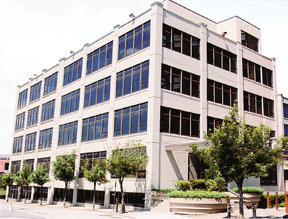
house up to 40 Brown medical labs.
Brown University plans to buy the former Speidel building in Providence’s Jewelry
District and transform it into a new biomedical research center, a project valued
at roughly $35 million.
The university has an agreement with the building’s owner, a unit of Belvoir Properties Inc., to buy the 105,000-square-foot building at 70 Ship St. for nearly $15 million. But a university spokeswoman cautioned late last week that the deal has not closed.
“If the sale goes through, the university will spend more than a year refurbishing the building for service as a biomedical research center,” said Laura Freid, executive vice president of public affairs and university relations. “But it is contingent upon due diligence, permitting and other factors.”
For Leaders Who Don't Have Time to Get Sick
Top performers guard their calendars, delegate relentlessly and optimize every hour of the day. Health,…
Learn More
The city’s Zoning Board of Review on June 25 approved a special-use permit for the project, which is needed because the building is outside of the university’s institutional zone.
Brown plans to invest another $20 million to renovate the 90-year-old building and outfit it with biomedical lab equipment and other research infrastructure once the sale is finalized, Freid said. Work likely would begin later this summer and finish in the second half of 2004.
The new center would focus on basic scientific research in the fields of genetics, genomics and proteomics, or the identification of protein functions. It would house up to 40 new labs and 150 researchers, including 27 faculty members as well as post-doctoral fellows, students and other laboratory staff.
Brown Medical School hopes to recruit 10 new faculty members to work in the center, Freid said, and the balance of the faculty would move down from College Hill. Research funding would come from an estimated $10 million in annual grants from the National Institutes of Health and other federal sources.
Brown also expects to move forward on another major building project later this year: A $92 million, 169,000-square-foot life-sciences building, planned on Meeting Street on Brown’s campus. University officials said that project – the largest single building project in Brown’s history – should commence this fall.
The Ship Street facility will house faculty from four Brown Medical School
departments:
• Molecular Biology, Cell Biology and Biochemistry
• Molecular Pharmacology, Physiology and Biotechnology
• Molecular Microbiology and Immunology
• Pathology and Laboratory Medicine
Freid said the medical school would aim to apply some of the genetic-engineering work done in the facility toward breakthrough medical treatments and research.
For example, researchers in molecular pharmacology hope to someday engineer artificial skin to treat burn victims. Molecular and cell biologists will probe further into how genetics control cell growth, which could have applications in cancer research.
Brown officials say the combination of the life-sciences building on the East Side and a new research center in the Jewelry District would lend plenty of traction to the state’s ongoing efforts to build its biotechnology industry.
“Obviously, both these buildings will have an enormously positive impact on Providence and on the state,” wrote Dr. Richard W. Besdine, interim dean of medicine and biological sciences at Brown Medical School, in a medical school newsletter this month.
“The expansion of our research enterprise will lead to an increase in ‘technology transfer’ activities, generate millions of dollars in local economic output and create hundreds of jobs,” Besdine wrote.
Biomedical research at Brown already has led to the spin off of at least 15 private biotech companies, according to Slater Center for Biomedical Technology, a state-funded program that has invested in 23 startup ventures in Rhode Island.
Brown estimates the new Ship Street center would generate an average of two startups annually, each attracting $7 million of private investment during their first seven years in business, based on a study of technology transfer by the Association of University Technology Managers.
University officials say the Ship Street site was chosen partly because of its proximity to Rhode Island and Women & Infants’ hospitals – the state’s two largest teaching hospitals. Hundreds of Brown faculty, medical residents and students spend time at the hospitals doing clinical or research work, floating between the hospital campus and College Hill – and, increasingly, the Jewelry District.
Since 1999, three new biomedical research buildings have opened in the morphing neighborhood just south of downtown. Now nearly 300 medical researchers are at work in a section of the city that once claimed status as the country’s jewelry making capital.
Indeed, a new biomedical research center on Ship Street would add to what some have called an evolving critical mass of biomedical-research infrastructure in the Jewelry District.
“The Jewelry District clearly is on everyone’s radar screen for biomedical and biopharmaceutical research,” Women & Infants’ Pediatrician-in-Chief Dr. James F. Padbury said earlier this year.
The hospital in January 2002 opened the Kilguss Research Institute on Chestnut Street, also a former jewelry factory, where about 75 researchers now work in disciplines such as reproductive biology and immunology.
An abundance of vacant factory buildings also makes the Jewelry District compatible with lab space. The buildings are spacious and sturdy enough to support the large, complex lab equipment and infrastructure needed for biomedical research.
The area also comes without the headaches of developing property on the Brown campus, where available real estate is almost nonexistent. The planned life-sciences building has been hampered by design constraints and opposition from East Side residents and businesses.
The five-story Speidel building, which the company used to manufacture watchbands throughout the 20th century before relocating in 1999, is mostly vacant, though a few offices are occupied. A 140-space parking lot adjacent the building, which abuts Interstate 195, would be included in the sale, Freid said.
Other nearby biomedical labs include 55 Claverick St., which is owned by the Lifespan health system and Brown and includes centers for AIDS and liver-cancer research. Lifespan also owns the Coro Building on Point Street, where about 125 researchers conduct basic scientific discovery in areas such as diabetes and orthopedics.
For the complete current issue, visit our subscription Web site, or call (401) 273-2201, ext. 227 or 234.