A Brown University team has developed a twin nanoparticle that the scientists believe could dramatically improve chemotherapy by narrowly targeting tumor cells and allowing doctors to track through MRIs or X-rays the path of cancer-fighting drugs.
The research, described in a recent online article in The Journal of the American Chemical Society, is “a very early first step” in demonstrating a new concept in nanoparticles for biomedical use, said Shouheng Sun, a Brown chemistry professor and co-author of the paper.
But the team’s work is important, Sun said, because it greatly expands the capabilities of nanoparticles in drug delivery, in imaging and in other possible areas, offering a new approach that has not, to his knowledge, been tried anywhere else.
For Brown and its partner hospitals, it’s also a step forward in a field that the university has made a priority because of its huge potential for medicine and its fit with Brown’s strengths in life and physical sciences, engineering and computing.
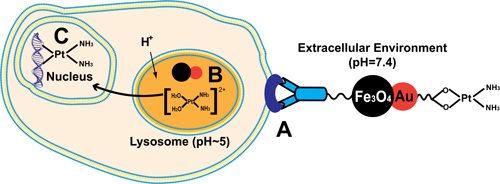
The nanoparticles that Sun and his colleagues built combine two kinds of nanoparticles that are already used in medicine: iron oxide and gold. On the iron oxide end, they attached a synthetic protein antibody. On the gold end, they attached the chemotherapy drug cisplatin.
Visually, the particles look like elongated, somewhat lopsided dumbbells, but in practical terms, Sun said, it’s more like a vehicle with a very good GPS system – the antibody – and a very important passenger – the drug.
The biggest problem with chemotherapy now, Sun said, is that it’s not very good at distinguishing tumor cells from healthy cells, so for all the tumor cells it kills, it also destroys enough healthy cells to make patients feel sick, lose their hair, and worse.
So in recent years, as nanotechnology has begun to flourish, scientists have talked about using nanoparticles to target cancer cells by attaching antibodies to particles carrying the drugs. But existing structures, Sun said, mostly using iron oxide, could only put tiny antibodies on the polymer coating over the nanoparticles, which hasn’t worked very well.
Moreover, Sun said, because there was no way to track the drugs’ path into the cells, “you couldn’t really tell whether the tumor was really being targeted; you couldn’t see it.”
This is where the new twin nanoparticles come in. By putting a high concentration of antibodies on a single spot, they can better target tumor cells, Sun said. And the gold side not only can carry the drug, but gold is also useful in imaging, so doctors can watch the drug enter the tumor cells.
“This is not only good for targeted delivery,” he said. “You are also going to be able to track the delivery, where the drug is going to go inside the tumor, that’s the unique part. It’s going to be good for imaging-guided drug delivery.”
Sun said the team used Her-2 breast cancer cells to test the concept because there’s a readily available antibody that has been proven effective. In the lab, the nanoparticles loaded with that antibody and cisplatin zeroed in on the tumor cells and killed up to 80 percent.
To further improve the safety of the drug delivery, the scientists used a pH-sensitive bond to connect the gold nanoparticle with the cisplatin and hold it in place until it reached the tumor cells, so the drug wouldn’t be prematurely released and attack other cells.
Whether this will work in actual bodies, Sun said, still remains to be seen, and that’s why now the next step is setting up animal studies. Breast cancer is not the only area in which the concept will be tested, he added; the scientists are also working with a doctor at Rhode Island Hospital to try to target pancreatic cancer cells, and because both iron oxide and gold have been shown to work well in imaging, they’re also looking at dual-imaging applications.
The journal article, Sun said, is “just one basic paper, but a first, important step.” Animal studies will demonstrate whether or not the concept is truly viable, and only then can it be tried in humans. Sun figures the animal trials could take about three years, but clinical trials, he said, are unlikely until about five years from now.
“That’s a long shot; that’s what we don’t know at this moment,” he said.
Asked why it takes so long, he replied, “because we’re not working in the pharmaceutical industry; we’re just working in the lab to give people these scientific tools.” If the animal studies show promise, he added, “industry will definitely step in and ask for more details.”
This is not Sun’s first nanoparticle chemotherapy delivery system. In a previous project, Sun’s lab built peptide-coated iron-oxide nanoparticles that, in tests with mice, successfully located a brain tumor cell called U87MG.
The breast-cancer nanoparticle research was funded by the National Institutes of Health. •