
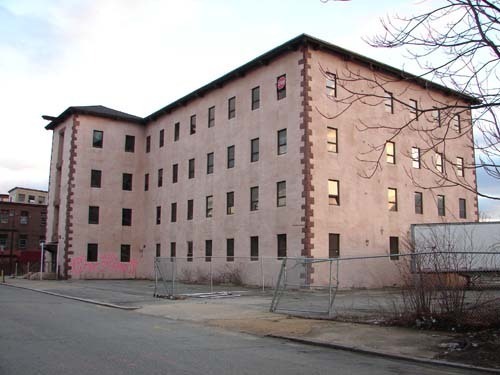
When John Risica bought a 65,000-square-foot former worsted mill in Olneyville in 2006, he wanted to turn it into working-class loft condominiums that would “make a difference” in the neighborhood. Most of the units would have been priced at less than $200,000.
But he soon found out how tough it can be for a small developer to find funding for a residential development. The market shut him out, part of the reason the project is now in receivership, Risica said in an interview last week.
“The beginning of 2006 was pretty much when the banks in Rhode Island decided that they weren’t going to lend on condos anymore,” said Risica, a Realtor with RE/MAX 1st Choice who operates WeLoveLofts.com. “Then, as soon as they got a sniff of the Olneyville neighborhood, they just backed up as fast as they could. There wasn’t a bank in Rhode Island that was even willing to look at it.”
Still, Risica’s Olneyville Urban Lofts LLC planned to go forward with the project. He would rely on the 30-percent R.I. Historic Preservation Investment Tax Credit program and the matching 20-percent federal program. But that plan hit a snag when the state reworked its credit program earlier this year.
After Gov. Donald L. Carcieri proposed scrapping the program altogether, the Rhode Island General Assembly voted to trim the benefits from 27 percent – a 3-percent fee is part of the program – to 22 percent of qualifying construction. Only developers already approved could use the credits and those who wanted to go ahead would have to pay the fee upfront, with most of the balance due by May 15.
Of the 102 projects already approved, 82 paid the upfront costs and continued their projects, according to R.I. Historical Preservation & Heritage Commission Executive Director Edward F. Sanderson.
For Risica’s small company, however, that upfront cost was a problem. The 3-percent fee was equal to $332,452.68, with $249,340 due by May 15, according to state records.
Initially, the project cost had been projected at $10.25 million, according to R.I. Division of Taxation records. That projection rose slightly when the revised estimates were required to be submitted after changes were made to the tax credit program. Now, the estimated cost is $11.08 million, which qualifies it for a state credit of $2.77 million.
The summary of the project notes that the “soft costs” that Olneyville Urban Lofts put into the project, for the state tax credit, traffic studies and other planning, were about $375,000 when it entered receivership. According to the City of Providence Assessor’s Office, Risica paid $520,000 for the 244 Oak St. property on March 31, 2006 and the 33 Magnolia St. property was purchased for $75,000.
But by the time the fee was due, Risica couldn’t find any more funding and he was faced with a tough decision – whether to sell the project that he’d invested so much in. The only other option was to watch it die, he said.
“So it went into receivership to be able to borrow the additional money to pay the historic tax credits,” Risica said. “We had to pay by May 15, so rather than miss that deadline we put it into receivership to give the original lien-holder the opportunity to lend us the money and maintain the value of the project.”
Once the project entered receivership, Risica relinquished his role as its developer. Before the May 15 deadline, the court-appointed receiver, Providence firm Winograd, Shine & Zacks PC, paid the necessary $249,340 fee to the state, so the tax credits will stay with the project for whoever buys it, according to Diane Finkle, a partner with the firm. In its role as receiver, the firm also entered an application for the federal historic tax credits for the project.
To be sure, it was a difficult project to begin with, said Olneyville Housing Corporation Executive Director Frank Shea. Last week he suggested the project might have stalled due to the public perception of the neighborhood, which has numerous vacant properties. Now, neighborhood revitalization might require a tenant who can bring jobs to people living nearby, he said.
“This is one of those areas where in 10 years it will probably be a very interesting vibrant area,” Shea said, “but at the moment everything is sort of stuck.”
For that reason, the developers who eventually decide to “take on” the neighborhood will likely see real challenges, much like the housing market forces that Risica encountered, Shea added.
Although it’s now in a former industrial area, the project’s buildings were once part of a prominent manufacturing plant. According to “A Sketch of the Mills of The American Woolen Co.,” published by the New York-based company during 1901, the Weybosset Mills were at that time one of the company’s 26 manufacturing plants in the Northeast. They had been purchased from the Weybosset Mills company during 1899 and after American bought the property the annual output was more than 1.1 million yards of worsted and cassimere each year.
The buildings that Risica intended to renovate into a 64-unit development are only part of that larger Weybosset Mills property. His acre is part of a 3.7-acre area that spans three blocks and is bordered to the south and east by Route 6 and Route 10. The entire Weybosset Mills was added to the National Park Service’s National Register of Historic Places on January 10, according to Sanderson’s office.
And the site has seen controversy before, Shea said. The project’s 244 Oak St. building had housed about 60 artists who were evicted with just a day’s notice in 2004. The city had cited fire code violations when they kicked them out, Shea said.
But it’s not just the challenging neighborhood that has stopped the project – it’s also that Risica isn’t a big developer. While he couldn’t raise the necessary funds to pay an upfront fee for a tax credit, other developers with high capital could continue with their projects.
“Quite honestly, they have a different business model than I do,” Risica said. “I’m a developer that wanted to put units on the ground for working-class people. I wanted to use the credits to get the development done, not to make money as a development company.”
Winograd, Shine & Zacks PC Partner Diane Finkle said last week that she has so far had requests for 30 packets of information about the development.
After the bidding process closes at 4 p.m. on October 6, Finkle said, they’ll know whether the project will go forward as Risica hopes. If a bid is accepted, he has a chance to recoup his investment, he said.
For him, the project was a step into a new business. It was an attempt to develop a property instead of selling someone else’s lofts. And it was a step into a new neighborhood, one that might not have been ready for lofts.
“We just had to do everything we could to maintain all of the work that we had done to date,” he said last week, “and make it possible for some other developer to step in and make the best of this situation.” •











This story is kind of a downer, but it’s not like everything is broken. In the middle of this whole mess, Slater Cotton Mill here in Pawtucket was sold and is racing through its conversion. Even a jaded commie like me is impressed by the speed with which that project has moved along.