Despite signs business growth could be slowing in the Ocean State, the private sector is bullish about 2018 and is looking to hire at record levels, according to the Providence Business News biannual business survey.
Indeed, 63.3 percent of respondents to the 2018 Winter Business Survey said they planned to hire in the next quarter, marking the highest response since the survey started a decade ago. At the same time, less than 5 percent of respondents said they were planning for workforce reductions.
The hiring plans undoubtedly come as a welcome sign for Gov. Gina M. Raimondo and other state officials who are pushing for job growth, especially in an election year. It also reflects strong optimism within the business community, as nearly three-quarters of respondents – 73 percent – predict the Rhode Island economy will improve in 2018.
Edward M. Mazze, distinguished professor of business administration at the University of Rhode Island, thinks the optimism is in part because of the heightened level of attention the business community is receiving from state leaders.
“There’s a lot of dialogue about making Rhode Island a better place to do business,” said Mazze, who partners with PBN to analyze the survey results. “When you hear the House speaker, Senate president and governor talk about the need for jobs and making the economy better, that spills over to these folks more so than previous [leaders], who may have said less when it came to these issues.”
The survey results, however, did not all trend in positive directions. Business owners reported a slowing of business activity and many grumbled the state’s limited workforce lacks skills necessary for today’s jobs.
The issues are likely to come up during this year’s statewide elections and Mazze said it could benefit elected leaders to listen.
“The important thing in an election year for incumbents is to get re-elected,” Mazze said. “If they spent more time serving their constituents, they would find it easier to do.”
[caption id="attachment_197784" align="aligncenter" width="640"]

A HAPPY CONTRADICTION: While a number of the economic indicators of PBN’s most recent Business Survey were strong, not all were. Thus despite current activity and new orders falling well-behind their summer levels, more companies plan to hire someone in the coming quarter than at any other time in the history of the survey. / PBN GRAPHIC/LISA LAGRECA[/caption]
OPTIMISM
What’s clear from the survey results is Rhode Island’s private sector is expecting good things in 2018.
The survey was sent to 626 businesses, with 64 responding.
More than seven in 10 respondents – 73 percent – expect the Rhode Island economy to improve this year. The response is consistent with the 73.2 percent of respondents who said the same thing last summer and a slight decrease from the 76.4 percent of positive responses last winter.
Mazze said the steady optimism is partly because respondents to the PBN survey are among the more successful business owners in the state. Business right now is good for them, as more than two-thirds of survey respondents reported 2017 profit grew from the previous year.
Mazze also suspects generally positive news reports about the economy have also fueled optimism.
“When you read the newspaper, there is a lot of reason to be optimistic. There’s more favorable news than unfavorable news. There’s more companies coming than leaving,” Mazze said.
[caption id="attachment_197783" align="alignleft" width="300"]

POSITIVE TRENDS: Barbara Thornton and Nathaniel Ginsburg are both partners at Brewster Thornton Group Architects in Providence. Thornton says the firm hasn’t had to lay anyone off since the fall of 2007 and hasn’t seen the level of activity it’s currently experiencing in a long time. / PBN FILE PHOTO/RUPERT WHITELEY[/caption]
Business owners are also seeing more development, which fuels a sense of action.
“It’s very exciting to see cranes on the [Providence] skyline downtown,” said Barbara Thornton, partner at Brewster Thornton Group Architects in Providence. “It’s been a very long time since we’ve had this much activity.”
The positive outlook locally is matched nationwide. The National Federation of Independent Business released a survey on Feb. 13 showing optimism for January rose more than forecasted. An index used to measure the results increased 2 points to 106.9, nearing November’s 107.5 reading that was the highest in monthly data since 1986. The optimism was one of the strongest readings in the 45-year history of the survey.
The federation said the results were fueled in part by supportive consumer spending and the federal tax overhaul signed into law in December.
[caption id="attachment_197782" align="alignright" width="277"]

HEALTHY ECONOMY: George Charette, president and CEO of Pawtucket Credit Union, says he’s not seeing a slowdown in the number of mortgage closings, which he uses as a bellwether for the health of the economy. / PBN FILE PHOTO/MICHAEL SALERNO[/caption]
“The tax cuts should put more money into the pockets of a lot of individuals,” said George J. Charette III, president and CEO of Pawtucket Credit Union.
Charette, who heads the largest credit union in the state, said he’s closely tracking his mortgage business, which he uses as a bellwether for the health of the economy.
“If the number of mortgage closings starts to decrease, that would certainly signal that there is some concern from the populace about their financial futures,” Charette explained. “We’re not seeing that at all at this point, and I’m hoping we won’t anytime soon.”
The mood among Rhode Island business owners hasn’t always been so hopeful.
When the survey started in summer 2008, barely one-quarter of respondents – 25.5 percent – believed the local economy would improve. By the winter of 2008, it fell to 17.6 percent, marking a low point. Survey respondents didn’t start becoming consistently bullish until the summer of 2013.
While business owners remain sanguine about their immediate prospects, there are some signs of slowing growth when it comes to business activity.
[caption id="attachment_197785" align="aligncenter" width="640"]

NEEDS INTENSIFY: Survey respondents are finding two consistent, if not growing, concerns – finding qualified workers and navigating the red tape of government. After a brief hiatus, health care costs and taxes also returned to top-of-mind concerns for business owners. / PBN GRAPHIC/LISA LAGRECA[/caption]
SLOWING ACTIVITY
About half of survey respondents said quarterly business activity improved from the previous quarter, representing a good sign for business growth.
But that number, 51.6 percent of respondents, represents a 23 percentage-point decline compared with the 2017 summer business survey and an 11.3 percentage-point fall from the previous year. It’s also the lowest response for the survey since summer 2013, and the lowest response for the winter survey since 2012.
At the same time, 49.2 percent of respondents said quarterly new orders exceeded the previous quarter, marking the lowest response since winter 2012. The tepid growth could help explain the growing number of respondents – 27 percent compared with 19.4 percent a year earlier – who expected their own businesses to perform the same as last year during 2018.
[caption id="attachment_197852" align="alignleft" width="219"]

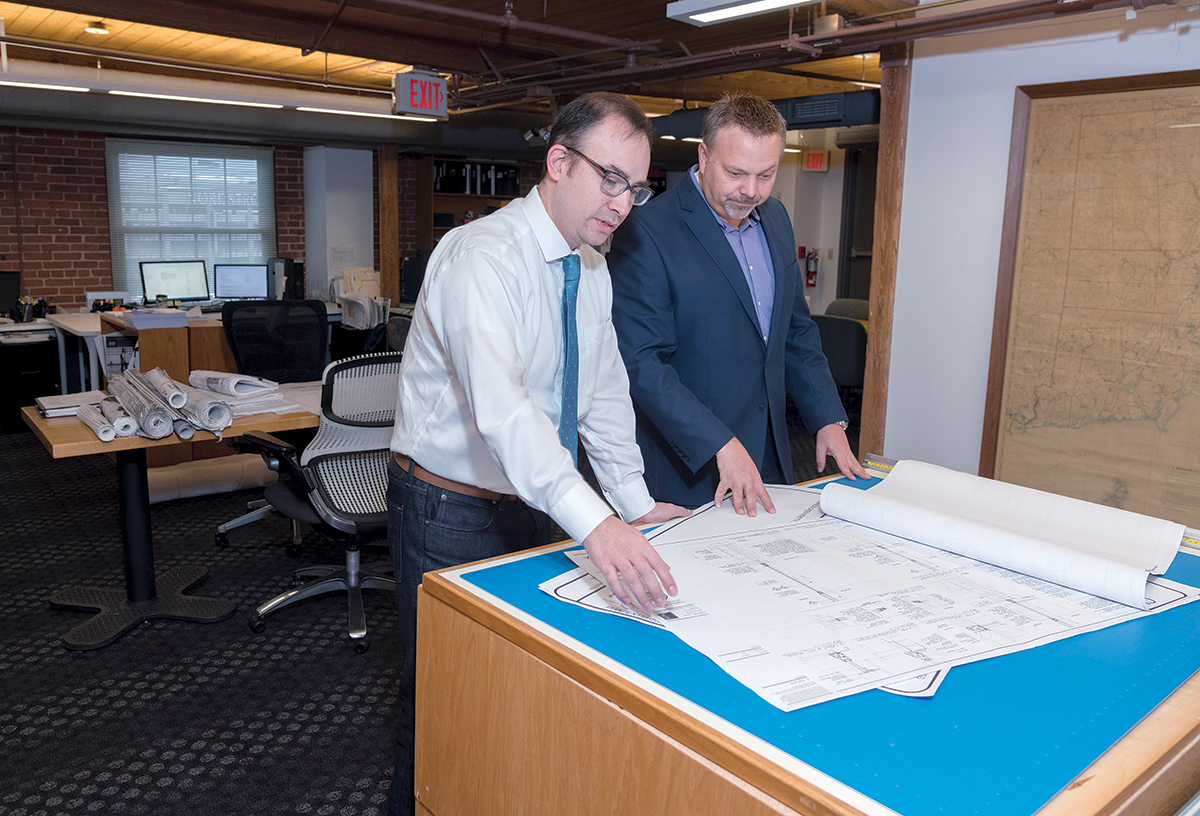
David DeQuattro, managing principal of RGB Architects, looking at plans with Martin Holland, job captain.
PBN PHOTO/MICHAEL SALERNO[/caption]
“That doesn’t surprise me,” said David L. DeQuattro, managing principal at Providence-based RGB Architects, when told about the trends. “Business is steady, but I wouldn’t say it’s robust.”
The architecture industry has a good feel for business activity, as it often becomes involved in development projects long before any shovels hit the ground.
DeQuattro said public-sector building projects are relatively nonexistent these days, which he attributes in part to the lack of resources in recent years put toward fixing schools throughout the state.
He lauded state leaders, including Raimondo, for proposing to borrow $500 million to spend on school repairs by 2022. The idea, proposed in December, came after the R.I. School Building Task Force in September reported the cost to bring all schools into good condition would total $2.2 billion.
Rhode Island voters will decide at the polls in November whether the state should borrow the money. If approved, DeQuattro expects the funding could be a shot in the arm for the local construction industry, which would in turn benefit complementary industries.
“The governor recognizes the best way to put people to work is construction jobs. The activity creates other jobs around it at local restaurants and through manufacturing components,” he said. “Building is something we still do well in this country.”
Mazze largely agrees.
“You’re going to see an increase in the construction business,” he said. “If everything moves in the right direction … you’re going to see some more hiring going on.”
Indeed, a lot of Rhode Island businesses are already looking to hire this year. But many are running into a common issue of finding and keeping in-demand workers.
[caption id="attachment_197786" align="aligncenter" width="640"]

THE PATH FORWARD: The business community has some pretty clear suggestions for elected officials on how to improve the business climate in Rhode Island, with new priorities showing up in the last half-dozen years. / PBN GRAPHIC/LISA LAGRECA[/caption]
HIRING
Hiring is clearly on the rise in Rhode Island.
In addition to the record-breaking number of respondents with plans to hire employees in the next quarter, 52.4 percent said they are employing more people than the previous quarter. That’s also a record high.
But a shortage of qualified workers continues to affect businesses. Fifty-nine percent of respondents said a shortage of skilled workers was among the greatest challenges of operating a business in Rhode Island, also representing a record high for the survey.
The issue, in talking with business owners, is multilayered.
“There’s a really nice initial labor pool,” said Thornton. “But it’s not sexy to stay in Rhode Island. It’s sexier to go to New York.”
The shortage pushes firms to compete with one another in Rhode Island, which extends into the Massachusetts market, Thornton said. More people moving into the area could help, she added, although evidence of such a trend is scant.
“The perfect person is the [one] moving into the area, but there’s not a lot of that,” Thornton said.
Her anecdotal evidence is supported by tax data. From 2015 to 2016, Rhode Island saw a net loss of 1,958 tax filers, according to the Internal Revenue Service. The moneymakers took with them about $182.1 million in adjusted net income.
The exodus undoubtedly exacerbates the hiring challenges facing Rhode Island businesses. IRS data shows the greatest number of tax filers left Rhode Island for Massachusetts.
“There’s a lot of work flowing there,” DeQuattro said.
Charette said PCU has hired on average five to six new employees each year for the last five years and expects to grow his staff at a slightly faster clip this year. He agrees with others, however, that finding good candidates is difficult. Still, he’s hopeful a budding partnership with the Northern Rhode Island Chamber of Commerce and the state’s workforce-development efforts could result in better recruiting for credit unions and other industries.
“There’s been a lot of conversations among businesspeople in Rhode Island about being able to hire people with the right skill set,” he said. “We’ll see how it goes.”
Beyond hiring challenges, Rhode Island businesses still see room for improvement in the local business climate. Survey respondents largely identified the state government as an entity that could help pave the way.
[caption id="attachment_197787" align="aligncenter" width="640"]

SLOWING MOMENTUM: Has Rhode Island’s business activity reached a post-Great Recession peak? Based on responses in this winter version of the PBN Business Survey, while not record highs, many of the key indicators of business success continued to hover near their highest marks, buoyed by strong performance and high expectations. / PBN GRAPHIC/LISA LAGRECA[/caption]
RED TAPE
A record nine in 10 survey respondents said state government should reduce so-called red tape to help support its business community.
Red tape, a catchall phrase to describe excessive bureaucracy, is always among the top responses for a question that asks what state government could do to help businesses. Mazze said respondents concerned about red tape are generally unhappy with the current business climate.
The 90.2 percent of respondents concerned about red tape is a 31.6 percentage-point increase compared with the summer survey and a 35.4 percentage-point increase compared with last winter.
Mazze said business owners may be thinking that now – as the economy and businesses are getting so much attention from state officials – could be the best time for government to make changes to lessen regulation of the private sector.
“They really want government to get out of their way,” Mazze said. “One way to do that is to get rid of some of the red tape.”
Charette is hopeful the R.I. Department of Business Regulation will be successful in its ongoing effort to reduce some of the more-outdated and arcane laws affecting the business community.
“They’re beginning to make some moves there,” Charette said. “They’re working to streamline approvals and to become a partner with the business community.”
Reducing the cost of doing business with the state, supporting workforce-development programs and providing tax incentives and credits were among the other top responses.
Health insurance costs continue to be the biggest growing expense for businesses. More than 60 percent of respondents said health insurance had increased the most as a percentage of all costs in the last five years. Salaries of new hires was a distant second place, totaling 24.2 percent. Workers’ compensation accounted for 6.5 percent of respondents.
The biannual survey yielded responses from more than eight industries. Although not scientific, the survey offers a snapshot of local business sentiment twice a year and how that changes year to year.
Thornton, who sees architecture as a bellwether for the economy, expects the overall bullish sentiment in the business community to continue as long as hiring grows.
“I consider architecture a nine-month leading indicator,” she explained. “The last time we were laying people off was the fall of 2007 and the economy was falling by fall of 2008. … We haven’t seen that yet, so that’s good news.”