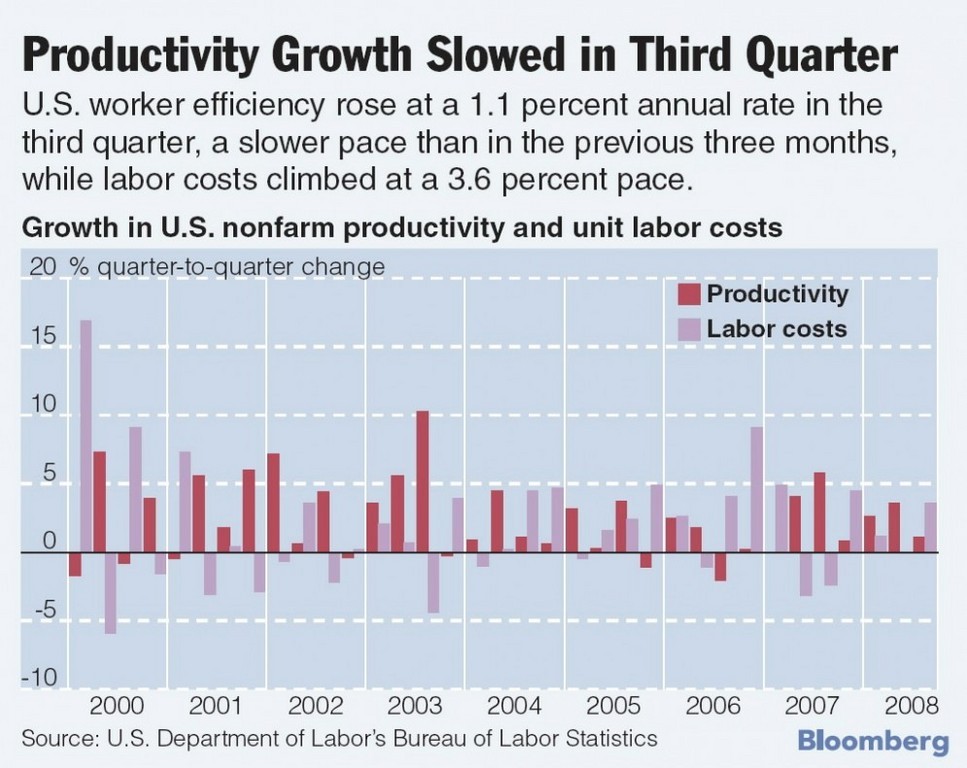
WASHINGTON – The productivity of U.S. business and manufacturing workers increased in the third quarter, although at a slower rate than in the previous three months, the U.S. Department of Labor’s Bureau of Labor Statistics reported today.
Productivity – measured in output per hour – rose at a faster-than-anticipated 1.1-percent annual pace. Analysts had expected productivity to rise at a 0.7-percent annual rate, based on the median forecast from a Bloomberg News survey of 63 economists. (Their estimates of the third-quarter change in productivity ranged from a rise of 2 percent to a decline of 0.5 percent.)
Meanwhile, labor costs climbed at an annual rate of 3.6 percent, the BLS said, exceeding the survey’s third-quarter estimate of a 3.0-percent annual pace.
The number of hours worked fell at an annual rate of 2.7 percent – the sharpest decline in six years, Bloomberg data show – while worker output fell at an annual pace of 1.7 percent.
Hourly pay rose at an annual rate of 4.7 percent – accelerating from the second quarter’s 3.5-percent annual pace – but “real” compensation after adjustment for inflation was 1.3 percent lower than in the third quarter of 2007.
Manufacturing productivity fell at a 1.0-percent annual rate in the third quarter, as productivity in durable-goods manufacturing rose at a 3.3-percent annual rate but that improvement was more than offset by a 7.3-percent annual pace of decline in manufacturing of non-durable goods such as clothing, the BLS said. “Output and hours in manufacturing, which includes about 12 percent of U.S. business-sector employment, tend to vary more from quarter to quarter than data for the aggregate business and nonfarm business sectors,” the bureau noted.
“Firms can’t quite keep up with how quickly demand is falling, though they’re reacting quickly by cutting employment and hours,” Nigel Gault, chief U.S. economist at IHS Global Insight in Lexington, Mass., told Bloomberg News. “It makes things worse for the job market,” Gault added. “We’ll see weaker productivity in the next couple of quarters.”
For Leaders Who Don't Have Time to Get Sick
Top performers guard their calendars, delegate relentlessly and optimize every hour of the day. Health,…
Learn More
A separate report today from the Labor Department’s Employment and Training Administration found that first-time jobless claims fell last week – after rising more sharply than previously thought in the week ended Oct. 25 – as the number of unemployment-benefit recipients nationwide swelled to a 25-year high. (READ MORE)
Additional information, including the 14-page Productivity and Costs report is available from the U.S. Department of Labor’s Bureau of Labor Statistics at www.bls.gov/lpc.