
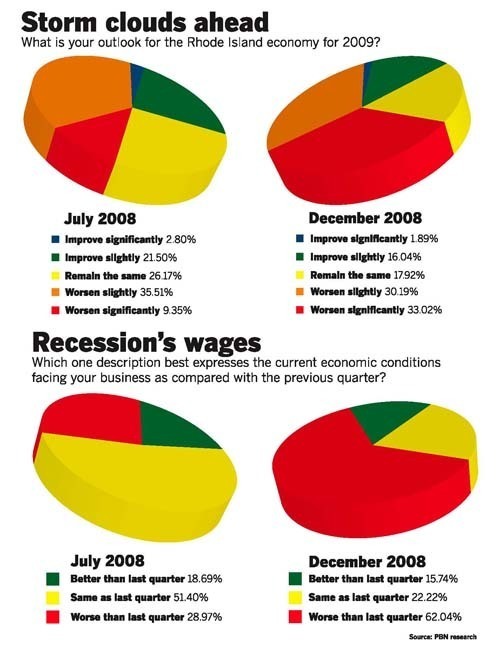
The silver lining has vanished for local companies, leaving behind a roiling, dark cloud over Rhode Island’s business landscape.
Five months ago, a business survey conducted by Providence Business News indicated that many businesses were weathering the global economic storm and seeing a brighter future on the horizon.
Since then, however, that storm’s buffeting winds have been ratcheted up several notches, toppling once-solid financial institutions, lifting the state’s unemployment rates to new heights and leaving behind more and more foreclosed properties.
At the same time, the stock market has tanked. In the last three months, despite recent rallies, the Dow Jones Industrial Average has dropped about 25 percent, and the S&P 500 and Nasdaq indexes are down more than 30 percent. Also helping to blot out the bright future, at least in the short term: the state’s seemingly insurmountable budget deficit, which is projected to be about $360 million for this fiscal year.
So it should be no surprise that a new PBN business survey shows that the glint of optimism respondents displayed in July has been swept away and replaced mostly with doubt, pessimism and a bit of anger at state leaders for not doing more to prop up Rhode Island’s economy.
Fewer than one out of every 10 businesspeople who responded to the survey in July said they believed the economy in 2009 would be significantly worse than this year. Now, one out of every three believes it.
“I don’t see any way that 2009 is going to be turned around to the good,” says Chris Hurd, owner of the Johnston car dealership Hurd Auto Mall. “There are too many issues that need to be worked out.”
When asked in July if layoffs were in their company’s future plans, 80 percent of the respondents answered with an outright “no.” Now they’re not so sure. About 66 percent said “no” in the survey taken in November, with more businesses either saying “yes” or at least indicating they are mulling over job cuts.
Also, a much greater percentage of businesses – nearly 56 percent – said in the most recent survey that they were not planning to hire any employees in the next quarter. That number is up from 40 percent in July.
Susan Fabrizio, president of Flagship Staffing Services in Cranston, is grappling with those employment trends, as well as a 9.3-percent state jobless rate.
Fabrizio says her company has a steadily growing pool of out-of-work administrative assistants, receptionists, data-entry personnel and bookkeepers to place, but fewer temp jobs in which to place them.
The survey is not scientific. PBN sent the 20-question survey to 1,470 businesses statewide in the database developed for the newspaper’s Book of Lists. It contained the same queries that were distributed to businesses in July, when 104 responded.
This time, 108 private, for-profit companies returned the questionnaire from industry sectors ranging from financial services to information technology, and manufacturing to construction.
A comparison of responses in the two surveys indicates a marked difference in attitude.
Of the challenges facing Rhode Island business, the weak economy still ranked highest among respondents (77.57 percent, up from 62.62 percent in July). But more businesspeople said they saw challenges in almost every other category on the survey, too.
Taxes ranked second highest at 69.16 percent (up from 56.07 percent in July), followed by health care costs (59.81 percent, up from 52.34 percent), government bureaucracy (54.21 percent, up from 42.99 percent), diminishing customer base (44.86 percent, up from 31.78 percent), energy expenses (42.99 percent, down from 48.60 percent), government fees (32.71 percent, up from 23.36 percent), shortage of qualified workers (24.53 percent, down from 26.17 percent), and transportation infrastructure (16.82 percent, up from 11.21 percent).
Access to capital continued to rank lowest among the challenges, but even that jumped from 5.61 percent in the July survey to 15.89 in November.
Respondents blamed at least some of their woes on state government. It’s a common refrain from the business community, but comments left in the survey seemed to go beyond mere frustration.
“I have come to conclude that there are no benefits to operating a business in Rhode Island,” one business owner – who wanted to remain anonymous when contacted by PBN – wrote in the survey.
Another respondent wrote: “Rhode Island is very unfriendly to small business. Small business gets NOTHING!!”
Edward M. Mazze, distinguished university professor of business administration at the University of Rhode Island, said it is clear from the survey that the state has not shed its reputation as a difficult place to do business.
“We still come across as a business-unfriendly state,” said Mazze, who assisted PBN in drafting the survey earlier this year. “The business community clearly has lost confidence in their state leaders and their ability to balance the budget and pass legislation to help business.”
John Gregory, president and CEO of the Northern Rhode Island Chamber of Commerce, said the efforts by legislators and Gov. Donald L. Carcieri to avoid raising broad-based taxes in the previous legislative session did buoy businesspeople for a time.
But whatever good feelings were created then have mostly evaporated as the state deals with another enormous deficit, this one partially created by a decline in state revenue as the economy slows.
Legislative leaders already have warned that tax increases – along with many other solutions – will be under consideration in filling the $360 million budgetary gap this year and another multimillion-dollar hole projected for next fiscal year.
“Businesspeople realize that this is a lot different of a situation,” Gregory says. “The state is spending a million dollars a day more than what we’ve got for this year. That doesn’t even address next year’s budget.”
There is also an anxiety that when state cuts trickle down to the local level, they’ll be passed along to businesses in the form of fee increases. “There’s not going to be any revenue sharing because there’s really no revenue to share,” said he. “Eventually, you’ve got to find other ways to make it through this.”
That might explain why, when asked about the important actions state government could take to support business in the year ahead, respondents checked off each of the choices at a higher rate than in July.
Reducing the cost of doing business in Rhode Island still ranked highest, with 89.62 percent of those surveyed marking that as important, up from 85.05 percent in July. Providing tax incentives and credits ranked second at 72.64 percent, up from 55.14 percent.
One notable change was that 29.25 percent of those surveyed said access to capital for growth was important, up from 15.89 percent in July.
That’s an area where Carcieri is taking action now. Earlier this month, he unveiled an economic stimulus plan intended to ease the credit crunch. The plan includes a pledge by eight banks and credit unions to make $165 million in loans to Rhode Island businesses over the next two years.
Overall, Mazze saw few surprises in the survey results. For instance, he noted, the survey expectedly shows that current business activity is slowing, and deteriorating economic conditions are whipping up a stiff headwind.
In July, only 14.95 percent of businesses said the current quarter – referring to the second quarter of 2008 – was worse than the previous quarter. In November, the number of respondents experiencing a quarter worse than the previous one more than doubled to 33.33 percent.
When asked to describe the current economic conditions facing their company as compared with the previous quarter, 62.04 percent deemed them worse than the previous quarter, up from 28.97 percent who gave that response in July.
Computer Associates Inc. in Smithfield is starting to feel the pinch, said CEO James McCooey.
The software maker, with 53 employees, had an outstanding 2008, mostly because of a big contract the company secured in 2007 to provide inventory and accounting computer programs for a national seafood company.
Now the flow of pending contracts in the pipeline has slowed to a trickle. “A lot of the sales are going into the wait-and-see mode,” McCooey says. “We’re not losing to competition; we’re losing to indecision.”
As a result, McCooey foresees no revenue growth or as much as a 10-percent reduction for the coming year, a first for the 31-year-old company. “Probably best case, we’ll have a flat year,” he said.
For now, Computer Associates is getting “very creative” about pricing and financing for their customers. “We need to see more business in the next couple of quarters,” McCooey said.
The PBN survey indicates McCooey’s task may be difficult in the near future. Only 23.36 percent of the businesspeople surveyed said their company planned a big-ticket purchase – such as computer software – in the next quarter, down from 27.10 percent in July.
Meanwhile, 62.14 percent of the respondents said they are paying higher prices for materials and supplies than the previous quarter – down from 77.57 percent in July – and fewer companies planned price increases as business owners remained fearful of losing customers.
A little more than 13 percent of those surveyed in November said their prices would be hiked next quarter, compared with 21.5 percent in July.
Robert Armstrong Jr. is one of those who is holding the line.
Armstrong, president of Munroe Dairy in East Providence, acknowledged that operating the home-delivery service is “a bit more of a challenge.” The company pays more for utilities, wholesale dairy products, and gasoline (until recently) and insurance for its 30 trucks.
Still, Armstrong feels it is necessary to keep his charges the same.
“You’re dealing directly with the end user, the consumer – if someone’s out of work or they’re cutting back, home delivery might not be a priority,” Armstrong said.
So far, the resistance to price increases has paid off. Munroe Dairy delivers to about 12,000 households in Rhode Island, and while the company lost 152 customers in November, it signed on another 216. “We’re ahead of the game,” Armstrong says.
At Hurd Auto Mall, lower car prices have been drawing potential buyers for the last two months, according to owner Chris Hurd.
“October was really, really, really off,” Hurd said. “So I think there is pent-up demand.”
But more customers don’t necessarily translate to higher profits.
“The fact that the margins are thinner and business is a little off, you combine that together and the only way to make that work is really keeping your eye on the cost of doing business,” he says. “We’re going to be fine.” •




Temporary construction staffing with temporary skilled tradesmen is the core business of Grus Personnel, We believe our mission is two-fold: to staff our client’s projects with the highest quality of skilled trades people available and to foster an environment in which the quality of our workers continues to increase.
http://www.gruspersonnel.com