
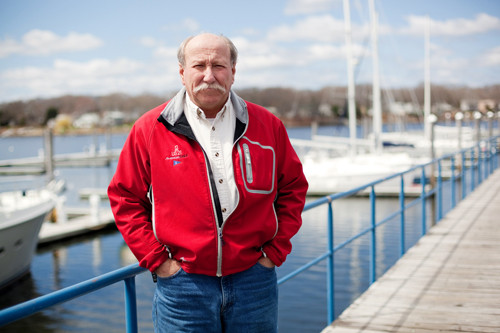
When Michael Keyworth took his seat in front of the House Finance Committee last week, some atypical company joined him at the witness table. Next to the legislative chairman of the Rhode Island Marine Trades Association sat an optometrist, a newspaper publisher and the president of an automobile dealership. They, and dozens more after them, sat united to oppose Gov. Lincoln D. Chafee’s plan to broaden the sales tax.
“It was an incredibly eclectic group of people,” said Keyworth, general manager at Brewer Cove Haven Marina in Barrington. “There were people from all walks of life that had never gone into that room.”
Just hours after Keyworth and others testified April 13, business leaders scored a victory. House Speaker Gordon Fox called the governor’s proposed two-tiered sales tax “unacceptable.” He pledged that the House would not pass Chafee’s budget, citing in part, “overwhelming opposition” by the business community.
In response, Chafee in a statement said he looked forward to working with lawmakers to “advance an honest, responsible budget that fixes our chronic structural deficits and puts Rhode Island on a path to prosperity.”
At the House hearing, more than 125 people signed up to testify and all but one, the executive director of The Poverty Institute, came to oppose the plan.
Chafee’s plan would lower the sales tax rate from 7 percent to 6 percent. But he would also tax a broad array of products and services for the first time, some at 6 percent and some at a new rate of 1 percent. Chafee said the plan would generate $164.9 million.
John Howell, publisher of The Warwick Beacon and The Cranston Herald, sat next to Keyworth at the House hearing. He said he believes the turnout by the business community stopped the tax plan in its tracks.
“That was a defining moment,” Howell said. “I don’t believe the governor or [lawmakers] saw the wave that was developing in opposition to this until the last three or four weeks.”
Laurie White, president of the Greater Providence Chamber of Commerce, agrees opponents made an impression.
“I do believe they have certainly heard from the witnesses the issues of economic competiveness,” White said. “In all the years I’ve been up here I’ve never seen as diverse an array of businesses groups that have come together.”
All said the tax plan would have a detrimental consequence to their industries already struggling in the midst of tough economic times.
Howell complained that taxing newspapers and other currently exempt items would mean higher prices and a decrease in consumer spending. That, he said, would force companies to cut back and potentially lay off staff.
It was an argument repeatedly heard during the all-day hearing. Business leaders also said they worried about the state taxing things used in the production of other items subject to the sales tax. Such a pyramid system would lead to certain products being taxed multiple times, they said.
The higher-end cost for customers would simply drive them out of state, they said.
And Keyworth wondered how long it would take lawmakers to raise the 1 percent rate. (The sales tax in Rhode Island started in 1947 at 1 percent.)
“It’s not hard to imagine 1 percent becoming 2 percent, 2 percent becoming 3 percent,” he told the House committee.
Gary S. Sasse, the director of revenue under former Gov. Donald L. Carcieri and now a visiting professor at Rhode Island College, criticized Chafee’s budget for expanding taxes while increasing spending by 7 percent.
He called Chafee’s proposal “a tax increase of historic proportions” that would dissuade businesses from investing or expanding in the Ocean State. And he said that Chafee’s two-tiered sales tax structure would make administrating the tax difficult and set Rhode Island apart from other states.
“We do not want to become the Lone Ranger, become the outlier,” he said.
Chafee administration officials, meanwhile, defended the plan as necessary in a time with shifting consumption patterns.
Richard Licht, the director of the R.I. Department of Administration, said a broader sales tax would provide a steadier revenue stream during troubled economic times when consumers cut back spending in certain areas.
That, he said, would help prevent an inclination in the future to raise taxes when times are tough.
White says that even with Fox’s statement, the business community must continue the pressure.
“We need to continue to make the case that any kind of broad-base sales tax expansion would be detrimental,” she said. •









It is apparent that some business sectors prefer not to pay a fair share of the cost of R.I. roads, schools, fire and police services, and food / air / water / product safety.
Instead of complaining about their own plight, they owe the remainder of the state’s taxpayers an explanation of where the money to rebuild Rhode Island infrastructure and preserve quality of life will come from.
The state would benefit from more community spirit and cooperation, and less self-interest.