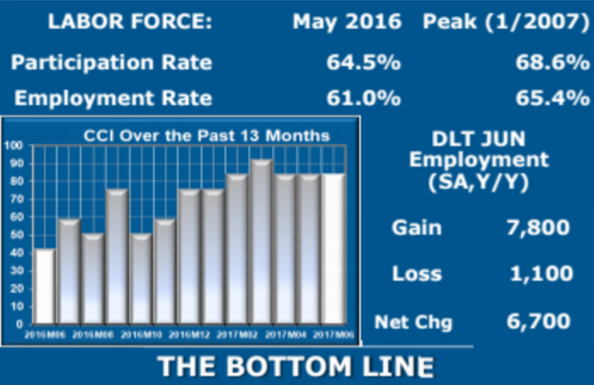
SOUTH KINGSTOWN – After a “very disappointing 2016,” the first half of 2017 was “quite favorable” said University of Rhode Island economist Leonard Lardaro whose Current Conditions Index for Rhode Island held steady at 83 in June, its third consecutive month at that measurement.
A CCI reading greater than 50 suggests economic growth and a value less than 50 indicates contraction.
Selling Luxury Real Estate Requires More Than Exposure
By Emilio DiSpirito IV License Partner | Private Office Advisor Engel & Völkers Oceanside www.DiSpiritoteam.com…
Learn More
The June 2017 reading is 41 points higher than the measurement of 42 taken in June 2016. In fact, from January to June, measurements from 2017 have consistently beaten their year-over-year comparisons – what Lardaro called an “exceptionally rare accomplishment.”
As reported in July, the state’s unemployment rate fell by 1.2 percentage points in June.
June saw 10 of 12 CCI indicators report positive growth.
New claims, a timely measure of layoffs, fell 3.9 percent in June – its sixth improvement in seven months.
There was a 30.1 percent bump in single-unit permits, which are reflective of home construction. Similarly, total manufacturing hours, the other goods-producing factor, jumped 2.5 percent and manufacturing wage grew 4.1 percent in June.
In its eighth consecutive improvement, U.S. consumer sentiment rose by 1.8 percent in June.
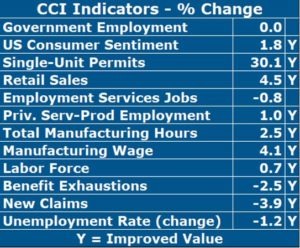
Calling it’s growth “somewhat volatile,” Laradaro’s CCI found private service-producing employment grew by 1.0 percent in June.
There were also jumps in retail sales and the labor force, 4.5 percent and 0.7 percent, respectively, in June.
Reflective of longer-term unemployment, benefit exhaustions fell by 2.5 percent in June.
Employment services jobs, an indicator of future employment, fell by 0.8 percent – a move which “continues to be cause for concern,” said Lardaro.
Government employment remained unchanged.
Laradaro said the state has moved past much of the “slowdown” which took place in 2016, but all is not rosy, especially because of the “highly deficient” budget the state passed in August.
Emily Gowdey-Backus is a staff writer for PBN. You can follow her on Twitter @FlashGowdey or contact her via email, gowdey-backus@pbn.com.