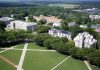
The Community College of Rhode Island occupies a unique position in the midst of the state’s economic turmoil.
The college itself is grappling with a $5.5 million shortfall in its budget for the current year, at the same time enrollment is growing to record levels and a “double-digit” increase in tuition is likely in the fall of 2009, according to Ray Di-Pasquale, college president.
Yet, in order for Rhode Island to emerge successfully from its economic travail, state officials and many major employers in Rhode Island rely on the state’s only two-year community college to continue to make training “affordable and accessible” to the work force of the next generation, according to Di Pasquale.
“Education is the key to making our state stronger, and someone must be the supplier of that,” Di Pasquale said earlier this month. Higher education in the state, including Rhode Island College and the University of Rhode Island, “needs strong support if we’re going to get through this,” he said.
Di Pasquale’s comments came prior to a morning meeting of the Rhode Island Press Association, held Jan. 16 at the CCRI Knight Campus in Warwick. In candid remarks, Di Pasquale, president for three years, provided his annual update on the status of CCRI.
With four campuses, in Warwick, Lincoln, Providence and Newport, CCRI currently has an enrollment of 17,600 full- and part-time students, plus another 35,000 in work force development, the latter with 94 percent Rhode Island residents. Some 2,500 students registered in just one week in mid-January and “they’re pouring in” at “record” rates, Di Pasquale said. “We’re bursting at the seams.” When people cannot find work, he suggested, they go to school.
Di Pasquale spoke of the “huge impact” that CCRI has on the state because many of its students, due to higher tuition costs elsewhere and academic issues, have no other way to obtain training and education but to start at CCRI. Some 70 percent of CCRI students, he said, require at least one remedial course, usually in English or math.
Tuition at CCRI, while still lower than the national average for community colleges, has been raised every semester and a “double-digit increase” is projected for the fall, according to Di Pasquale. He is worried that rising tuition will adversely affect the school’s main mission of being accessible and affordable. At least 2,100 students “weren’t able to pay their bills” from the previous semester, he said, and many will not be able to return for financial reasons.
Tuition rates per semester for full-time students in Spring 2009 are: $1,497, in-state students; $2,246, regional/interstate students; and $4,245, out-of-state students. This compares to $1,397, $2,066 and $3,960, respectively, for the previous semester.
Expecting another multimillion-dollar cut in Gov. Donald L. Carcieri’s supplemental budget, released in early January, Di Pasquale said he was relieved to see the governor’s proposed reduction for CCRI to be “far less” – $2.09 million, but the college knew and had already planned for a $2 million loss, leaving just $90,000 to make up. Di Pasquale hopes the legislature will maintain the governor’s proposed figure. The operating budget for the current fiscal year is $123 million.
To cope with the budget shortfalls, the college has: placed a freeze on about 100 vacant jobs in nearly all areas (excluding faculty positions); is providing no professional development and no travel reimbursements for employees and is in the middle of a $5.5 million capital fundraising campaign, the first in the college’s history.
“We’ve raised well over $2.5 million in a year and a half,” he said. Di Pasquale added the college is setting aside $1 million for a scholarship fund, and the rest will go for “the basics,” such as equipment for classroom laboratories and library upgrades, needed to retain accreditation.
In terms of work force development, CCRI is the primary educational institution and “catalyst” that works with companies in Rhode Island requiring assistance to train employees, Di Pasquale said. He spoke of partnerships the college has or is forming with such organizations as CVS Caremark, Taco Inc., Cranston Print Works Co., Lifespan, Care New England and National Grid. For instance, “we are the only ones training radiographers and dental hygienists in the state,” Di Pasquale said, and “we are the largest provider in the state of registered nurses.”
A potential funding bonanza that Di Pasquale intends to pursue is an offer recently made by Bill Gates, Microsoft founder. Gates has pledged to donate millions of dollars to community colleges in seven or eight states, according to the CCRI president, and “we will go after those dollars,” he said.
The community college also plans to expand its line of online offerings, now at roughly 165 courses that are “the first to fill,” Di Pasquale said. “We want to grow that, because if we don’t, someone else will.” The college has procedures and policies in place to ensure that online work is of the same quality and as difficult as — and often more difficult — than classroom courses, he said.
All in all, Di Pasquale remains hopeful and optimistic about the state and the college’s future. “We have a very good college, we’re the only community college in Rhode Island,” he said, “and we’re everywhere in the state.” •
No posts to display
Sign in
Welcome! Log into your account
Forgot your password? Get help
Privacy Policy
Password recovery
Recover your password
A password will be e-mailed to you.
- Featured Event -