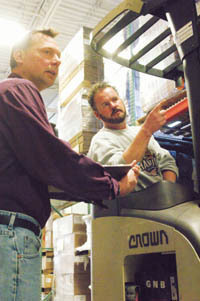
Goldline Controls, in North Kingstown, has used a CCRI program to teach supervisory skills to a selected group of line workers.
Program teaches key skills for supervisors
Until about two years ago, the North Kingstown manufacturing facility for Goldline Controls Inc., which makes electronic chlorinators, had one supervisor responsible for about 70 people.
Building a Strong Data Foundation in the Age of AI
Artificial intelligence (AI) has become a key priority in the boardroom and across management —…
Learn More
Realizing the need for more steps in the chain of command, the company appointed “line leaders” – people to be in control of smaller groups on the manufacturing line. Those individuals would then be responsible to report to a production supervisor.
The people put in those positions, however, had no prior management experience, human resources director Laurie Roberto said.
“They didn’t have a previous leadership experience,” she said, “other than the natural inclination for one particular person to rise above others and take charge.”
Looking to bring the new management up to speed, the 30-year-old company reached out to the Community College of Rhode Island’s Institute for Leadership & Organizational Development, an office within the school that does customized, on-site training for companies looking to teach their executives how to be better at what they do.
The institute has partnerships with several larger training firms that allow it to offer a wide range of options, said director and founder Fred Colonies. An important partner is AchieveGlobal, a Florida firm that specializes in leadership and customers service skills.
Through the partnership with AchieveGlobal, the institute offers workshops on “leadership for results,” front-line supervisory skills, “facilitating for results,” “genuine” leadership, service, quality enhancement, team leadership and team effectiveness.
The program also can include assessments of individual employees to determine who is best-suited for positions within the firm. Employees have the opportunity to contribute questions they feel are important for the jobs and also are asked what skill areas they think they are lacking in.
“Every company has a specific set of needs based on the level of competency their employees are at,” Colonies said. “What may work for one organization may not meet the needs for another organization. We have to customize the program to deliver training and to support the individual participants to learn competencies they can apply at their particular work site.”
About 20 companies have set up sessions with the institute this year, Colonies said, ranging from insurance companies, to banks, to municipal preservation societies. Colonies said there is a need for leadership training in every sector.
“Based upon what is going on in the business community, there are skill shortages for just about every firm that’s doing business in the state of Rhode Island,” he said. “Any firm – whether they’re a new startup or one that’s been in existence for a number of years – can benefit from the training that we can provide them with.”
Goldline’s customized program worked so well, Roberto said, that next month it’s hosting another institute session, this time with all levels of management. The topics, Colonies said, will include genuine leadership, coaching, managing priorities, correcting performance problems, problem-solving, and resolving conflicts within a team.
Roberto said that while the first session was meant to help employees settle into the newer hierarchies, this year the program will encompass all levels of management. In some cases, it can help instill confidence in the leaders, she said, helping to increase productivity and morale in the facility.
It also helps people that are not familiar with the dos and don’ts of management, such as what is appropriate to say and how to treat people under them, she said.
Roberto also said the company picked the CCRI institute because the training is done on-site, which has helped increase participation.
“They bring it right on site, which is very convenient,” she said. “We find that more people take part in it if they can stay right at work and get paid for the amount of time they spend in the class.”