A new training program for energy-efficiency inspectors starting in February at the Community College of Rhode Island is linked directly to National Grid. The energy provider is funding the building-analyst training and expecting to do business with contractors who are certified as energy auditors after completing the program.
The program has been set up to prepare students for the Building Performance Institute Inc.’s energy-auditor certification, an exam that will also be offered at CCRI. An energy auditor is an inspector that checks houses to make sure no heat or other energy is lost. Until now, that designation hasn’t been available in Rhode Island.
“National Grid is looking for subcontractors in the area to go into National Grid customers’ homes and perform energy audits,” said CCRI Center for Workforce and Community Education Training Coordinator Tasha Roberts. “But one of their requirements in order to be able to hire one of these subcontractors is that they need to be BPI certified. And that certification and training wasn’t offered in Rhode Island.”
So the energy provider approached CCRI about offering the course, National Grid Residential Program Manager Margaret Curran said recently. “We had a need to add to our qualified-contractor list and we thought it would be a win-win for both the community college and the customers of Rhode Island – as well as us.”
She continued, “If we use the Community College of Rhode Island to roll out this platform, we can open it up to people who are not just in the trades who are trying to sharpen their skills, but also to create job opportunities for young people to start a career.”
Roberts said CCRI, when approached, jumped at the opportunity to partner with National Grid.
“We think ‘green’ energy [is] the thing to do right now and it’s the way that everything is moving,” she said. “We wanted to be one of the first colleges in Rhode Island to offer this training.”
The course – the first in a series – is 36-hours long, including 14 hours of field training.
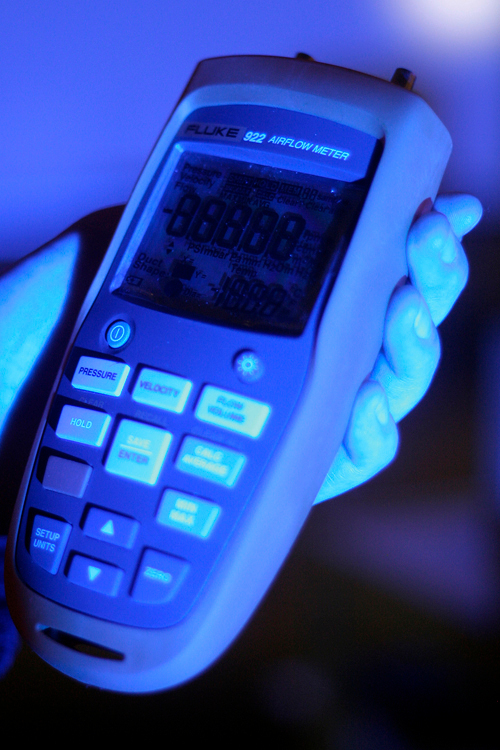
Students will make their way out to an on-campus house to practice and to test equipment used in the audits. That equipment was purchased for about $7,500 from National Grid. The equipment includes gas-leak detectors, hand tools and a digital thermometer.
The biggest-ticket item was a “blower door,” a $3,000 fan system that fills and seals a doorframe and blows air into a home. “Using that – and I don’t know exactly how they do it – they can test for air leakages in the house and find out where they are,” Roberts said.
National Grid also paid $6,000 for the course curriculum, licensed from the New York State Energy Research and Development Authority. To offer the course, CCRI had to become a BPI member, which includes a $250 annual fee.
For contractors that are already conducting energy audits in Rhode Island – National Grid is requiring the certification, but it’s not a career requirement – it’s possible to skip the coursework and go right to the final exam, Roberts said. “We don’t have a BPI test scheduled yet, but we’ll be scheduling it toward the end of the training,” she said. “The cost is $225 per exam and there’s a field exam and a written exam.”
Currently, East Bay Community Action and other community organizations employ energy auditors and “we’ve started talking with them and I think the plan is for them is to come to this training and get certified,” Roberts said.
The training course will cost $650. Depending on the interest level – a minimum of eight students are needed to make it worth the cost – it’ll be offered as often as needed. At 36 hours, it will be run over a two-week period, with three classes each week.
A teacher hasn’t been hired, but “we’re looking at someone from the R.I. Office of Energy Resources who’s just retired,” Roberts said. “He’s very qualified, but he hasn’t committed yet.”
For National Grid, mandating the certification is a way to ensure homeowner safety, Curran said.
Under the EnergyWise program, the energy provider offers lighting-system upgrades, insulation and air-sealing work. The course, which is just the first level of a multicourse training, will allow the company to assess that work. “The major goal for the BPI certification is to have our work inspected,” she said. “That was one of the major factors in our deciding to go ahead with the BPI – it’s an ongoing training.”
Curran, who described it as a “lifelong” process, said required follow-up coursework will be offered eventually at CCRI, “when the need arises.” She said National Grid also employs inspectors that will randomly check work done by new contractors.
National Grid now has just a few energy-audit contractors working in Rhode Island. They were certified in other states. But it’s an expanding field and one where National Grid intends to grow, Curran said.
“We’ve had such an influx of people requesting energy audit and weatherization measures – not only in Rhode Island, but throughout our footprint – that we know the demand is there,” she added. “The need is there, now more than ever. They have a waiting list now.”
Community colleges in New York State now offer the certification. National Grid is also in discussions with community colleges in Massachusetts and New Hampshire to create similar programs, Curran said. “Community colleges just seem like a natural fit for this program,” she said. •