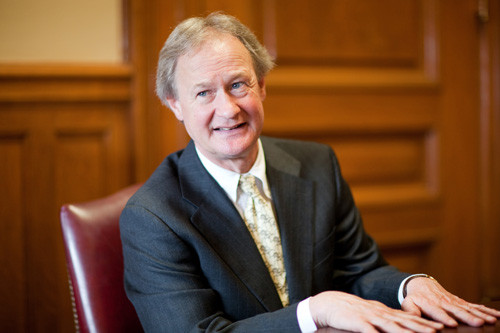
Gov. Lincoln D. Chafee’s first budget proposal covers a lot of ground.
The $7.66 billion tax-and-spending plan not only addresses unfunded-liability pension concerns, education funding, transportation-infrastructure borrowing and a $331 million projected deficit, it contains proposals that could have far-reaching effects on local businesses. Chafee wants to broaden and lower the state’s 7 percent sales tax, cut the 9 percent corporate tax rate, restructure the minimum corporate tax, and add a combined tax reporting component.
Chafee and his policy director, Brian Daniels, recently spoke with Providence Business News about the budget plan, his outlook on economic development and proposals to expand gambling in the state.
PBN: There are a lot of moving parts in your inaugural budget submission. What were your priorities in assembling it?
CHAFEE: The priorities were to close the $295 million deficit [initially projected in fiscal year 2012], to invest in our schools, and to look at some of the structural problems and to address them to the best of our ability. What I’m most proud of in the budget is the borrowing in DOT. During the transition, Director [Michael] Lewis showed how we have to borrow every two years for our 20 percent match to the federal 80 percent. That doesn’t make any sense – you borrow every two years. How much are we paying in interest a year on that borrowing? $43 million. This is insanity. We do address that. And also the auditor general during the campaign shared with us the looming municipal pension funds, disasters looming on the horizon. And we addressed that with our [Municipal Accountability Stability and Transparency fund, or MAST].
PBN: But is what we’re really doing taking general revenue and plugging the holes of those municipal pensions? If that municipality is meeting its pension obligations and the state is matching it and giving money to help with other budget problems, that’s money that’s going to the pension. It seems that it doesn’t address the long-term problems of unsustainable pensions.
CHAFEE: I disagree. Some of the city councils are not putting in their annual required contributions. They’re just not doing it. And that can’t continue because it’s eventually going to end up on our doorstep, like Central Falls.
Rhode Island's Market Has Changed. Developers, Builders, Investors and Sellers Must Change With It.
By Emilio DiSpirito IV License Partner | Engel & Völkers Oceanside Leader | The DiSpirito…
Learn More
PBN: But what about forcing the municipalities to make changes in the pension obligations?
CHAFEE: I don’t want to micromanage every city and town, but I give them parameters. First of all, find out how bad your problem is, and then we’ll help you get to where you need to be. … I was adamant that these are icebergs on the horizon that I don’t want to hit.
PBN: Some observers have said the spending cuts in your budget proposal didn’t go far enough. How do you respond?
CHAFEE: The difficulty here was that [former] Gov. [Donald L.] Carcieri was adamant about no revenue increases. He did not want to address the revenue side of the equation. So all the tough decisions were on the expenditure side, and there wasn’t a whole lot left. Of course I didn’t want to raise taxes. But there wasn’t a lot left, and in these tough times, the social programs – day care to get people to work – they’re going to keep raising that federal poverty level so that it’s harder and harder to be eligible for poor people to put their child in day care so they can work, at the times we most need these programs. There were difficult decisions.
PBN: How much discussion did you have with legislative leaders on your budget plan? Any sense of commitment from them?
CHAFEE: I certainly saw [Gov. Carcieri’s] budgets being taken by the General Assembly to the recycling bin and dropped in, and the House Finance Committee draft their own budget. I did not want that to happen. Along the steps of writing the budget, we would bounce ideas off legislative leaders.
PBN: On your sales tax proposals, for instance, did you feel like you got some commitments?
CHAFEE: I wouldn’t say commitments. But at least an understanding and knowledge of where we’re going. … The parameters of broadening and lower [the sales tax] and sending a message that if Rhode Island is going to be designated just by that number — the corporate tax of 9 percent of sales tax number of 7 percent, never mind the fine print of exemptions and the tax credits – we’re going to lower it.
PBN: What parts of this budget proposal would you go to bat for? What do you really want to survive the legislative process?
CHAFEE: I think it’s been unfair that Rhode Island has been designated as this tax hell, based just on the numbers and not the fine print. “Seven percent is a high number, therefore you are tax hell.” But when you sift through the exemptions, we’re really about the middle of the country. Everything is exempt. If that’s the game, let’s play it and let’s drive that number down because it’s a perception game. I want the perception to be positive. Also, when you broaden and lower the sales tax, you create a steadier stream of revenue in the ups and downs of the economy.
PBN: Connecticut and Massachusetts don’t tax many services right now. Under your proposal to tax more services, Rhode Island will be an outlier in that way.
CHAFEE: Yes. But we were careful in addressing those items that are difficult to cross your border to get the services. People are going to criticize, where are the accountants and lawyers [in the list of taxable services]? But you can go across your border too easily for that. Whereas your landscaper or your nail-polish salon, you’re not going to drive.
PBN: There has been discussion about “pyramiding,” where business-to-business services are taxed, and that cost is passed to the consumer, who will also be taxed. Did you calculate the potential negative economic impacts of that?
CHAFEE: We didn’t have time for studies. We didn’t have that luxury.
PBN: If all these pieces are so interconnected, will it be difficult to actually make compromise in different areas, because if you pull out one piece of the equation, the whole thing is skewed?
CHAFEE: I would hope that the pieces all stay connected. I did the best I could at putting together a document. Or we did.
DANIELS: We do understand the implications of pulling one part out. And as we have conversations with the House and Senate finance committees and fiscal staff, we want to make sure everybody understands the importance of doing everything as a package as opposed to picking out the parts they like. Corporate tax is a good example. There are the jobs-development tax credit, combined reporting, lowering the corporate minimum and the corporate rate – those help reinforce each other and create a better climate and fair corporate tax structure. But if you pull one part out, it’s harder to get the other things done now or in the future.
PBN: Let’s talk about the R.I. Economic Development Corporation and how you see its role. You proposed a 15 percent cut in its direct state appropriation. Do you see the primary purpose of this agency as generating new jobs in the state?
CHAFEE: Yes, but I do believe that as a government, we don’t create jobs. We create a climate that encourages job growth, and that’s what we’re going to try to do. Part of that is fewer deals, fewer special programs for individual companies. That worked well for me as mayor [of Warwick].
PBN: So you see the EDC of the past as just a conduit for special deals?
CHAFEE: Yes. The Verrecchia report supported that – fragmented, disjointed, lacking focus. I want to change that. Fewer deals, more focus, and what Brian Moynihan from Bank of America told the [Greater] Providence Chamber of Commerce – certainty. He must have used the word “certainty” 10 times [when he spoke at a Chamber event last year]. Businesses want certainty, not another deal coming to [a] competitor.
PBN: The EDC will start the next budget year [under Chafee’s plan] with program cuts, salary cuts – what should they be cutting out, from your prospective? PBN: The approach of the EDC of years past in trying to lure businesses into the state is a focus that doesn’t work? PBN: Legislation was submitted earlier this month proposing a statewide vote to change the state constitution to allow privately owned casinos. Carcieri vetoed a similar bill last year. Where do you stand on the matter? PBN: So what are the two or three questions that you think we don’t have answers for yet, in terms of what’s best for Rhode Island? PBN: Curt Schilling’s 38 Studios recently demonstrated its first video game. Are you monitoring 38 Studios and its relocation here? PBN: You’ve been highly critical of the loan guarantee approved by the EDC. Will you be at the ribbon-cutting when the company opens its new headquarters in Providence in a few months?
CHAFEE: The TD Bank [project status designation that allowed tax breaks in exchange for job creation] that was passed at the last EDC board meeting [is one example]. One of my appointments [to the board, Stanley Weiss] who hadn’t been confirmed yet said, “What are we doing this for?” He’s right. It was too far down the commitment to TD Bank to renege, but that’s exactly the kind of change I want to make. I want to retain some flexibility and not be too rigid about job growth. But it’s an overall philosophy and it worked well for me as mayor.
CHAFEE: Yes, that’s right. The experts agree with me. We had a presentation at the National Governors Association by a Harvard Business School professor, Michael Porter, saying exactly that: You’re better off as governors investing in education and infrastructure than special deals.
As a senator I sat at this table when Gov. Carcieri called in legislative members to talk about the tax breaks for GTECH. I don’t want to look back, but too much of that happens. Do we want the status quo in Rhode Island? I don’t think so.
CHAFEE: The Lottery Commission wanted to do a study because of what’s happening in Massachusetts. The R.I. Department of Business Regulation, the Lottery Commission and other entities are getting together to study what might happen if Massachusetts goes to table games. At the same time, the Narragansett Indians are interested in what might occur. So we’re proceeding … [a study] was being discussed, but I want to see how much it’s going to cost before I agree to do it.
CHAFEE: Who would use table games? If the take from Lincoln is higher than what the tribe by federal law will get, what does that mean? More people going because the odds are better? The state’s take is less so more people go because they’re winning more?
The elements are Lincoln wants table games. Neither the tribe nor the state want to build a casino in Charlestown – that doesn’t work for anybody. Everybody has some interest here. Can we pull them all together?
CHAFEE: I pray, hoping it works, because I have $75 million in state money in there.
CHAFEE: Yes, it’s time – Keith Stokes is the EDC director, he was involved in it – we move on. When the first dollar went out the door, we were on the hook. It’s time to get behind it and hope it does well. •