On paper, Michael J. Denci is the owner of Anchor Color and Chemical LLC, a small East Greenwich chemical supplier he founded seven years ago.
But at the urging of a circle of fellow business owners, Denci recently penned a mission statement for Anchor “expressing God’s ownership of the business.”
Denci also credits the same peer group with suggesting other religious-minded changes that he said have altered the course of his growing company.
“It’s affected the way we’re doing business and the outlook of the whole organization in the long-term,” he explained.
Denci is a member of the C12 Group, a national business-leadership development organization that established its first chapter in southern New England less than a year ago.
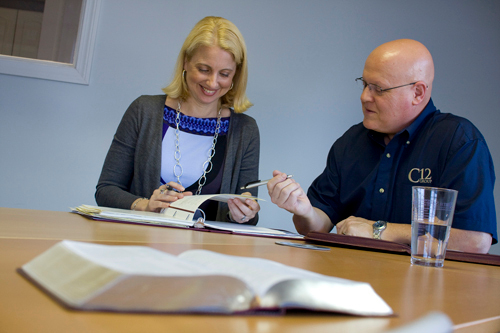
The for-profit C12 operates similarly to business coaching and advisory groups such as Vistage and CEO Roundtable, except for this: C12 is a Christian business group where members aren’t shy about using the Bible as sort of a business manual.
They say they use their Christian values as an ethical guide in everything from personnel matters to negotiations.
“I see that the application of what Jesus did, those same principles, can be used in my business every day,” said C12 member Jim Nooney, president of North Kingstown-based Nooney Controls Corp.
C12 got its start in Central Florida in 1992, and it took hold in the Bible Belt states of the South and Midwest. Now the organization’s presence extends to about 700 members across 23 states.
Rick Ferris, chairman of the local chapter and a former business owner himself, said the group is gathering momentum in the Northeast. Membership in his group numbers nine now, with four others contemplating joining.
Members pay a monthly fee ranging from $575 to more than $1,000, depending on the size of the member’s company. The fee allows them to participate in a full-day meeting each month, plus one-on-one consultations with the group leader.
For what they lack in numbers now, the local C12 Group makes up in enthusiasm, Ferris said.
Religious-minded executives in the area have so far “tended to be dedicated when they discover something like C12,” he said.
Michael Morizio, CEO of Westminster, Mass.-based software company ScoutAdvisor Corp., was flying to monthly C12 meeting in Tampa, Fla., before Ferris launched the local chapter.
“The level of transparency you have with these CEOs you don’t get anywhere else,” Morizio said.
Executives such as Nooney and Denci say having peers they can commiserate with about business problems and solutions has been invaluable.
“As a business owner and a leader of a small business, you don’t have anybody to bounce things off of,” Denci said.
As of now, members include partners in local law firms, accounting firms and the owner of a marketing company.
C12 members don’t see a dichotomy in espousing biblical principles while keeping a close eye on the bottom line. Wanting to make money differs from greed, they say.
“We’re looking at what’s best for God’s kingdom,” Denci said. “There’s nothing unbiblical about operating a business that is making a profit.”
According to figures provided by C12, members’ companies appear to have done well.
C12 said long-term members saw an average 22.1 percent annual growth in their companies’ profits between 1992 and 2006, while “blue chip” U.S. companies experienced an 8.5 percent annual increase between 1995 and 2005.
A higher power “is guiding me, in the way I treat my suppliers and my customers and employees,” Nooney said.
And local C12 members say they are not fearful that mixing their religious beliefs with business could offend or discourage customers and suppliers.
Denci said he constantly does business with people who have different beliefs, including a customer who is Jewish. They sometimes have friendly discussions about religion.
While the full-day monthly gatherings of the local C12 Group start with devotionals and prayers for members’ businesses, meetings go beyond Christianity.
Recent topics included implementing Lean operations, funding growth and conducting negotiations.
Then members discuss a business case study that typically involves the use of Christian values to solve a business dilemma. Then one group member is expected to give an in-depth, three-year history of their business.
At some point, members are free to seek advice from others on specific business challenges they are facing.
Denci, for instance, has been given advice on buying out his business partner and hiring a new salesperson. At the same time, he said he was “challenged” to write the mission statement that said God has ownership of the business.
Nooney said he consulted with the group about a conflict with an employee and about how far to assert religious beliefs in the workplace. His fellow member told him he shouldn’t pretend to be something he’s not.
“You shouldn’t hide from your employees why you think the company is solid,” Nooney said. •