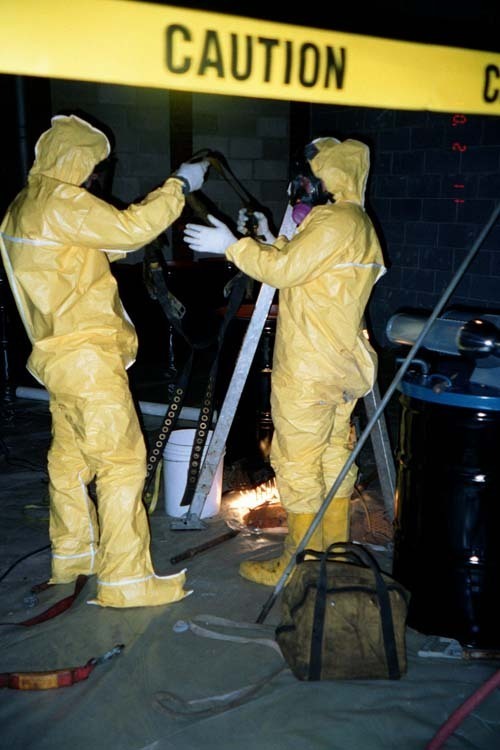
In recent weeks, field technicians for Marshall Environmental Group Inc. removed a 2,000-gallon tank unearthed at a construction site between the U.S. Post Office and the town Police Department in West Warwick, hauled away 70 drums of grit that had been used to sandblast a bridge, and drained oil from the cylinders of 28 hydraulic car lifts abandoned at a former car dealership in Pawtucket.
The jobs are typical of the daily work done by Marshall Environmental, a Warwick-based hazardous waste contractor that responds rapidly to manage unexpected environmental hazards at construction sites. The company works closely with many commercial real estate developers in Rhode Island and throughout the Northeast.
Niche environmental clean-up contractors like Marshal Environmental are in high demand by developers as they rehabilitate former mills and factories and raze old buildings to put up new ones, said Peter Marshall, the company’s founder and CEO.
“Our specialty is to come in, identify what the problem is, perform the project and be in and out as soon as possible,” he said.
Clients of Marshall Environmental in Rhode Island include Conley’s Wharf, Brown University, Foundry Corp., Carpionato Properties/Greene Construction, Alexion Pharmaceuticals, Pasquazzi Bros., Bond Bros., E.W. Audet, Stonestreet Construction, Ocean State Steel, the R.I. Convention Center, Blackstone Consulting and Marshall Properties, among many other real estate developers, corporations, municipalities and agencies.
The company employs four full-time field technicians, and brings in up to 22 subcontractors for large jobs, all of whom are certified by the U.S. Department of Labor’s Occupational Safety and Health Administration (OSHA). Its services include transportation of hazardous waste, decontamination of industrial facilities, removal or sealing of underground containers and virtually every other aspect of environmental remediation.
Marshall, who has worked in the environmental-cleanup industry for 20 years and launched his own company four years ago, works closely with the R.I. Department of Environmental Management and private real estate consultants on most of its large jobs.
As an example, the company was recently hired by a real estate consultant working with the City of Pawtucket, to turn an eight-acre field on the site of a former steel-manufacturing plant into public soccer fields.
Called in after two years of negotiations between the city and the DEM, Marshall Environmental worked under the watchful eye of state environmental regulators as it removed contaminated soil and oil that had been sitting for decades in groundwater below the field, then sealed the site with two layers of rubber liner before adding five feet of fresh soil on top.
Beyond Cash Donations: How New Forms of Giving Are Transforming Not-for-Profit Accounting
Evolving Funding Landscape for Not-for-Profits Not-for-profit organizations are being asked to do more with less,…
Learn More
In many cases, his company’s technicians don’t know the extent of a cleanup until they are literally in the middle of it, Marshall said.
Recently, the company was called in to remove soil and water from underneath a parking lot that had been built atop a former oil tank farm in Chelsea, Mass., where oil was being discharged into the local water treatment system.
“The moment that we stuck the shovel in the ground with the excavator, it started oozing black oil,” Marshall recalled. “So we had to dig a hole 20 feet by 20 feet by 15 feet deep, and we pumped out like 22,000 gallons in one day.”
Marshall Environmental’s technicians removed 50 gallons of water a minute for eight hours. Then they hauled away five large containers of oil, helped another team of contractors install an oil-water separator in the hole, and closed it back up, he said.
Not surprisingly, technicians working in the field often get a bit dirty on the job. Marshall said he has considered sending the producers of the Discovery Channel show “Dirty Jobs” a video of his technicians cleaning out an underground container filled with No. 6 oil – a grade of oil with the viscosity and color of molasses, once used to heat large mills.
“When you clean out a tank that has No.6 oil in it and you put your yellow suits on – these poor kids, they come out, they’re nothing but black,” Marshall said, laughing. “They look like the Creature from the Black Lagoon.” •