When Newport Federal Savings Bank revamped its Web site last May, one of the services placed front and center was online banking – a service the bank says is used by about 40 percent of its customers.
But online banking is already old news at Newport Fed. The six-branch institution has started offering mobile banking, which gives customers the ability to conduct some banking business on their cell phones. That makes Newport Fed a pioneer – only about 4 percent of U.S. banks are expected to offer mobile banking this year, although the number is growing quickly, according to Aite Group, a financial services research firm.
“You think of the younger generation – that’s what they do,” said Susan Ouellet, Newport Fed’s marketing officer. “My 16-year-old daughter works on her BlackBerry. So she’s never going to know what it’s like to get a paper check.”
Small banks and credit unions say online banking is no longer just an option – for many of them, it is an imperative if they hope to compete successfully with the nation’s largest financial institutions and attract younger customers.
More than 50 million U.S. households used online banking in 2008, and 20 percent of them did all of their banking electronically, according to the Web research firm comScore. Another financial services research group, Javelin Strategy & Research, predicts the total will reach 83 million households by 2013.
Mark Schwanhausser, a research analyst at Javelin, said small banks and credit unions have to stay current on technology if they hope to attract customers from the millennial generation.
“This is the first generation of Americans born and raised in the Digital era, and there is no question that they will snub any business that fails to give them robust services online and through their mobile devices,” Schwanhausser wrote last month. “Failing to anticipate that reality is likely to make your bank or credit union as outmoded as [the] rotary-dial phone.”
Nearly 40 percent of online banking is dominated by just three mega-banks, according to Javelin: Bank of America, Wells Fargo and JPMorgan Chase. Bank of America says about 29 million people use its Web-based, online banking service. Yet Schwanhausser argues the present turmoil buffeting the big banks offers an opportunity for smaller competitors to shore up their own online and mobile services.
However, making those investments can be difficult for small institutions, particularly credit unions with between 700 and 1,000 members, said Robert Kimmett, senior vice president of the Credit Union Association of Rhode Island. Often they have a “more specialized, savings-and-lending culture, not a transaction culture,” he said. “Online banking is really all about transactions.”
Still, Kimmett said, as credit unions debate how to reach a new generation of customers, online banking and, to a lesser extent, mobile banking play key roles in the discussion. He also noted that “online banking is seen, from a marketing standpoint, as very sticky,” because it gets people to forge a deeper relationship with their bank, particularly when they use it for bill payments and other electronic transactions.
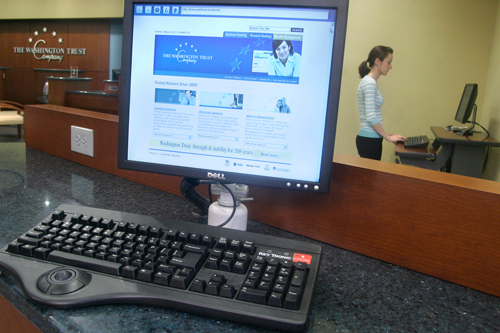
At The Washington Trust Co., online banking is prominent even at their new bricks-and-mortar Providence branch on Westminster Street, which has a self-service Internet kiosk in the lobby for customers to access their online banking account in person.
Lisia Quinlivan, vice president and e-commerce manager at Washington Trust, said the bank added more services to its online banking system last year to meet the demand. “It’s all about convenience, and the more that they can do through online banking without having to come into the branch or call our account information center, the more they can do freely on their own 24/7,” she said. “Those are the standard features, and that just continues to grow.”
Like many small banks, Washington Trust used to charge customers to use online banking, but eventually scrapped the fees to compete with the bigger banks offering it for free.
The question now for many banks is whether to invest in mobile banking. The number of Americans who used mobile banking grew from 400,000 in 2007 to 3.1 million in 2008, and is expected to reach 7 million this year, according to tech research firm ABI Research.
Bank of America has led the way, with 1.9 million active mobile banking users as of February – a nearly 50 percent increase from just four months earlier. New technology seems to be driving the adoption: Bank of America says 40 percent of its mobile-banking users access it on Apple’s iPhone and iPod Touch devices.
Quinlivan said Washington Trust is exploring mobile banking, weighing the opportunity against the cost.
Newport Fed, on the other hand, added mobile banking not long after it became available from COCC and Online Resources Corp., the vendors that manage the bank’s online services.
“Newport Fed’s not afraid to take risks,” said marketing officer Ouellet. “It was the next thing – they were offering it, we were on board. You cannot watch Bank of America commercials and [fail to] do it.” •