The pieces are as disparate as you could imagine: The 25-acre American Locomotive Works industrial complex, being reinvented as commercial, retail and residential space. The Steel Yard, a no-frills, nonprofit metalworking shop run by artists and artisans.
The Wolcott Eco-Office, a former electronic warehouse turned into living space and an office that is Rhode Island’s first “Net-Zero” environment, heated, cooled and powered by the sun. And farther down the Woonasquatucket River, the Riverside Townhomes, 51 affordable housing units looking out onto a brand-new park on the waterfront.
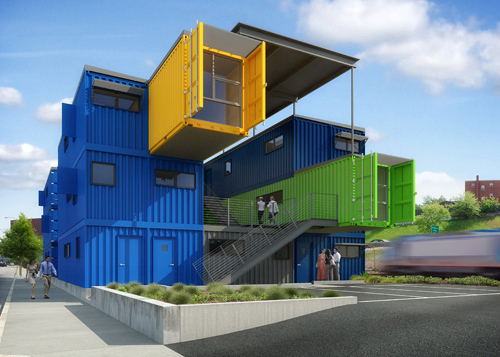
There are artist enclaves – The Hive, The Dirt Palace – and smaller, but still substantial mill redevelopments, such as The Plant and Rising Sun Mills. There’s Eagle Square, almost all new construction. And soon there will be The Box Office, built out of recycled shipping containers.
On a city planner’s map, these and a dozen or more additional projects that have sprung up in the Olneyville and Valley sections of Providence look like individual dots in an intractably big area.
And while the massive ALCO project, on Valley Street, is hard to miss, its bright sign visible from a distance, if you’ve never been to the Eco-Office, The Hive or The Steel Yard, you may have no idea where they are. Even Riverside Park is off many local residents’ radar screens.
Yet if you ask people familiar with the area’s redevelopment in recent years, including city leaders as well as outsiders who’ve invested money and resources in the community, they will say the dots really are getting connected – and that Olneyville is a prime success story.
“We think of Olneyville as a model for what can happen in other places,” says Barbara Fields, executive director of the Local Initiatives Support Corp.’s Rhode Island office. The latter is leading a major project with Olneyville Housing Corp., which developed the Riverside project, to promote sustainable revitalization by involving people from all sectors in the community.
The project is bringing together residents, businesses, nonprofits, police and many others to craft a common agenda. But even as that work proceeds, Fields adds, “development continues, and you have what I think is one of the more remarkable achievements in the city, in this state and in the country.”
The latter is where The Steel Yard is, and the adjacent Monohasset Mill, an affordable live-work space for artists. It’s also where ALCO is taking shape, home to the R.I. Economic Development Corporation and soon to United Natural Foods, expected in September.
John T. Jacobson, developer of the Eco-Office, where he also lives, can look out his hilltop window onto ALCO and the riverfront beyond it. Up the hills off Valley Street, there are houses and small businesses. Then, farther down, is Olneyville proper, with a fair amount of development on Valley Street, though far less on Harris and Manton Avenues.
Forget the Jewelry District, he says, looking over a map of his neighborhood: “There’s more going on from here to here, in terms of creative capital, artists, restaurants, music, and also more green building, than anywhere else in the state.”
In some cases, one site’s success has come at another’s expense: Eagle Square, for example, which had started to struggle, managed to get Price Rite to take a space vacated by Shaw’s Supermarkets. But now the former Price Rite store at Olneyville Square sits empty.
The latter, says Robert Azar, principal planner for the city, is “a huge development opportunity.” In fact, he says, “we’ve always seen a lot of potential for Olneyville Square to be a very lively place, almost like another downtown.” So far, however, there are no takers.
The neighborhood is also not what it was just a year ago. On one hand, there’s still plenty happening – The Box Office, for example, is a new project. Yet since the state killed off its historic tax credit, investment in mill projects across Rhode Island has slowed, and this area is no exception. Struever Bros. Eccles & Rouse in particular has taken a huge hit, not just from the economy and what some see as having overextended itself in this market. As a result, ALCO is now proceeding slowly, and Azar doesn’t expect the site to ever look quite as originally planned.
“We lose people every month who are forced to move to other parts of the city because of rising costs,” says Shannah Kurland, strategy and development coordinator for the group. “We consider people more important that development projects, and the people are being more dispersed than ever.”
Foreclosures and related evictions are also taking a big toll, Azar says, and the neighborhood is clearly “struggling.” Yet some see new opportunities in that, if it’s handled well.
Jacobson says the best projects for Olneyville right now are ones that don’t require huge tax breaks and other government incentives. In this market, he says, “cash is king right now, so you can acquire things that you couldn’t do before.” But the key, he adds, is to have solid, viable projects, nothing speculative. “You have to be the end user.”
Insiders can rattle off quite a few projects like those on the horizon, some closer than others to fruition. Community-development corporations, meanwhile, especially Olneyville Housing, keep working aggressively, backed by several partners. Azar says that while he expects growth to continue at a slower rate, “I think in general, there are a lot of positive signs” that many still-untapped opportunities will be realized.
Clay Rockefeller, co-founder of The Steel Yard and a resident of Monohasset Mill, says one of the real tests will be whether all of these projects create more jobs for local residents, which is the “bottom-line” priority for many people. It would help, he says, if in light of the economic downturn, everyone in Olneyville could “regroup” and focus on the common good.
“There is no doubt in my mind,” he says, “that we are facing unprecedented challenges.” •