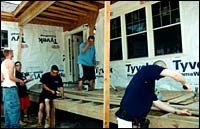
Technical Center work on an energy
lean home. (Al Alexio)
The construction industry has grudgingly turned its attention to energy efficiency in recent years.
New building techniques that improve insulation, enhance air quality and use fewer materials are slowly catching on. Still, the industry has a long way to go.
ISO 9001:2026: A Practical Opportunity to Build for What’s Next
For Rhode Island manufacturers, ISO 9001 has been much more than a certificate on the…
Learn More
“There is a huge lack of understanding of energy efficiency in the (construction) industry,” said Jerry Hanna, Energy Star new-homes project manager for Narragansett Electric. “A lot of contractors look at energy efficiency as another thing they have to do, another hurdle.”
But the hope is that the next generation of Rhode Island contractors won’t have the same aversion to energy efficiency.
An innovative new class at Woonsocket Area Career and Technical Center is working toward that end. About 45 of the school’s students have been helping build an energy-lean home in Woonsocket since last fall. While learning basic construction skills, students also are taught energy-conserving construction technologies.
Walls are built to maximize insulation space while leaving out unneeded headers and studs. Saw cuts around pipes and wires have been filled with low-expansion foam. Engineered lumber is used, which is more flexible and stronger than standard lumber and composed of 40 percent less old-growth wood.
“In five years, when some of these kids are starting their own companies, these energy-efficient techniques will be old hat to them,” said Charlie Myers, a teacher at WACTC and creator of the construction-technology class.
The home is being built to specifications outlined by Energy Star, a federal energy-conservation program endorsed by a number of utilities.
Homes built under Energy Star standards use 30 percent less energy than typical homes, according to the Environmental Protection Agency. Although building to Energy Star specs adds roughly $1,500 to construction cost of a single-family home, the extra costs are more than offset by energy savings, according to the EPA.
And builders in Rhode Island can take advantage of financial incentives of up to $2,500 through the Public Utilities Commission. But as few as 5 percent of homes in the state are built using Energy Star guidelines, Hanna estimates.
Myers said his students have been taught the importance of air sealing, which is a key element of the Energy Star program.
“Most contractors will say a home should be built with enough holes to let it breathe,” Myers said. “But under Energy Star, the home is built airtight, with a ventilation system that mechanically moves the air.”
Students in Myers’ class calculate the number of cubic feet in the home and set the vent’s timer so it recycles the home’s air every three hours, which is an Energy Star standard.
The result: better air quality. Occupants of Energy Star homes suffer from fewer allergies, colds and headaches, according to the EPA.
The city of Woonsocket donated the land for the house, which will be sold to low-income, first-time homebuyers by the Woonsocket Neighborhood Development Corp. The Conservation Services Group, which administers the Energy Star Homes program in New England, provided technical expertise during construction. And Narragansett electric provided $24,000 for safety equipment, transportation and a construction loan.
WACTC students will host an open house at 6 p.m. Wednesday at the school, 400 Aylsworth Ave. in Woonsocket.
Energy Star officials have said the Woonsocket course should serve as a prototype for energy-efficiency courses at vocational schools across Rhode Island. Several schools are interested, Hanna said, although it might prove difficult to duplicate the public-private partnership needed to create new programs.
Myers has aggressive plans for the new program. He said he hopes to have students someday build a “zero energy” house, relying solely on alternative power sources such as photovoltaic roofing shingles, which convert sunlight into electricity.