
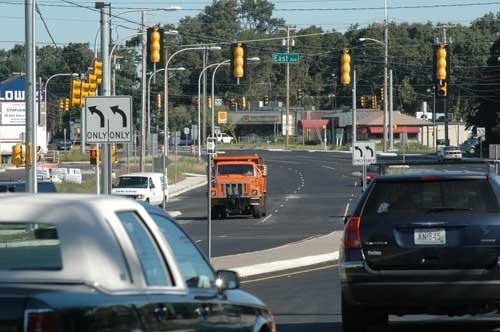
When FM Global proposed building a $60 million headquarters in Johnston, it knew that it would be signing on to fund another project: a $2 million widening of Atwood Avenue to accommodate the traffic it would create.
At the Central Avenue headquarters – where the company broke ground April 10 – Atwood Avenue will need to be widened from one lane to two lanes in each direction, spokesman Steve Zenofsky said last week.
“We had to look at – if we were going to stay here, stay in Rhode Island and build our headquarters – how we would make it as easy as possible for our employees to get to work and to get home each night to their families,” Zenofsky said.
About 900 employees will commute to the new office each day, he added.
Carpionato Properties Inc. – which is building the 875,000-square-foot, $70 million Stonehill Marketplace retail center just down Atwood Avenue – will pay a similar price to widen a connecting stretch of the road, Carpionato Senior Vice President Kelly Coates said last week.
For the R.I. Department of Transportation (DOT), there is no set formula for determining how much a developer will have to invest in infrastructure near their developments, said acting Chief of Design Robert Smith. Instead, there’s a simple guideline: a developer will pay for whatever improvements are be needed to accommodate the traffic they bring to the area.
“But most permits that we get here are for very minimal actual improvements to the road,” Smith said in an interview last week. “Most [projects] on their own aren’t going to require that the road be updated.”
So every development is evaluated differently and developers are required to pay for a range of infrastructure improvements: from widening roads to adding traffic signals to adding new street signs, he said. Most upgrades to public infrastructure, however, costs less than $100,000 for developers.
But during each of the last three years a “big” development in Rhode Island has paid for large-scale infrastructure changes, Smith said. That’s been bumping up the private sector’s investment in state roads, he added.
The two most recent projects have been Fidelity Investment’s new $200 million building in Smithfield and the $220 million expansion of Twin River, for which the company paid more than $2 million for local infrastructure improvements – including the addition of a traffic circle – in Lincoln, Smith said.
But there are other ways that a developer can “share” costs with the state, DOT spokesman Charles St. Martin said.
In Warwick, Carpionato will invest about $500,000 in improvements on top of the DOT’s $6.5 million reconstruction of the Route 5 and Route 113 intersection.
There, Carpionato’s involvement had pre-empted the state’s planning process, Coates said. After purchasing the former Apex store property – now a Lowe’s – Carpionato paid for the traffic and signal designs for the nearby intersection, Coates said.
But “that roadway needed work, regardless of whether there was more development or not,” Smith added. That’s why Carpionato’s investment in the Warwick development is only 7.14 percent of the total $7 million for the project.
The need for road widening was different in Johnston, where that project is the result of FM Global and Carpionato’s developments. There, the two will be paying for all of the road improvements, Zenofsky said.
Smith said the system DOT uses today to determine a company’s investment was established during 1983, the same year that he started with the agency. For both big and small projects, the developer is required to file a Physical Alteration Permit.
For commercial developments, there’s a fee structure for those applications. Requests for curb cuts have fees that range from $1,000 to $3,000, depending on the size of the building they will accommodate, according to DOT regulations published in February 2005. And a request for a traffic light addition calls for a $5,000 fee.
Other than the ease of travel for employees, there are other reasons why a business might want to invest in local infrastructure. A 2001 study completed by the National Cooperative Highway Research Program showed that the annual increase in business costs for a “region” could range from $20 million to more than $1 billion if traffic congestion is a prevalent in the area.
There seems to be the mentality that Rhode Island’s budget deficit will cause the DOT to cut back on some projects – “We’re in a new world, a world where the DOT doesn’t have any money,” Coates said.
Still, for FM Global, the widening of the road likely will be a complex project. Along with earning the needed DOT approval before starting, the company has to present plans to the city and move utility poles that now line the edge of the property, Zenofsky said.
Meanwhile, the town is still dealing with allegations that it did not allow enough public input during the design review of FM Global’s new headquarters. The company’s current landlord – it has a lease with Capital Lease Funding Inc. at a nearby building until July 2009 – has alleged that it was not given time to comment on possible runoff and traffic congestion issues at the new site. The Johnston Planning Department, which has been reviewing the site plans since a court-mandated public hearing in early August, is expected to announce its decision on those allegations tomorrow night at a town planning board meeting.
But, despite the concerns raised by CapLease, construction has been continuing on the site and the project is on schedule for completion by next July, Zenofsky said, adding, “It’s tight, but we’re pushing along.”
Meanwhile, the total projected cost for the half-mile road that Carpionato has agreed to widen has not been finalized, but “it’s a good-sized project,” Smith said.
There will be lingering costs for Carpionato in Warwick, also. On Route 5, where a median and guardrail had separated traffic, there now will be a planted median strip.
The DOT “has picked out the landscaping that’s going to go in the center islands,” Coates said, “and we’ve agreed to maintain that landscaping … We have a vested interest in that whole area. Improvements in traffic improve the value of the surrounding properties.” •











With variable speeds on main arterial roads and Liquid Flow Traffic Intersections traffic jams, gridlock and congestion cannot happen.
These intersections at http://www.ubtsc.com.au when placed into the road mosaic will allow all motorists to cross town in peak traffic, faster, safer, without stopping at a single intersection while reducing fuel costs and pollution.
You just have to build them.
But none of this will happen without the help of people who want to give the country a roads infrastructure that works.
Today’s road system” is broke and it needs fixing” but not with outdated road intersections that stop and slow traffic flow and adding extra lanes that just makes the mobile car park bigger.
To fix the problem needs investment and if that’s the kind of investment it will take, that’s the kind of investment that must be made.
Then you can build a traffic system that finally and completely eliminates all jams gridlock and congestion.
Perhaps a staff reporter would care to feature an article that explores the benefits to all with a roads infrastructure that cannot fail and gives all vehicles the opportunity to cross town in peak traffic without ever stopping at a single intersection. What saving would the economy get from this infrastructure?
The following is a commentary submitted on behalf of Paul H. McDowell,Chairman and Chief Executive Officer,CapLease,Inc. and Gary Landriau,Senior Vice President,CapLease. CapLease is a business owner on Atwood Avenue, concerned about unmanageable increases in traffic.
—————————————————-
CapLease, which owns the Johnston building that is the current headquarters of FM Global, understands that change is inevitable, particularly in business. We have known for several months that FM Global will leave our building in 2009. Quite naturally, we have begun the work of finding a new tenant for the building, which may result in bringing a new, major employer to Johnston.
However, before that happens, we must make certain that traffic will be able to move on Atwood Avenue after all the planned development is complete. Unfortunately, current proposals before the Johnston Planning Board at Stonehill Market and the FM Global site practically guarantee gridlock unless we work together to solve these traffic problems now.
Everyone – CapLease, FM Global, each company?s traffic experts and the Town – agrees that Atwood Avenue must be widened and substantially upgraded to accommodate the significant new development there. There are five intersections with traffic lights along Atwood between Central Avenue and Route 6. FM Global?s 2008 traffic study determined that when the pending projects are completed, three intersections would earn a Level of Service rating of ?D?. The remaining two intersections will rate an ?F? – this on an A through F scale – ?F? being short for Failure.
The Johnston Planning Board says that a rating below ?C? is unacceptable for these intersections. However, the Planning Board so far has imposed no binding, meaningful conditions on any of the projects proposed for Atwood in order to attain the rating that local taxpayers deserve. This approach is unheard of for a project like the one proposed by FM Global. It is a prescription for disaster on Atwood Avenue ? for both residents and businesses.
In addressing this issue, we have three simple questions: Who will widen Atwood Avenue to the Route 6 Interchange? Where will the money to pay for this work come from? When will the work be finished?
FM Global has agreed to minor road improvements directly adjacent to their site. However, there?s much more to be done to prevent a traffic meltdown. The best approach, for residents and businesses alike, would be a written agreement between all parties – public and private ? for improvements approved by RI DOT all the way up Atwood Avenue to the Route 6 Interchange.
From there, one last step would be required to avoid gridlock ? a measure that is usually required in all significant development proposals across the United States. Quite simply, the Planning Board must make occupancy of any new development contingent upon completion of road improvements all the way to the Route 6 Interchange ? something everyone agrees is necessary. Johnston taxpayers will benefit from this approach, as will all Rhode Islanders who travel on Atwood Avenue.
This would not be the first time that the Johnston Planning Board has taken this approach. When the Board approved plans for a ?Big Box? retail development on Atwood Avenue in 2005, they also imposed 24 conditions on that approval. In that matter, the Planning Board concluded that Atwood Avenue must be widened to five lanes beneath the overpass at Route 6, combined with significant improvements to the Route 6 ramps. These improvements were required even before FM Global announced plans for their large new building. Now, traffic experts all agree that an additional lane, for a total of six, will be required. The time to address these requirements is now. Clearly, preventing future gridlock on Atwood Avenue should be part of the price tag for new developments.
As a major investor in the Atwood Avenue corridor, CapLease would like to see a vibrant, efficient and passable street where thousands of people can work, shop, live and travel each day. Unfortunately, the plan on the table right now will make Atwood Avenue more like Bald Hill Road, Mineral Spring Avenue or Boston?s Southeast Expressway.
CapLease is relatively new to Rhode Island, but we?re sure that when it comes to traffic on Atwood Avenue, we can do much better than an ?F?.