
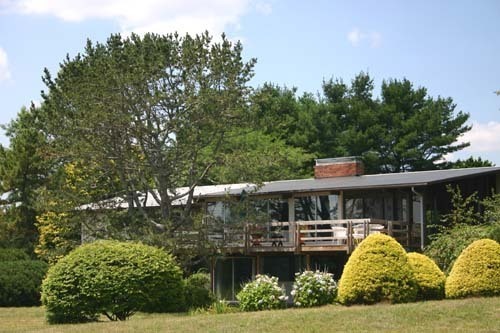
Although North Kingstown’s Richard Sawyer has trimmed almost 30 percent from the asking price for his 72-year-old, saltbox-style house – pushing the price well below the town’s valuation – he still can’t find a buyer.
Originally priced at about $1.2 million, the 1,583-square-foot, newly restored home on Poplar Point is now listed with Prudential Gammons Realty for about $850,000, Sawyer said last week. But since 2006 the town has valued the property at $967,800 – and more than 80 percent of that value is attributed to the .13 acre of waterfront land the house is on.
Sawyer’s situation is becoming increasingly common among waterfront homeowners in Rhode Island who are looking to sell.
“What we’re seeing in Rhode Island is that a lot of these property assessments were done before all the property values tanked,” Sawyer said.
Yet in Barrington, where a revaluation is now wrapping up, the assessed value of waterfront properties is actually on the rise, although preliminary results show that there’s been an approximately 2 percent drop in the town’s total property value since the last revaluation at the end of 2005.
“The preliminary numbers for Barrington are that 75 percent [of properties] went down and that 25 percent went up,” Assessor Michael R. Minardi said in an interview last week. The rise in value was for “mostly” waterfront property, he said, adding, “The waterfront properties appear to be maintaining their value, if not increasing.”
Many of the town’s waterfront residents have been up in arms about their revaluations. In the last month, public meetings have drawn hundreds of people who say their home values shouldn’t be rising in a down economy. Some are hoping for a cut in taxes, or to avoid an increase.
In Rhode Island, however, property taxes are based on a percentage – set by each municipality – of assessed property value. So if homeowners’ assessments drop, there is a chance (but certainly no guarantee) their taxes might also drop, provided the town doesn’t change its property tax rate, also called a mill rate. In the same way, if the assessment goes up, it is not certain the taxes will increase.
“Everyone gets up in arms when the property assessments are announced, but they should really wait until the mill rate gets announced,” said Paul A. Leys, president of the Rhode Island Association of Realtors. “It’s really a combination of the two – if the assessment goes up and the mill rate goes up, there’s really going to be hell to pay.”
Residential Properties Ltd. President and CEO Sally Lapides last week said she has been seeing selling prices at all levels fall across the state since October, when financial-market turmoil came to a head. “It was pretty strong prior to October,” she said. “And after the banks and Lehman Brothers and the stock market went awry, I think consumer confidence began to be lost.”
But Lapides, who is based in Providence, said she is now seeing an interest in older homes along the waterfront in Barrington. Potential buyers are looking at high land values, low home values and low selling prices as a positive. That’s because they intend to raze the current houses to make way for larger, more expensive houses, she said. “It turns out that the majority of the value is in the land” in those cases, she said.
But back in North Kingstown, Sawyer said he hasn’t seen much interest from buyers who are OK with paying a premium for land.
He paid $802,000 for his home in 2002 and put the house through a full interior renovation, including adding cherrywood floors. “Still, only about $170,000 is the structure itself,” he said. “One of the problems we face as waterfront-property owners is that people come in and say, ‘You expect me to pay $1 million for a 1,600-square-foot house?’ They’re expecting a modern McMansion, but you’re really paying for the location.”
At least one home on his street, Newport Avenue, has recently been razed for a multimillion-dollar new home, he said. For now, Sawyer is patiently waiting to see whether that new construction will again raise the assessment on his home.
The last revaluation on Sawyer’s property brought his assessed value up $200,000. North Kingstown is scheduled to do another revaluation by the end of 2009.
While the sale of million-dollar homes statewide remained strong in the beginning of 2008 – with only a 7.8 percent drop in volume during the first five months – year-end statistics show a much larger drop, according to Rhode Island Association of Realtors statistics. The number of $1 million-plus sales fell in 2008 by 27.4 percent, dropping to 138 homes for the year. And sales in the last quarter were worse, falling 40.9 percent from the year before.
This year sales of luxury homes continue to fall. As of March 16, there were 10 homes that sold in 2009 for more than $1 million in Rhode Island, according to statistics gathered last week by Residential Properties’ Chris Whirlow. That’s a drop from 2008’s 25 sales in the same period and 2007’s 30 sales in the same period.
The winter months are usually a slow time for residential real estate, “but this market has been particularly cautious,” Lapides said.
And luxury homes that are on the market seem to be staying there longer than other homes. Properties valued at more than $1 million on the market have been there for an average of 189 days, Whirlow said. The average for all single-family homes is now 140 days on the market.
But Lapides said she’s started to see the market “thawing” – with an increased interest in waterfront homes.
“I do think that in this particular market, waterfront is particularly valued,” she said. “I think a lot of people are now looking at waterfront and getting rid of their second home.”
Leys says that dynamic shouldn’t necessarily mean that waterfront home values should increase. Vision Appraisal Technology, the appraisal company that works with Barrington and 17 other Rhode Island municipalities, also just completed a revaluation in Newport.
Leys said 90 percent of homes in Newport lost value in that assessment, but many of the waterfront homes rose in value since the 2006 appraisal.
“I do question where Vision Appraisal is justifying their thinking,” he said. “Because that house that’s being assessed today – that probably is not going to sell for as much as it would have in 2006 at the height of the market.”
In Barrington, Vision Appraisal District Manager Stephen Ferreira said five waterfront property sales in the last two years played a “significant” role in heightening neighboring assessments. Because the total stock is so small – the five are among 40 homes on the waterfront valued at a minimum of $3 million each – their high selling prices made the difference. The five sold for between $3 million and $4.75 million, he said.
“Any appraisal, particularly residential property, has to rely on sales,” Ferreira said. “That’s the best indicator of market value. … Sales are the only true way to establish values in a community.”
But many waterfront residents argue that an assessment taken at the peak of the market – as in North Kingstown – and those taken just before or during a market drop – as in Barrington – don’t represent their actual home values.
Sawyer’s neighbor in North Kingstown, Mia DiBenedetto, said her valuation has dramatically increased over time.
“I’m paying an extraordinary amount of taxes,” she said. “And there is no way that my home is even close to this almost $1 million that these houses were appraised for at the peak of the market.” •












Rhode Island needs a property tax approach that does not penalize its resident homeowners for living in a desirable location. Changes in taxable valuation of owners’ primary residences should be capped for predictability. Upon an actual property sale, of course, property valuation would get reset. And secondary residences could be subject more to the ever-changing market forces. Lee County in Florida has such a system to protect its full-time residents.
Such a system would force more transparency on the towns, themselves, as they would have to actually raise tax rates to increase revenues, and not simply rely on the (usually rising) property values to solve their financial needs.
I see time and time again how long-time residents get squeezed out of their homes by market whims – and the associated tax hikes caused solely by valuation changes.
Now that we have a full-blown economic crisis on our hands, perhaps we can right the wrong we do to ourselves and stabilize the property taxes for in-state residents.
Thor Johnson
Saunderstown