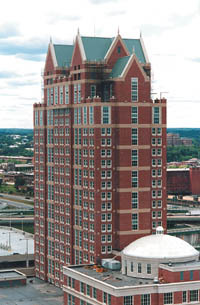
The Westin includes 364 rooms.
These must be the types of naysayers that James Hagan had in mind.
A headline in the Sept. 6, 1993, edition of Providence Business News reads, “Westin Hotel: Ill omen – or beacon of hope?”
For Leaders Who Don't Have Time to Get Sick
Top performers guard their calendars, delegate relentlessly and optimize every hour of the day. Health,…
Learn More
The accompanying article, which was written before the Westin Providence opened, said that city hotel operators vocally opposed the opening of the state-funded facility, fearing that the 364-room hotel only would add to a saturated market with a dwindling customer base.
Others were not sure if the construction
of the Rhode Island Convention Center, which included the Westin, was worth the risk.
“People oppose everything in the beginning,” said Hagan, then president of the Greater Providence Chamber of Commerce, in an interview last week. “They opposed the convention center, they opposed [Providence Place] mall, they opposed T.F. Green Airport – but when they’re done, they love them.”
Hagan, now retired, was an early supporter of the convention center and hotel project. But the critics did have reasons to be skeptical, most notably the project’s price tag: The 100,000-square-foot facility cost $354 million, financed with state-issued bonds that will take 30 years to pay off.
David DePetrillo, the state director of tourism, said Rhode Island took the risk because it was missing out on a market that has a multiplier effect.
“We were missing out on that whole area of business where people were drawn to a convention center and stayed in multiple hotels,” DePetrillo said.
But according to PBN articles from around the time of the center’s 1993 opening, people also feared that the state would not be able to draw conventions to Providence without a revitalization having taken place.
The city was considered dangerous. While the state was considering opening a hotel, others were closing. Commercial shopping was a shadow of what it had formerly been downtown.
James McCarvill, executive director of the Rhode Island Convention Center Authority, was quoted in PBN at the time as saying that he didn’t like to show potential clients around much.
“We don’t take them through downtown,” he told PBN. “We take them to the facilities and the hotels – they can represent a good picture.”
“You could throw a bowling ball down Westminster Street from one end to the other and hit nothing,” McCarvill said.
But Hagan said the whole idea behind the center – which was worked on throughout the 1980s by governors, philanthropic organizations and private organizations – was to aid the city’s renaissance.
While the convention center was supposed to be the way the state brought people in, the Westin was a key component for making the project successful. According to McCarvill, no developer wanted to build a hotel downtown.
“There wasn’t anybody out there who was willing to invest in downtown Providence, even with the convention center adjacent,” McCarvill said. “Without an anchor property that complemented the property, you wouldn’t have had the opportunity to do the kinds of events that got you noticed.”
The pairing of the convention center and the Westin Providence, Hagan said, has been successful at drawing people into the state and getting Rhode Island noticed. Along with other projects such as the relocation of the Providence River, Hagan said, the convention center project helped spur Providence’s renaissance.
“I really think it has been an engine for economic growth in the downtown area,” he said. “It really was a key part of that process.”
With the center and the hotel open for more than 12 years now, state officials have taken steps recently to assure that the center will remain vital and continue to reach new markets.
The Procaccianti Group last year completed the acquisition of the Westin Providence from the Convention Center Authority, paying $95 million for the facility. Procaccianti, a Cranston-based hotel ownership and construction company, announced plans to spend several million dollars upgrading the existing hotel, hoping to enhance its competitiveness.
As part of $80 million in pledged investments, the company also is constructing a 28-story mixed-use tower that will sit adjacent to the Westin. The building will add retail space, 200 more guest rooms, and 107 condominium units.
For McCarvill, the transaction signifies a transition in the market – “sort of like a phase two” that also may allow the state to get into bigger conventions and meetings markets.
“We’re not needed in that sector anymore,” he added, “The private sector wants to be in that sector.”
Also last year, the state negotiated an agreement with the city of Providence to purchase the Dunkin’ Donuts Center, a facility that will now fall under the jurisdiction of the Convention Center Authority. The move, once renovations are completed, is expected to help the convention center to draw bigger events.