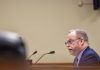
To panelists at Operation Clean Government forum this month, there’s no mystery why Rhode Island Republicans are rallying around their anti-corruption crusade.
“It’s the idea that we’d have less corruption if we had more competitive elections,” said Ross Cheit, a political science professor at Brown University and a member of the R.I. Ethics Commission.
“Absolute power, it has been said, tends to corrupt absolutely,” added opinion writer Ed Achorn, of The Providence Journal, who also served on the panel. “If legislators feel they can be defeated, they’ll act the right way.”
More than 150 people were on hand for the May 10 event at the University of Rhode Island, in South Kingstown, where they heard a half-dozen critics and observers of state government speak on the subject: “The General Assembly: Private Deals and Public Corruption.” Operation Clean Government, the reform group that organized the event, is officially non-partisan, but that didn’t stop the state Republican Party from seeking to drum up interest with advance e-mails to the press.
But if the Republicans were expecting a verbal thrashing of the Democrat-controlled General Assembly, they were disappointed. Several speakers sounded almost sympathetic.
“My appreciation for the improvements that have been made over the past 30 years is enormous,” said Kenneth Payne, a former policy advisor to the state Senate. He characterized Rhode Island lawmakers as no worse than those in other states. The difference, he said, is Rhode Island’s small size; people often feel they know state legislators, and thus corruption becomes a personal issue.
“The legislators are ridiculed as buffoons and crooks,” added Bill Rappleye, a longtime political reporter for WJAR-TV, NBC10 News. “That’s unfair. It doesn’t seem to me that envelopes of money are being passed around the Statehouse.”
Not everyone agreed. “Everything is not money in envelopes. … They may be part-time legislators, but they’re full-time crooks,” WPRO Radio talk host John DePetro said.
The topic was inspired in part by Operation Dollar Bill, the ongoing federal probe of Statehouse corruption. The investigation has resulted in guilty pleas from two Rhode Island politicians, former Sen. John Celona and former House Majority Leader Gerard Martineau. Both men were accused of cutting deals or accepting gifts in exchange for pushing legislation that benefited insurance giant Blue Cross & Blue Shield of Rhode Island and pharmacy chain CVS Caremark.
Arlene Violet, a former state attorney general and former radio talk host, blamed the state’s history of political corruption on “a welfare mentality” that she believes haunts Rhode Island. She did not single out the poor, however; she also pointed a finger at social service agencies that take state money and spend it sloppily, and big business interests that push for special deals with state government.
“There’s a never-ending parade of people demanding, ‘I want mine,’” she said. “The bottom line is, we have become a state of welfare recipients, from the very poor to the very rich.”
Achorn, sounding a similar theme, attacked public employee unions as one institution that wields too much clout in the Statehouse. In his opinion, the unions have successfully installed legislators who will do their bidding.
Achorn recalled that humorist H. L. Mencken once suggested people be elected to office by lottery, then added there might be a bit of wisdom to that wisecrack. “I support term limits,” he said. “I think they’re great.”
Cheit suggested a switch from a part-time, unpaid legislature to one that is full time. He also supported the idea of creating another elective office at the Statehouse, that of inspector general, to investigate allegations of corruption. He went on to say the legislature has done a good job of funding the Ethic Commission. However, he added that “if we had more lawyers and more investigators, we would do more.”
Payne warned that budget cuts to watchdog agencies, such as the state Ethics Commission, could mean setbacks in efforts to fight corruption. “The current contraction of Rhode Island government could make things worse,” he said.
Some of those present also expressed concern about the current wave of cutbacks at metro newspapers and TV newsrooms across the nation.
“If the newspapers and the TV stations yield to market forces, if they say there’s no interest among readers, than it all goes away, and the public is uninformed,” said forum moderator Dave Layman, a former Providence news anchor. “We end up knowing more about Britney Spears than anything else.” •

No posts to display
Sign in
Welcome! Log into your account
Forgot your password? Get help
Privacy Policy
Password recovery
Recover your password
A password will be e-mailed to you.
- Featured Event -