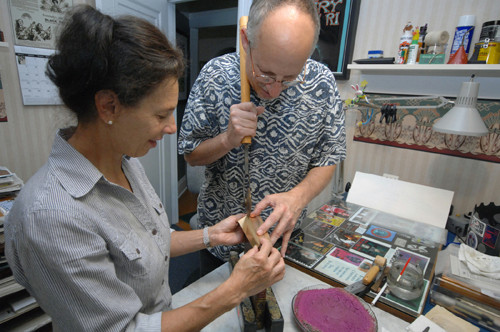
Forget that old saw that warns against judging a book by the cover. When George and Patricia Sargent go to work on a tome, the outside becomes a work of craftsmanship, and a tip-off that the item is a valued collectible.
The Sargents – work partners and spouses – run Dragonfly Bindery Studio, a Woonsocket business that specializes in rebinding and restoring antiquarian books. They also repair maps and documents, produce limited-edition fine arts books, and build one-of-a-kind storage boxes that can boost the value of a book by a thousand dollars or more
“It never gets boring,” George Sargent says of his craft. “Every book we work with is unique, with its own problems, its own history.”
Their studio is a small room off their kitchen, filled with tools, exotic materials such as Japanese silk or sharkskin leather, and books in various states of repair. The house is an elegant, two-story affair built perhaps a century ago, with artwork hanging from almost every wall.
The Sargents have always been book lovers, as the groaning shelves in their home attest, but it’s only by chance that they wandered into their trade.
Both graduated from Rhode Island School of Design in the late ’70s. Surviving on their talent at first proved difficult. She took a teaching post at a Worcester-area high school; he did industrial spray painting.
“Then Patty came home one day and said, There’s a book binder in Worcester looking for someone to work with him,” George Sargent recalls. “I decided to give it a try.”
He spent three years as an assistant at the studio. After mastering the skills he decided to strike out on his own. “Most booksellers have a shelf of books that need repair,” he says. “I’d show them a sample of my work, and they’d hand me a few books for rebinding. Patty was always around, and she’d ask, Is there anything I can do? We both began learning how things are done.”
In the booming 1980s and ’90s, investors seized on collectibles – including books – as a new place to put their money.
Their assignments range from routine repairs to library books and restoration work on centuries-old rare volumes. When repairing a valuable first edition, the usual goal is to retain as much of the original cover as possible. The Sargents may replace a damaged binding with a new one, and then glue the old material on top to keep the authentic appearance.
The binding is blue leather, with gold-leaf lettering. An onlaid illustration on the cover shows two figures – Good and Evil – swinging at each other with swords. Study those weapons, and you’ll see they’re actually plastic spears used to stab cocktail olives.
The same techniques are used on other projects as well. To those in the book trade, the Sargents are perhaps best known for the elaborate and eye-catching storage cases they created for entertainment lawyer Donald Drapkin, who collected titles that inspired screenplays. Protective boxes – meant to shield books from wear or sun exposure – are usually rather plain, decorated with nothing than the title, or perhaps an illustration lifted off a dust jacket. Drapkin wanted his cases to be art objects, and the Sargents delivered.
They added a scurrying cockroach to the case for Franz Kafka’s “The Metamorphosis.” And a submarine decorated the spine of the case that held Tom Clancy’s “The Hunt for Red October.” Cases for “King Kong” and “Creature from the Black Lagoon” featured full-color illustrations of the monsters.
For 14 years, Drapkin’s books kept arriving at their shop. The Sargents eventually created about 350 cases, each costing $500 to $750.
In 2005 an agent from Christie’s, the auction house, called to tell the Sargents that Drapkin was selling his first editions. They were invited to the New York auction, where their cases created a buzz among bidders. About 300 titles sold, for a total of $2.3 million.
In 2008, the Sargents discovered their business is not recession-proof. Collectors have become more conservative with their spending. And budget cuts mean public libraries have reduced the number of books they send out for repairs. The Dragonfly team has responded by changing some of their business practices. They now advertise, something they never did before. And Patricia Sargent is working at a store.
“Volume is up and down,” his wife adds. “We’ll get so much we can’t catch our breath, and then nothing. We don’t have the security we used to have.” •
COMPANY PROFILE
Dragonfly Bindery Studio
OWNERS: George and Patricia Sargent
TYPE OF BUSINESS: Book binding and antiquarian book restoration
LOCATION: Park Avenue, Woonsocket
EMPLOYEES: 2
YEAR FOUNDED: 1982
ANNUAL SALES: WND
Beyond Cash Donations: How New Forms of Giving Are Transforming Not-for-Profit Accounting
Evolving Funding Landscape for Not-for-Profits Not-for-profit organizations are being asked to do more with less,…
Learn More