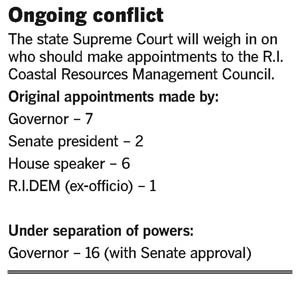
The R.I. Supreme Court is preparing to issue an advisory opinion on whether the state’s separation-of-powers constitutional amendment applies to the R.I. Coastal Resources Management Council.
The court recently extended the deadline for parties to file legal briefs on the politically charged issue to March 14 to accommodate leaders of the Rhode Island House. A coalition of environmental advocates filed its own brief on Jan. 31. The deadline for filing reply briefs is currently April 14. Dates for oral arguments have not been set.
The court opinion could be handed down this spring. Though it would not be binding, it could carry enough weight to help resolve the political controversies, internal divisions and allegations of misconduct that long have plagued the agency responsible for stewardship of Narragansett Bay and approving development along Rhode Island’s coastline.
At stake is the R.I. General Assembly’s ability to appoint half of the 16-member CRMC. The separation-of-powers amendment enacted in 2004 requires the governor to appoint all members of any executive commission or quasi-public agency, subject to Senate confirmation.
But leaders in the General Assembly say there is a loophole in the state constitution that gives the General Assembly an opening to continue sharing control of the powerful agency. In June, on the last day of the legislative session, the General Assembly re-established its right to appoint four legislators and four legislative appointees to the CRMC, and passed a resolution asking the Supreme Court to issue an advisory opinion.
Environmental advocates and government watchdogs say the separation-of-powers amendment overwhelmingly approved by voters in 2004 plainly applies to the CRMC, and that removing General Assembly control of half the council’s seats is necessary to protect against potential conflicts of interest.
“From the point of view of environmental protection, this is really a critically important agency, and they need to have the same checks and balances that we have for all of our other agencies,” said Cynthia Giles, director of the Conservation Law Foundation’s Rhode Island office. “This is not a hard question. This is a classic executive agency – it’s exactly like an executive agency in every way. It’s plainly covered by separation of powers.”
House Speaker William J. Murphy did not respond last week to a request for an interview.
The CRMC was created in 1971 to balance competing environmental and economic interests in the use of Rhode Island’s shoreline and waters, and regulates development along 400 miles of coast and on Narragansett Bay.
Many of the more than 1,000 applications the CRMC rules on annually are for requests to renovate or expand coastal homes and boat docks, but the council also has permitting authority over projects involving billions of dollars, including proposals from energy companies to build liquefied natural gas facilities or wind farms in state waters or on the shoreline.
Perhaps not surprisingly, the agency long has been a lightning rod for controversy, and was a major focus – along with the state’s Lottery Commission – of advocates who championed the ballot initiative that created the separation-of-powers law.
A case of alleged misconduct by the CRMC in its rejection last March of an application to nearly double the size of Champlin’s Marina on Block Island is currently before the state Superior Court.
Three of the four legislative appointments to the CRMC are still hearing cases; the fourth seat is unfilled. The four legislators who were appointed by lawmakers to the council withdrew soon after the separation-of-powers amendment passed in 2004. The CRMC is currently operating with only 11 members.
Shortly after separation of powers was enacted, Speaker Murphy announced he would ask the R.I. Supreme Court to rule on whether the amendment applied to the CRMC and the Lottery Commission. He temporarily reversed his stance following outcry from separation-of-power advocates, issuing a news release in January 2005 saying he would begin implementing separation of powers.
But the General Assembly did not reconstitute the CRMC to comply with the constitutional amendment, and two years ago, it passed its first resolution asking the Supreme Court to weigh in on the issue. The court declined to consider the issue at that time, saying it had not been given adequate time to conduct hearings.
The General Assembly took up the issue again in June, when the House of Representatives narrowly approved a new resolution to seek an advisory opinion on several questions regarding separation of powers, including whether the amendment could be implemented without a new law being passed by the legislature. •