in Coventry.
At the Apeiron Institute for Environmental Living in Coventry, visitors are bombarded with one simple mantra: how to use less stuff in their daily lives.
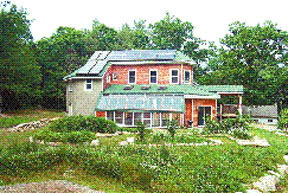
The nonprofit group’s 3,600-square-foot building, set on 55 forested acres and nestled amid towering pine trees, is a showcase of “sustainable living” – or reusing natural resources rather than destroying them.
The building’s frame is comprised largely of salvaged lumber. Its walls are made from natural, durable materials such as straw bale and light clay.
ISO 9001:2026: A Practical Opportunity to Build for What’s Next
For Rhode Island manufacturers, ISO 9001 has been much more than a certificate on the…
Learn More
The walls are insulated with densely packed cellulose derived from discarded newspapers, magazines and cardboard – a natural material that is said to insulate far better than fiberglass.
The place is heated partially with a “radiant floor”: Water is warmed by solar collectors on the roof and circulated through tubing underneath the center’s concrete floor.
Wastewater from sinks and showers flows into a reconstructed wetlands out back – a shallow, lined trench in which tall plants use the refuse as nutrients while filtering the waste.
In all, the building uses 70 percent less energy than a typical home, the institute says. It has four separate insulation systems, three heating systems and two wastewater treatment systems – all demonstration projects for people to learn about environmentally friendly building techniques that can be incorporated in their own homes.
“This house really is a sampler of what’s out there,” said Brad Hyson, executive director of the Apeiron Institute.
The center, which opened in March 2002, also is an antidote for America’s consumption obsession, Hyson says. The problem, he says, is boiled down nicely in a study by Mathis Wackernagel, a program director at San Francisco-based environmental group Redefining Progress.
The study measures the “ecological footprint” of people in different countries – essentially how much land they use and the country’s use of natural resources.
It says that each person on Earth has a “fair share” of about 5 acres of land, and anything more than that is in essence hogging natural resources. The average “ecological footprint” for Americans: 25 acres, the highest in the world, the study says.
“The focus of what we do is waking people up to the fact that we’re the most consumptive society on the Earth, and our consumption patterns are not sustainable,” Hyson said. “I’m confident that we have the solutions to the problems we now have. It’s really a matter of human will.”
Since its completion, the environmental center has hosted more than 6,000 visitors. Most are students who come through on school field trips, from elementary school through college. The center also offers adult workshops for people interested in learning about sustainability.
The building cost roughly $250,000 and was constructed mostly via in-kind support from more than 100 businesses and the sweat of some 2,000 volunteers. The building’s lease was contributed by the Nickerson Community Center in Providence, which owns the property and runs a summer camp there.
The Apeiron Institute, founded in 1994, has an annual budget of less than $100,000 a year. It is funded by various state agencies, personal donations, revenue from educational programs and special events, and grants from the Rhode Island Foundation and other charitable groups.
The institute also runs the Rhode Island Sustainability Coalition, a group
of state agencies, nonprofits, schools, businesses, and individuals working
to bring sustainability practices to the state from around the world.
For the complete current issue, visit our subscription Web site, or call (401) 273-2201, ext. 227 or 234.