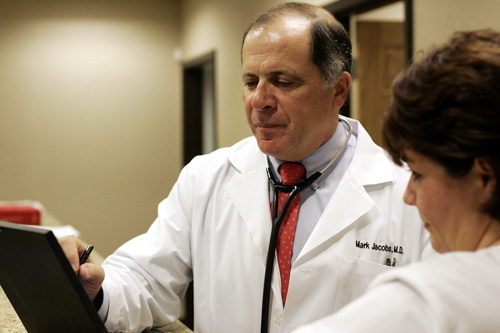
Dr. Mark D. Jacobs takes good care of his diabetics. He gives them checkups at least every three months, and asks them to get their blood work done ahead of time so they can discuss the results and how to do better. He talks with them about diet, exercise and regular testing.
But with a tight schedule, Jacobs only has about 15 minutes to spend with each patient – not enough for real in-depth conversations. And Jacobs only really knows the people he sees: The ones who miss their checkups can easily fall off the radar screen. How many diabetics in his practice aren’t getting the recommended care? He’d love to know, but he can’t even guess.
A new project called the Rhode Island Chronic Care Sustainability Initiative (CSI-RI) aims to change that for Jacobs and, potentially, all primary care doctors in the state.
Launched last month, CSI-RI is based on a national model called the “patient-centered medical home,” which involves ensuring that every person has a primary care provider who manages his care and offers the help and guidance needed to improve his health.
The model takes a team approach, with nurses, nutritionists, medical assistants and others working closely with doctors to support their work. And patients’ needs are seen as paramount, so extended hours, 24/7 phone access and educational programs are advised.
The concept is not entirely new, but it’s only now being tested on a large scale. UnitedHealthcare, for example, is sponsoring a pilot project in Arizona, and it’s working with three other health plans for a project in Colorado. On a bigger scale, the U.S. Centers for Medicare & Medicaid Services will be launching a project shortly.
CSI-RI is the first, however, to cover a full state and involve all health insurers. Blue Cross & Blue Shield of Rhode Island, UnitedHealthcare of New England and Neighborhood Health Plan of Rhode Island are investing a combined $2.43 million over two years, and Tufts Health Plan is expected to join them after it enters the market next year.
R.I. Health Insurance Commissioner Christopher F. Koller is overseeing the project, while Quality Partners of Rhode Island is providing expert support and training.
But the real hands-on work will be done by 28 doctors in five practices with about 25,000 patients – Jacobs’ Coastal Medical in Smithfield; Family Health & Sports Medicine in Cranston; University Medicine Foundation in Providence; Hillside Family and Community Medicine in Pawtucket; and Thundermist Health Center in Woonsocket. All have agreed to implement the new model over the next two years, with a special focus on patients with coronary artery disease, diabetes and depression.
The goal is to show the concept works, both financially and in terms of health outcomes. In theory it should: Research has shown that investing in primary care improves health outcomes and reduces costs, and chronic disease is known to be a major cost driver.
Yet does this mean that if Jacobs’ practice called all diabetics at least once a month, hosted group sessions with a nutritionist, and made it easy to get free or reduced-cost blood testing supplies, they’d be so much healthier that the cost of their care would drop sharply?
The challenges are substantial. For instance, if consumers don’t buy into the new model, they won’t use the extra resources. If costs don’t drop, and insurers can’t at least recover their investment, CSI-RI’s financial model won’t be sustainable in the long haul, or extendable to the whole state. And if doctors find the extra work costs them more than insurers pay, they’ll be less likely to participate.
Still, those involved see CSI-RI as a huge opportunity.
“This is the way medicine should be,” said Dr. Albert J. Puerini Jr. of Family Health & Sports Medicine, who is also president and CEO of Rhode Island Primary Care Corp., an alliance of small primary care practices. “We’re looking at ourselves as pioneers. A lot of this we’re making up as we go along; nobody’s ever done this before.”
The project is very structured, with contractually set payments and goals. The insurers are paying each practice $3 per member per month – so Puerini and his two partners, for example, are getting $9,834 per month for 3,278 patients (although that is the majority of the patient load, is not their full panel; Medicare fee-for-service and uninsured patients are excluded).
In addition, the insurers are paying for a nurse case manager at each site – $54,549 per year for Puerini’s office. If the typical primary care doctor generates $300,000 to $350,000 each year, as Koller said, that means CSI-RI will boost the practice’s revenue by 16 to 19 percent.
But in exchange, the doctors and their staff have to do a lot of work. For starters, they have to create a registry of patients with the three targeted conditions; then evaluate their progress and the care they receive, based on federal standards, over the next two years.
They also have to improve the practice as a whole, following guidelines for a patient-centered medical home devised by the National Committee for Quality Assurance (NCQA). That will mean, for example, improving patient access and communication through written standards and electronic tools; tracking tests and referrals to other providers; adopting evidence-based treatment guidelines; and measuring and reporting clinical outcomes, doctor by doctor.
All but one of the practices – University Medical Foundation – have electronic medical record systems, which are expected to be instrumental in analyzing whole patient populations to see, for example, how Coastal’s diabetics do compared with regional benchmarks, and whether those who attend educational sessions have, on average, lower blood-sugar levels.
But much of the work will be low-tech: having nurse Laurie Sparks talk with a patient after Jacobs examines him so she can answer any lingering questions, help him set goals to improve his diet, and maybe figure out why he’s not been testing his blood regularly.
With depression, Jacobs said, Sparks will be “a tremendous help,” because she’ll be able to call to make sure patients are OK and that they’ve seen the psychologist they were sent to. And with all conditions, she will be able to identify helpful community resources.
Some primary care providers across the state are already doing some of this work – especially community health centers, such as Thundermist, but also practices such as Hillside that have participated in a related state project, the Rhode Island Chronic Care Collaborative.
But as Dr. Michael Fine, medical director of Hillside, noted, “we’ve been doing this on a shoestring because we believe in it; now [CSI-RI] gives us the resources to do it well.”
Given the magnitude of the changes the practices need to make, support is crucial, and they will be getting it in two ways: through regular meetings and conference calls to discuss their experiences with one another, and through the Chronic Care Collaborative, which will train not just the doctors, but their entire teams, funded by a $200,000 grant through Koller’s office.
Dr. Gus Manocchia, chief medical officer for Blue Cross, said it’s unclear whether CSI-RI will save any money, but he does expect it to make a big impact on patients’ experience at the doctor’s office, and on Rhode Island’s fragile primary care system.
“We’re not getting the best-quality care, or the most cost-effective care,” Manocchia said. “And the fact is, most physicians are unhappy with the type of medicine they’re practicing. … This is going to make their practices more enjoyable and make them feel more fulfilled.” •