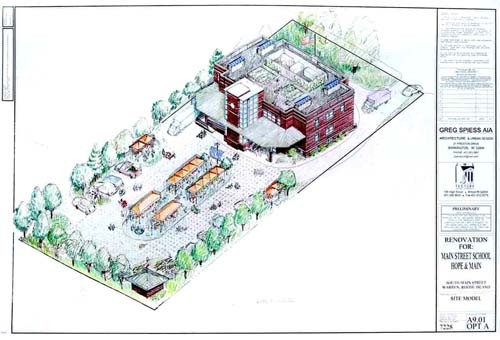
This three-story, brick school once prepared generations of Warren children in math, science and English. Now Lisa Raiola envisions the school preparing the next generation of culinary business owners.
Her plan would take the vacant, town-owned Main Street School and fill it with five commercial-grade kitchens, restored classrooms and a large common area for lectures or an indoor farmers market. A sprawling parking lot out back could host outdoor markets in the warmer months.
For a modest fee – likely between $20 and $25 an hour – bakers may rent a kitchen to whip up their new dessert, caterers could prepare meals for weddings, and chefs in niche food markets might find a place to experiment. Elsewhere in the building, a weekly market would offer a chance for them to sell their products, and instructors would teach entry-level business skills.
“We’re really helping you to launch a commercial food business, not just giving you a commercial kitchen to rent,” Raiola said.
Raiola is the founder and executive director of Hope and Main, a nonprofit formed to spearhead the project. (The nonprofit’s name stems from the building’s proximity to where Hope Street turns into Main Street.)
Last year, Warren officials picked Hope and Main to redevelop the former elementary school, which closed in 2008 as part of a school redistricting. Under the plan, Hope and Main will lease the building and share any profits with the town, which would then plow that money into economic development.
Hope and Main hopes to secure funding this summer, break ground in the fall and wrap up work by next spring.
To pay for the estimated $2 million project, Raiola is courting government money. The town won $11,000 from the federal Community Development Block Grant program to pay for an elevator. The U.S. Department of Agriculture has agreed to put up $50,000, representing 15 percent of the kitchen equipment costs, said Caroline Wells, Warren’s director of planning and community development.
Raiola and Wells also say the 95-year-old building has a good shot at winning federal historic tax credits. Raiola also thinks that the U.S. Economic Development Administration will chip in a $1.1 million grant because the federal agency has awarded money to similar projects in the past.
Hope and Main is also cultivating a crop of potential kitchen users whose rent would cover the building’s operational costs. Earlier this month about 120 people attended an information session and at least one-third inquired about rental opportunities, Raiola said.
Interest springs for many reasons. The Hope and Main concept offers aspiring chefs a shortcut to commercial kitchens that can cost hundreds of thousands of dollars to build and involve reams of government licenses and regulations.
“It’s an enormous reach for someone to make that leap to build their own kitchen,” said Greg Spiess, the project’s architect.
The anticipated on-site training in food safety and business techniques draws interest as well. So too does the chance to tap into the rapidly growing consumer interest in buying locally grown and prepared food.
The movement has taken off in recent years and received a big boost when first lady Michelle Obama launched Let’s Move, said David Rocheleau, the community-service chef educator at Johnson & Wales University. The campaign to cut childhood obesity includes a focus on fresh foods. Obama also planted a garden at the White House.
Meanwhile, in medical offices around the country, doctors are highlighting Americans’ obesity problem and urging the consumption of fresh foods. As a result, markets are racing to oblige by clearing off shelves to make way for local products.
“I think awareness, even nationwide, is at an all-time high,” Rocheleau said.
The Warren incubator concept sprung from Raiola’s personal interest in encouraging the local agriculture and culinary industries.
The Bristol resident became interested in encouraging the local food industry about five years ago. She was suffering from a life-threatening illness and doctors put her on a diet free of sugar and gluten. They also encouraged her to buy local organic produce free of preservatives and unbattered by hundreds of miles of transportation.
After Raiola recovered, she considered opening a small business that would prepare foods for specialty diets. She visited the building official’s office in Warren to talk about the process of opening a commercial kitchen and Wells, the town planner, happened to walk by.
Wells told Raiola about the Main Street School and took her on a tour. The 17,000 square feet of space was far more than Raiola envisioned. But she was intrigued by the idea of broadening her concept to create an incubator space and location for local entrepreneurs to prepare their goods for sale to stores, hospitals and schools. Institutions especially hold tough standards for the food they buy and small-business owners have few places where they can legally prepare their foods to meet the requirements.
“It is truly a missing link in our local food chain,” she said.
Cities outside of Rhode Island have successfully implemented the idea. Spiess said he knows of about 70 in other states, but none in Rhode Island. (In Providence, developers Rachel Rafaelian and Erik Bright are working to install a shared commercial kitchen in the former Eastern Butcher Block Mill, but the building features more than just kitchen space.)
In Warren, Wells said many residents and town officials consider Hope and Main a natural extension of the nearby downtown business district and appreciate that the incubator would leave the exterior of the historic school intact.
“It is one of the very rare projects I have worked on where there aren’t any enemies to the project,” she said. “I think people see it as an amenity that will have a positive quality-of-life impact on their lives.” •