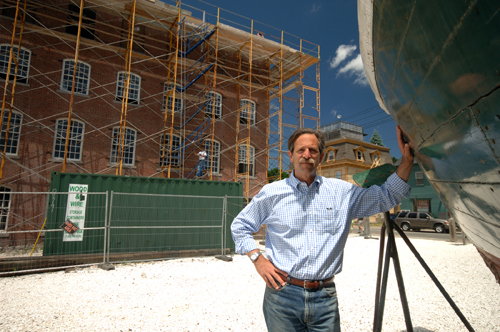
For the International Yacht Restoration School (IYRS) in Newport, it was worth paying a $229,500 fee up front – even on only a month’s notice – to receive a 22-percent tax credit through the R.I. Historic Preservation Investment Tax Credit program for its renovation of a 177-year-old, 28,000-square-foot mill on Thames Street.
The $10.2 million project is expected to be completed by the end of 2008, a few months ahead of schedule, and will expand the school’s space and house commercial marine tenants. It’s expected to qualify for tax credits totaling $2.55 million from the state.
The nearly quarter-million dollar fee has been part of the program for some time. But the budget crisis precipitated some changes. In January, Gov. Donald L. Carcieri proposed cutting the historic tax credit program significantly. Although it trimmed Carcieri’s plans, the General Assembly passed sweeping changes to the program on April 12. Those changes required developers that wished to receive credits – lowered from 27.75 percent to 22 percent – to file a qualifying cost estimate and pay a large portion of the processing fee by May 15. In the case of the IYRS, that meant moving up payment from 2009 to a month ago. The program will end in 2012 once the projects already approved for credits are complete.
“We understand that the state is running a budgetary deficit – so we can appreciate why the state wants the money now instead of at the end,” IYRS President Terry Nathan said last week. “Our preference, obviously, would have been to hold onto our cash until the end. But we’re happy to have the state tax credit.”
According to new statistics provided by the state last week to Providence Business News, it seems that most developers agreed with Nathan. Of the 102 projects that had been approved prior to the changes, 82 will go forward with construction, according to the R.I. Historical Preservation and Heritage Commission (RIHPHC), the state office that administers the program.
“Everyone was sort of wondering how many projects would go forward,” RIHPHC Executive Director Edward F. Sanderson said last week. “And the simple answer is that those that dropped out were not a big culling of the projects.”
The numbers are slightly skewed, however, because many of the projects that won’t continue had been inactive for years, Sanderson added. Some of those 20 projects hadn’t filed paperwork with the commission since 2002 and the majority hadn’t been in contact with Sanderson’s office since 2004. Only one had filed any paperwork in 2007.
Under the changed program, RIHPHC estimates that the total cost of the tax credits for Rhode Island taxpayers will be $62.13 million for the current fiscal year, ending June 31.
And the 82 projects scheduled to be completed between 2008 and 2012 will cost taxpayers less than previously estimated, Sanderson said. For those, the state will credit developers with $255.34 million. He had estimated in April that the credits would cost the state $8 million more – $263 million.
According to a study compiled during 2007 by Maryland-based research group Lipman, Frizzell & Mitchell LLC for the nonprofit Grow Smart Rhode Island, the state had invested $160.57 million between 2002 and 2006. That pegs the state’s total investment in the program at about $478.04 million during the 10-year life of the program.
The qualifying construction costs for future projects will top $1 billion, significantly more than the $876 million that had been estimated in April, according to RIHPHC. That’s because many developers “sharpened” their estimated qualifying construction cost, Sanderson said.
“Under the old system, if they had estimated their cost at $10 million, but when they were all done it turned out to be $15 million, there was no penalty for the inaccuracy of the original estimate,” Sanderson said. “But under the new system, you have to pay a fee to get the credit, so there’s a real incentive to make sure that your estimate is accurate.” Under the new system, tax credits will not be applied to any construction cost that runs over the developer’s estimate.
IYRS’ estimate jumped from $3 million to $10.2 million, according to Sanderson’s office. The estimated qualifying cost for developer Urban Smart Growth LLC’s four projects was hiked by more than $14 million – from $153.99 million to $168.57 million.
Peregrine Group LLC revised its estimate of qualifying costs for its Rumford Chemical Works development in East Providence from $30.7 million to $35.3 million. But Peregrine Principal Colin Kane said some developers might have paid the fee as a type of “insurance.” Even though all 82 projects paid, there is no guarantee that they will be completed, Kane said.
With the program’s changes, the fees for projects that will be collected between 2008 and 2012 increased from $19.7 million to $30.64 million — $23 million of which was collected during the current fiscal year. (Developers could pay 2.25 percent by May 15 and the other .75 percent by March 5, 2009.)
For Urban Smart Growth, one of
the highest-volume developers drawn
to Rhode Island by the creation of the credit, the lesser credit was still worth the up-front fee.
According to state records, Urban Smart Growth paid fees for four projects – The Conant Thread Co. in Central Falls, Hope Artiste Village in Pawtucket, and the former U.S. Rubber and Greystone mills, both in Providence – before the May 15 deadline. For the estimated $168.57 million in qualifying construction costs, the company paid fees of $3.79 million, which will earn it state tax credits equal to $42.14 million upon completion.
That fee wasn’t a major problem for Urban Smart Growth, because the company is “stable” with low debt and high cash reserves, said principal Lance Robbins. “But any time you have to reach in your pocket and write a $4 million check, it doesn’t feel good.”
The projects that were hurt were those projects for which much of the work – but not the completion – happened during 2007, he said. Those projects will now get 22 percent, instead of the 27.75 percent they would have received. “We didn’t get [the higher] credit on that 2007 work, just because we didn’t place it in service by the end of 2007,” he added. “That was the only place where we kind of were blindsided.”
There are projects, too, that were too late in filing for their first approval and weren’t able to get into the program. In Newport, just a few blocks from the IYRS project, the city’s Redevelopment Agency had planned to complete a renovation of the former Newport Armory on Thames Street. It had planned a Faneuil Hall-type development, into a boater-oriented Harbor Center with views looking over Newport Harbor. (READ MORE)
“With the change in the law, it’s going to be extremely difficult to do the renovations that we wanted to do,” said Newport Redevelopment Executive Director Bruce Bartlett. “We’re going to have to regroup and figure it out.” •
For Leaders Who Don't Have Time to Get Sick
Top performers guard their calendars, delegate relentlessly and optimize every hour of the day. Health,…
Learn More