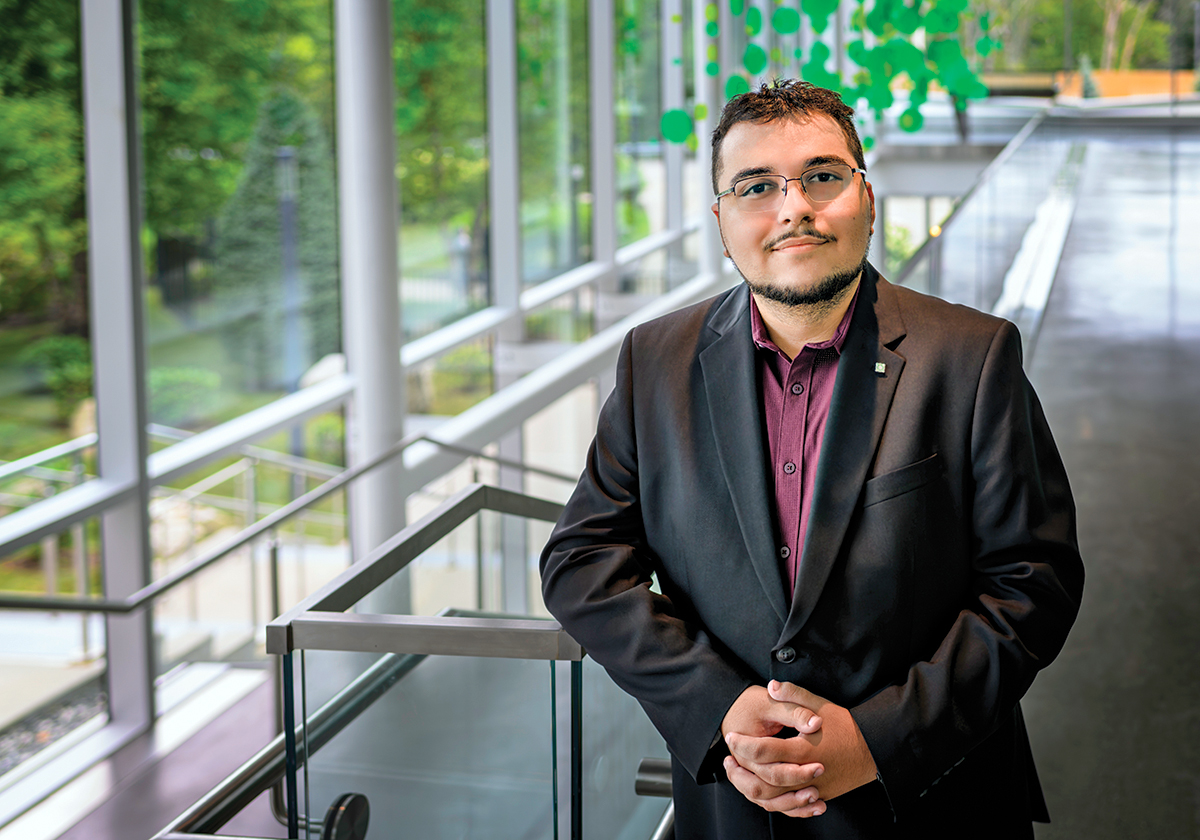
Growing up, Nygel Gomes always felt drawn to the inner workings of technology. In high school, a cyber education program for K-12 students gave Gomes the hands-on experience he needed to decide that he wanted to turn this interest into a career. Gomes went on to pursue cybersecurity programs at Rhode Island College and the University of Rhode Island. He has also taken on state advisory roles and joined the ranks of 10,000 Systems Security Certified Practitioners throughout the world. Now a corporate security and resilience analyst for Citizens Financial Group Inc. in Johnston, Gomes hasn’t forgotten the impact that earlier learning opportunities had on his career. As he continues to broaden his cybersecurity knowledge, Gomes seeks to create more educational opportunities for young people interested in a similar path.
What attracted you to a career in technology and cybersecurity? In 2019 my alma mater, East Providence High School, introduced a new program. It’s called CyberPatriot – an Air Force-sponsored cyber-education challenge for K-12 students. Students were organized into teams and had the chance to work hands-on in securing all sorts of software and devices. It was a friendly competition, but the goal is to introduce students to cybersecurity early and address the growing skills gap this industry faces. This program was a key contributor in my decision to study computer science in college. I had grown up fascinated by computers and technology, so having the opportunity to turn it into a career was something special.
Your work has spanned the manufacturing, life sciences and software sectors. What led you to your current role at a banking company, Citizens Financial Group?In the cybersecurity industry, professional development is paramount. Threat actors are leveraging emerging technologies every minute to try and compromise organizations of all sizes. A major factor in my decision to undergo a transition to Citizens Financial Group was the programs in place to train, upskill and ensure colleagues are on the cutting edge. There are countless seminars, badging systems and certification training courses made available at Citizens to keep us ready for various cyberthreats. My subject matter expertise in cybersecurity is primarily with legal compliance and federal frameworks – a discipline Citizens values heavily. In addition to the programs in place to incentivize community involvement, it seemed like a good fit.
Much of your community involvement has centered on education initiatives. What draws you to this area? A major factor in my career growth has been extra-curricular activities throughout my time in K-12 and post-secondary institutions. Between CyberPatriot and the Science and Math Investigative Learning Experience at the University of Rhode Island, I grew interested in STEM [science, technology, engineering and math] early on. At the college level, I began networking with countless professionals who introduced me to curriculum design. I also had the opportunity to teach a program called GenCyber – a National Security Agency-sponsored program where students across the U.S. participate in hands-on cyber activities. I quickly realized the role educators have in student development, and I wanted to have the opportunity to pay it forward.
Where do you see room for improvement in STEM education in Rhode Island? STEM education is critical to developing a highly skilled workforce and fostering job growth here in R.I. This starts in the classroom, and there are a number of ways we could introduce students to these disciplines. Just last year CS4RI revised the computer science curriculum to include sessions on cybersecurity, artificial intelligence and various emerging technologies. Making sure our existing STEM curriculums are cutting edge ensures our students are ready to meet the challenges of today’s world. I’m also a major advocate for extra-curricular activities in K-12. Exploratory learning is a great way for students to be exposed to a number of different disciplines. It’s how I found my interest in cyber.
You serve on Gov. Daniel J. McKee’s Young Leader Advisory Board. What does this role entail, and what’s the importance of this group? Last year it was a tremendous honor to join Gov. McKee’s Young Leader Advisory Board. We are a constantly expanding group of young individuals across R.I. who share a common goal – finding ways to improve the state. For example, members of the YLAB recently published a coloring book for Litter Free RI. It is a great way of educating students on the importance of keeping our community clean. We are given the opportunity to network with professionals not just in R.I., but across the states. Recently I’ve had the opportunity to collaborate with the R.I. Department of Labor and Training on how [the state] can safely adopt artificial intelligence while mitigating the risks of job displacement. Programs [such as] the YLAB contribute to the growth of current and future leaders, and I am incredibly proud to be a part of this team.
What advice would you give to someone who is interested in pursuing a cybersecurity career? While at Rhode Island College, a number of apprenticeships and training activities were made available. Most notable was a program called RI Made, where students audited local small and medium-sized manufacturers to align them with federal cybersecurity frameworks. This hands-on experience was invaluable in developing the in-demand skills organizations look for. Taking advantage of the job opportunities that colleges may offer is a great way of getting your foot in the door. The cybersecurity industry also has dozens of certifications you can take with no prior experience. Most notably, ISC2’s Certified in Cybersecurity and CompTIA’s Security+. Obtaining these will open many doors in your cybersecurity career.
What are your longer-term career goals? The legal aspect of cybersecurity has always been a big interest of mine. Frameworks, state laws and international regulations are constantly evolving. These are critical skills that can help organizations mitigate the risk of data being compromised. Currently I’m studying for the ISACA Certified in Risk and Information Systems Control certification to reinforce my knowledge in governance, risk and compliance. I’ve also started a Professional Master of Science in Cybersecurity at the University of Rhode Island.
Afterward, I’m looking to stay involved with the Institute for Cybersecurity and Emerging Technologies at Rhode Island College. My time at RIC got me hooked on education and I am excited to see what the future holds.