B of A tries quelling Mass. outrage over layoffs; R.I. officials working quietly behind the scenes
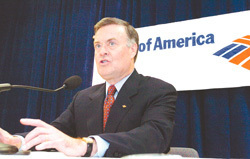
Such was the outcry in Massachusetts over Bank of America’s recent
layoffs and its relocation of key Boston-based units that CEO Kenneth D. Lewis
rushed to the Hub last week to meet with state officials and try to assuage
their concerns.
Lewis faced claims that the bank had broken its promises; the bank admits cutting 700 Bay State jobs, including 135 in branches. Massachusetts Treasurer Timothy P. Cahill had threatened to pull about $120 million in state money out of the bank; Banks Commissioner Steven L. Antonakes had given him 10 days to explain why units that were supposed to be Boston-based were being moved. U.S. Rep. Barney Frank, D-Newton, meanwhile, said he would block legislation important to the bank if didn’t get satisfactory answers.
Building a Strong Data Foundation in the Age of AI
Artificial intelligence (AI) has become a key priority in the boardroom and across management —…
Learn More
Opinions vary on how helpful Lewis’ visit was – though Cahill did withdraw his threat for now, and Antonakes told The Boston Globe that Lewis had said the recent branch layoffs had affected 135 Massachusetts workers, but another 150 had been hired.
In Rhode Island, however, the protests have been far more muted, and with no public response at all from the Charlotte, N.C., bank.
Gov. Don Carcieri’s spokesman, Jeff Neal, did not return phone calls requesting comment from PBN. Another governor staffer refused to answer a question about a letter Carcieri had reportedly sent to Lewis.
Marisol Garcia, spokeswoman for Rhode Island Treasurer Paul J. Tavares, said her boss had met with top Bank of America executives several times, but while he is “monitoring the situation” with regard to layoffs, “right now there is no plan of action” to put pressure on the bank as Massachusetts has.
Bank of America has a big monetary stake in keeping Rhode Island’s business: the state’s General Fund, a nearly $3-billion item, is deposited at Fleet Bank (not all at once).
Garcia said there’s been no talk of switching banks, and while the branch layoffs caused some concern, “in comparison to the Massachusetts layoffs, the impact on Rhode Island has been small. …We knew from the beginning that there would be some layoffs.”
Should bigger layoffs come later, Garcia added, Tavares “would definitely” get more involved.
Townsend H. Goddard, spokesman for the Rhode Island Economic Development Corp., made it clear that his agency is taking a very different approach to Bank of America than officials in Massachusetts or even Connecticut have taken.
“We try not to make our economic development efforts political,” Goddard said. “We try to do what we do quietly and behind the scenes, and will continue to do so.”
Publicly chastising Bank of America by “waving our arms and politicizing our efforts … will do nothing to further our efforts to maintain jobs and attract new investment into Rhode Island by this company,” Goddard added.
“I wouldn’t confuse the fact that Massachusetts has played a much more outward public perception game in the media and the fact that we haven’t (to mean) that we’re not actively working on this,” he said. “We’re very aggressive when these things come up, and we have been talking to them for many months, not just about retaining their presence, but we try to enter a strategic dialog with them about what can we offer that other jurisdictions can’t.”
Rhode Island could actually benefit from the bank’s preference for spreading its operations around different states, Goddard said. It’s well situated between Boston, Connecticut and New York, is less expensive than other places, has financial services-friendly laws, and already has “plenty” of other financial institutions here.
“If, ultimately, Bank of America makes a business decision to reduce its investment in Rhode Island, then certainly we would be disappointed, but we hope not to reach that point,” Goddard said.
One Rhode Island official who did challenge the bank openly was state Rep. Peter F. Kilmartin, a Pawtucket Democrat and House speaker pro tempore. Kilmartin wrote to Carcieri urging him to follow the leads of Massachusetts and Connecticut officials who had “taken an active role in trying to save jobs in their states.”
Kilmartin also wrote to Lewis expressing concern about the “secrecy” of the merger process and saying Rhode Island needs to know the total number of layoffs planned and the “overall goals and growth outlook” of the bank “to best plan the economic future” of the state.
Kilmartin added that legislators have taken “significant steps to be business friendly,” passing 41 law changes since 1995, at least 18 of which benefit financial institutions, and generally showing they are “pro-business.”
Given that, he wrote, “we hope Bank of America will recognize that fact and protect the jobs of Rhode Islanders.”
Asked whether Bank of America is concerned about its public image in the wake of the controversy, Boston-based spokeswoman Alison J. Gibbs offered this:
“Our research shows that our customers in this region are generally neutral to positive on the merger. Bank of America has a great reputation for customer service. Customers have responded very favorably to the Bank of America banking center model, which we’re currently rolling out in the Northeast. We are excited about our entry into the region and look forward to serving our customers here. That’s our position.”