Owe taxes to the state?
Now there’s a greater chance that the public is going to know about it, too, because of a little-discussed section of the $7.7 billion fiscal 2012 state budget approved last month.
As part of the plan to close what was projected to be a $300 million shortfall, the budget calls for state tax officials to assemble and publicize two lists of the state’s top delinquent taxpayers – one containing 100 individuals, the other 100 businesses.
The idea: The fear of being placed on the list will persuade people and businesses to pay up, or at least make arrangements to pay. Budget officials estimate the new lists will add $1.78 million to the state’s coffers in fiscal 2012 alone; about $1 million in taxes and penalties from late-paying businesses and another $779,900 from individuals.
“It’s set up as an enforcement tool,” said Peter McVay, R.I. Division of Taxation’s associate director of revenue services. “We find once [delinquent taxpayers] hear their name will become public information on this list, that entices them to come forward and try to work with us.”
The state has made top 100 delinquent lists public since 2004, typically updating them quarterly.
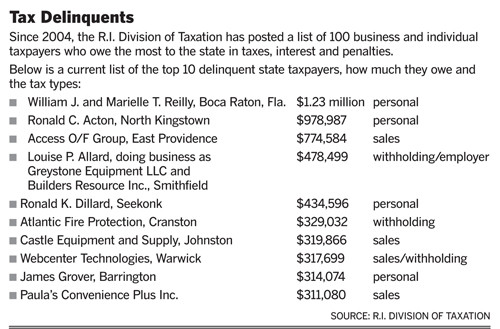
Right now, the people and businesses on the list – posted on the Division of Taxation website at www.tax.ri.gov – owe a combined $14.6 million.
Many of the businesses listed are out of business, in bankruptcy or in receivership.
The No. 4 delinquent on the list, Greystone Equipment LLC, in Smithfield, owes $478,499 in withholding and employer taxes. The business entered receivership in 2009, according to the secretary of state’s database.
Further down the list, in the 25th slot, is Struever Bros. Eccles & Rouse Inc., the Baltimore-based developer that had taken on numerous mill renovations in Rhode Island before the state eliminated its historic-preservation tax credit program and the financial markets imploded in 2008 and 2009.
Struever Bros. went under, leaving behind unfinished projects and a $172,208 sales tax bill.
McVay acknowledged that the state would likely never see the tax dollars from defunct companies on the list – and there are many. That’s part of the reason why tax officials wanted to create two lists – to open some additional spots.
Before, Smith said, government officials might not have wanted to buy ads in newspapers. But there’s little cost to post information on the Web – and that’s where most state lists appear.
“It’s a creation of the Internet era,” Smith said.
Rhode Island’s move to create two lists mirrors what already takes place in Connecticut, where the top 100 individuals and top 100 businesses are published online.
The method is different in Massachusetts. The Mass. Department of Revenue provides a list of the top 10 delinquents, in both the individual and business categories. But Massachusetts also allows online visitors to search a database by name and location for anyone who owes more than $25,000.
In Rhode Island, posting delinquent lists is one of several tools the state uses to collect on tax debts. One of the tools, implemented in 2009, had the Division of Taxation threatening to close businesses that didn’t pay overdue sales taxes. The Sales Tax Permit Renewal Block Program brought in more than $4 million that year.
In Rhode Island, the Division of Taxation is protective of certain tax information. Tax officials say they can’t talk about how much individuals and business owe in back taxes, interest and penalties, unless they’re on the list.
Taxpayers are added to the top 100 list only if their payments are at least 90 days overdue. And they receive plenty of warning, McVay said. A notice is sent by certified mail 30 days before a taxpayer is added to the list. “And they’ve been receiving regular delinquency notices before that,” McVay said.
The Division of Taxation credits the delinquent-list program with bringing in $10.43 million in taxes, interest and penalties since fiscal 2004 from individuals and businesses on the list. That doesn’t include the taxpayers who paid their bill after they were told they’d be on the list.
McVay said those who come in to work out a payment plan are removed from the list, even if the outstanding balance isn’t paid immediately.
The $1.78 million in additional collections estimated under the new list system is based on past history, as well as the average balance of the next 100 delinquent taxpayers that hadn’t yet been on the list.
In the past, once notices have been issued, 19 percent of individuals and 25 percent of businesses either pay up or agree to a payment plan.
“Your true delinquents aren’t going to care either way,” McVay said. “Once they’re on the list, it’s not as effective.”
The top delinquent taxpayer, for example, has been on the list for several years. William J. and Marielle T. Reilly of Boca Raton, Fla., owe $1.23 million in personal taxes, according to the Division of Taxation. Reilly could not be reached for comment last week.
There are a few prominent names on the list, too. Former professional boxer Vincent Pazienza is No. 19, with an outstanding personal tax bill of $195,825, taxation officials said. And Mark Portugal, a one-time Red Sox pitcher, is listed at No. 94 because he owes $54,443 in personal tax, the list said. Neither Pazienza or Portugal could be reached for comment last week.
McVay said it will take the Division of Taxation several weeks to develop the new lists, because state law requires at least 30 days notice for delinquent taxpayers who are eligible for the list.
Janet Raymond, senior vice president of economic development and operations at the Greater Providence Chamber of Commerce, said the group had no objection to the state expanding the scope of the delinquent lists in part because it encourages taxpayers to pay their fair share. •