During Gail Skowron’s undergraduate college career – and, prior to that, during much of her childhood on Long Island – she wanted to be a veterinarian. So she took up a double major, studying chemistry and biology, to create the groundwork for graduate study in that field.
“But I couldn’t get a [summer] job with any of the male veterinarians, because I was just supposed to marry a veterinarian, not be one,” Skowron, who is 52 years old, said in a recent interview.
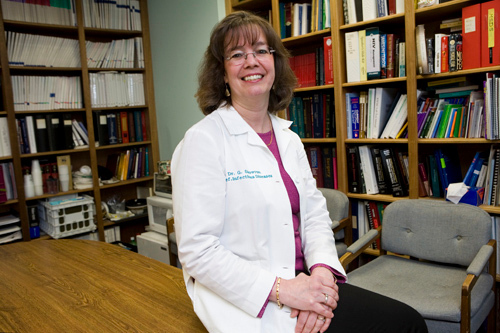
Undaunted, Skowron broadened her career goals and is now a doctor and chief of Roger Williams Medical Center’s Division of Infectious Diseases.
“By the time I was ready to apply to vet school, I realized that I didn’t have a very good resume for that,” she said. “At that point, I was really interested in research and what I really wanted to do was ask good questions.”
So she decided on medical school. While at Columbia University’s College of Physicians and Surgeons – she started at the school in 1978 – she ran into an as-of-yet-unidentified virus.
“As a third-year medical student in 1981, I saw my first AIDS patient,” she said. “I was in New York just at the beginning of the epidemic. So I did my residency there, right at 114th Street, right in the middle of the epidemic. When I did my infectious disease rotation … we couldn’t tell who was infected, we had no drugs to treat the virus. We hadn’t even identified the virus.”
AIDS wouldn’t be identified for another five years, in 1986, so in the early 1980s, much of the work that Skowron and her colleagues did was “making people comfortable,” she said. In 1985, when Skowron finished her residency, she was ready to get back into the lab. She applied for a Stanford University fellowship, where then-Chief of Infectious Diseases Thomas Merigan was studying a strand of the herpes virus. She had worked with herpes before and got the gig – in July 1986.
When that fellowship ended, Skowron interviewed at RWMC. She started in 1989 and began applying for grants – including one from the National Institutes of Health – for HIV study. She started with a study of immunity in infants born to HIV-infected mothers. From there, she started researching a particular cell – the “natural killer,” an infected cell that kills other cells.
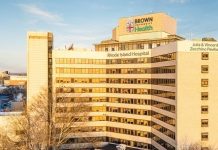
By the time RWMC then-Chief of Infectious Diseases Steve Zinner left in 1999, Skowron was ready to step into the position. The division, which deals with infections in the hospital and outpatients, now has two full-time members and a few part-time staffers.
With offices in Roger Williams hospital and also at 50 Maude St., Skowron runs a private practice with about 40 patients called the HIV-AIDS Clinical Care Program. She also has an appointment as associate professor at Boston University and does on-site courses at the hospital with BU and New England College of Osteopathic Medicine students. At Brown University, where Skowron is an adjunct associate professor, she has given an annual antiviral pharmacology lecture since 1995.
And research is still a big part of Skowron’s career. She’s working with doctors in the RWMC Department of Surgical Research on a project that could help modify patients’ immune cells to fight HIV. Although it might seem that Skowron’s career path had been pushed year-by-year ever farther from where she had wanted to be – practicing as a veterinarian – she said she wouldn’t have chosen another career.
“I think I’ve done exactly what I wanted to do,” she said, adding, “Through the years, I’ve had a lot of satisfaction treating individual patients. There’s a lot we can do in our practice … to change somebody’s life. •