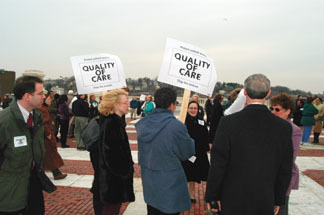
Wednesday evening.
The State House rally put on by the Rhode Island Medical Society last week
was only the most visible component of a broad strategy to draw attention to
what doctors say is a rapidly deteriorating practice environment here.
The society has been running print and radio ads throughout the state, portraying
physician practices as small businesses that have no control over rising expenses
or shrinking revenues.
“What if those small businesses can’t make it?” a newspaper ad reads. “Doctors
respond the only way they can. They work longer hours, pack in more patients
and cut services they lose money on (like mammograms).”
A modernized health plan: Supporting cost management and the employee experience.
The Surest health plan came from a group of innovators wondering: What if health care…
Learn More
The group has spotlighted physicians who have taken extreme measures to improve
their lot – doctors who have stopped seeing new Medicare patients, dropped out
of the Blue Cross & Blue Shield of Rhode network; even one who quit her
practice altogether.
Most notably, though, the society has publicized the deepening rift between
it and Blue Cross.
“I want to take the gloves off here and let insurers know they need to involve
doctors before they make unilateral policy decisions,” said Dr. David B. Ettensohn,
a Pawtucket pulmonary specialist and medical society president. “We’ve been
completely left out of the process because we have a single payer in this state.
Blue Cross basically has a monopoly.”
Last month, Ettensohn and a group of physicians met with Gov. Don Carcieri
and leaders of the state House and Senate to ask for some relief. Specifically,
doctors are pressing for either closer regulatory oversight of Blue Cross or
legislation that would allow doctors to band together when negotiating fee schedules
with health insurers. (Similar bills have failed in the past).
It is striking activism for a 190-year-old organization that largely has worked
behind the scenes while advocating for its 1,400 member physicians. But officers
say unprecedented pressure on both expenses and revenue has galvanized doctors
in Rhode Island.
Medicare payments to physicians have been cut 10 percent over the last two
years. Most doctors saw malpractice premiums spike more than 40 percent this
year – in some cases doubling. Health-care premiums for many doctors’ offices,
like most small businesses, are up more than 20 percent.
But what many doctors have described as “the last straw” was Blue Cross’s
now-aborted plan to trim payments to specialists by 7 percent. The cut would
have taken effect April 1, but Blue Cross announced March 6 that it pulled back
from the plan.
“The Blue Cross cut helped very much to unite the physician community,” said
Newell Warde, the society’s executive director.
In reversing its decision, Blue Cross officials acknowledged the rising malpractice
premiums and dipping federal reimbursement confronting physicians.
“We have come to believe that our physicians face financial burdens in other
areas that currently make it unwise to adjust our fee schedule at this time,”
Ronald A. Battista, president of Blue Cross, said in a press release.
But Battista emphasized that future reimbursement decisions will be based
on market conditions, and that “obtaining value for our customers will remain
a priority.”
He added that Blue Cross still believes it is “disadvantaged by reimbursement
arrangements entered into by some physician groups,” alluding to the fact that
some insurers pay lower fees to Rhode Island doctors than Blue Cross does.
And Blue Cross officials scoff at the “monopoly” reference. The employer claims
to have a percentage share of the commercial health-insurance market in the
low 60s.
“A monopoly would seem to indicate that we could walk into any employer in
the state and demand that they take a Blue Cross & Blue Shield plan,” said
Blue Cross spokesman Scott Fraser said. “Last time I checked that just does
not happen in this marketplace.”
Society officers seem keenly aware that garnering public sympathy for the
financial plight of doctors and their six-digit salaries is a tough sell. Instead,
doctors are couching their message in the context of quality of care and even
economic development.
When they’re forced to squeeze in more patients to offset higher costs and
flat reimbursement, doctors say it ultimately threatens quality. And conditions
have gotten so bad, physicians say, that doctors are leaving the state, and
practices have trouble recruiting replacements.
“I was seeing 15 to 20 percent more patients every year and making less money,”
said Dr. Elizabeth Conklin, a general surgeon who said she quit her private
practice at South County Hospital on March 7.
Conklin, a 43-year-old South County native, said she might leave surgery for
good. She said she’s tired of working 80-hour weeks and haggling with Blue Cross
over claims.
“I’m not sure where the idea came from that physicians should be subsidizing
this massive health care infrastructure,” Conklin said.
Much of the society’s stepped-up activism seems attributable to the harder
line toed by Ettensohn, who assumed his one-year term as society president in
September. He admits that his rhetoric is at times “inflammatory” and “aggressive,”
but he insists that the practice environment warrants the provocative stance.
“I don’t know the rules of engagement, but I can rabble rouse,” Ettensohn
said. “The Rhode Island Medical Society has been reactive in the past. I want
it to be proactive. And we’re not done here.”
For the complete current issue, visit our subscription Web site, or call (401) 273-2201, ext. 227 or 234.