Although the national market for selling federal Low Income Housing Tax Credits is at a standstill, construction won’t stop on the Clock Tower building, a redevelopment that’s central to Burrillville’s Stillwater Worsted Mill redevelopment and is dependent on those credits.
But construction is expected to slow, the developer said in an interview last week.
“We rely on those tax credits for the project,” NeighborWorks Blackstone River Valley Executive Director Joseph Garlick said. “And the low-income tax-credit market is pretty much frozen right now … At this point there are no purchasers out there.”
Without selling those credits, issued by the U.S. Department of Housing and Urban Development, Garlick’s project will move slowly forward. But any forward momentum is positive, because so many projects right now are being stopped by the slow market for the credits, he said.
“I have friends from around the country that are part of the NeighborWorks network and there are about 40 projects that are stalled for want of purchasers of these tax credits,” he said.
Those federal housing credits account for $6.5 million, or about 40.6 percent, of the $16 million NeighborWorks project.
The project is also dependent on Federal Historic Preservation Tax Incentives and R.I. Historical Preservation Investment Tax Credits.
For a $4.5 million state credit – a program the Rhode Island General Assembly has halted for new applications – NeighborWorks had to pay an upfront fee of $405,000 to the state in May 2008. NeighborWorks has another $135,000 due by March 5, 2009, according to R.I. Department of Revenue Division of Taxation records. Those fees hadn’t been expected costs – the state previously had allowed them to be paid after construction was finished – but NeighborWorks didn’t have too much trouble coming up with the cash, Garlick said.
“We knew we were going to have to pay that fee anyway. We’d budgeted for it,” he said. “It was a matter of getting the funds drawn out sooner, rather than later.”
The building, on the National Register of Historic Places, is significant to the community, said Town Planner Thomas Kravitz.
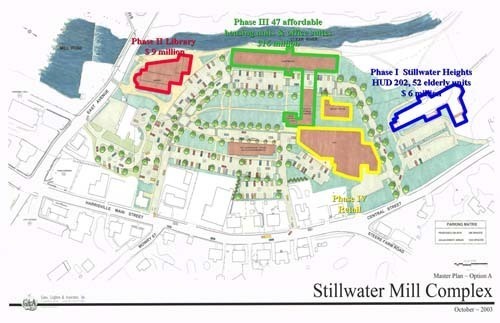
And it’s vital to the Burrillville Redevelopment Agency’s redevelopment of the 13-acre Stillwater Worsted Mill, much of which has already been completed. That development includes the new $9 million, 25,000-square-foot Jesse M. Smith Library and the $5.7 million development of a 52-unit, subsidized elderly housing project, both finished.
“It pretty much serves as the heart of Harrisville,” Kravitz said. “It’s geographically the center of town and you could consider it the center of town from an institutional, government perspective. Town hall is here.”
There’s already been interest from potential tenants for the Clock Tower development. With more than a year until the NeighborWorks project’s completion, about 10 people are already on waiting lists to rent one of the 47 units, of which 36 will qualify as affordable housing, Garlick.
“That’s pretty exciting,” he said, adding that some of the interest came from people who want to live close to a library. Kravitz said the Clock Tower building will also have five small private sector offices on the northern wing. Those will be available for build-to-suit, he said.
The NeighborWorks project will also add about 280 linear feet of access to the Harrisville Village’s river, which the library opened to public access. “That’s what’s cool about this project – it fronts on the Clear River,” Kravitz said. “That was never accessible to the public and now I’ve seen guys fly-fishing from it. How many libraries can you go to and fly-fish from at the same time?”
But for now, the NeighborWorks project’s completion has been pushed from December 2009 to spring 2010. Although many of the corporate purchasers of the housing tax credits are now being cautious in buying them, Garlick said this is the time of year that those buyers reassess their long-term finances. Many might decide to get back into the market, he said.
“The hope is that in the next couple of months, the market will get rejuvenated with the new administration,” Garlick said. “There’s a lot of optimism … there’s a lot riding on the new president’s shoulders. Some say that within the first quarter of this year they expect people to come back into the tax-credit program.”
Kravitz credited the project’s resilience – in that it didn’t come to a halt – to its affordable housing component. He added that the town is approaching Gov. Donald L. Carcieri’s 10 percent affordable housing goal and should have more than 9 percent when this project hits the market.
“There, of course, are always people in line for affordable housing,” he said. “Because of that, this project can withstand the market that we’re in, when the economy is really hurting the private sector, from a lending perspective.”
He added that NeighborWorks and the town are now looking at selling the state historic tax credits. The value of those could also be affected by the economy, he said.
There are still two more phases to the Stillwater project, Kravitz said. Two more mill buildings, totaling about 23,000 square feet, and an empty parcel are yet to be developed.
“And by the time those are developed, it might be nice to do a small retail component,” he said. “You’re going to have all those housing elements occupied and it will be interesting to see what type of retail-use demand pops up, what people need and can walk to … shops that are very pedestrian-friendly.” •